Committee approves one‑year, 10‑site red‑light camera pilot; staff to pursue parallel state option for cost‑sharing
May 12, 2026 | Charlotte, Mecklenburg County, North Carolina
This article was created by AI summarizing key points discussed. AI makes mistakes, so for full details and context, please refer to the video of the full meeting. Please report any errors so we can fix them. Report an error »
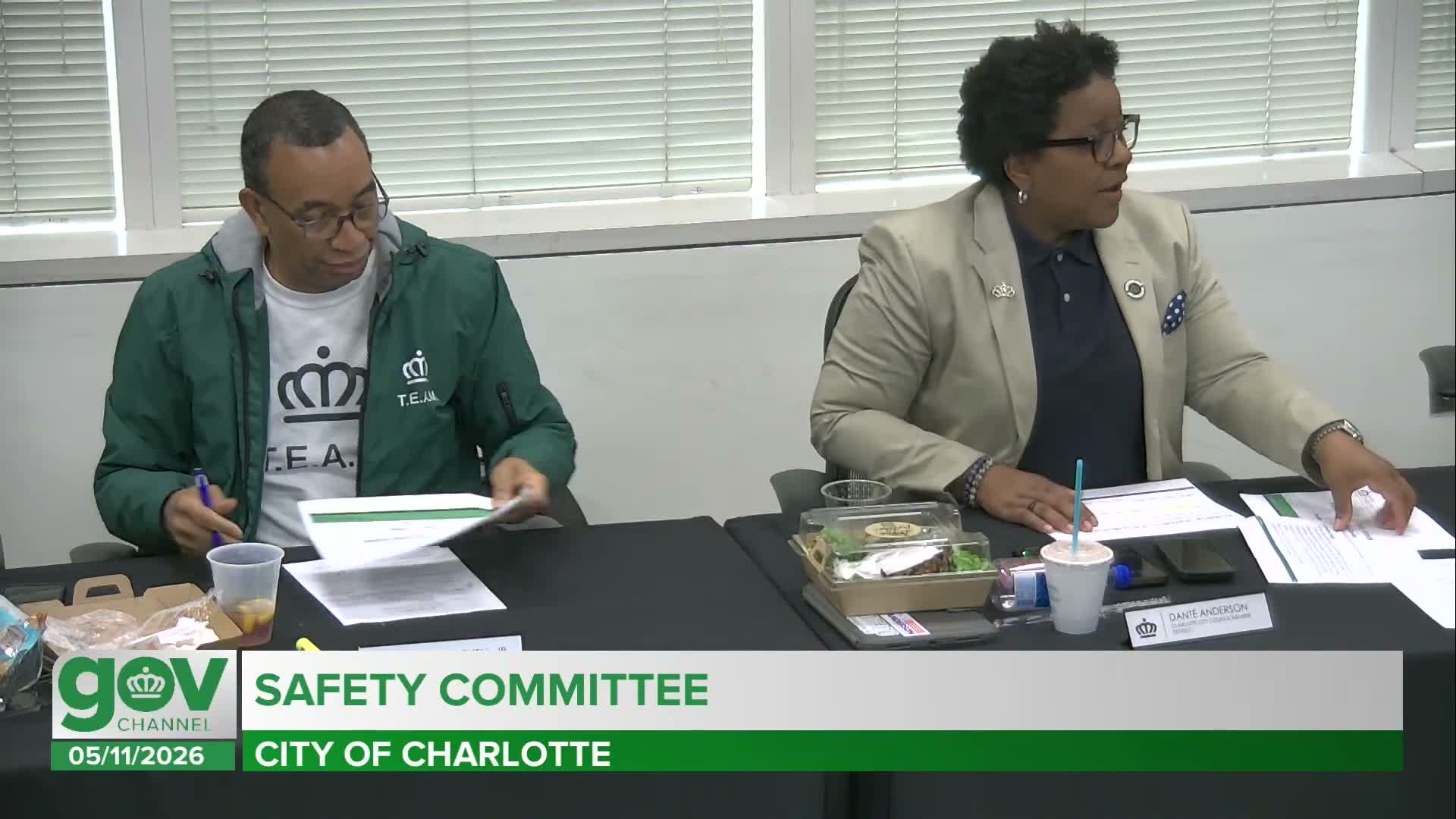
Debbie Smith, of the Charlotte Department of Transportation, briefed the committee on two options for reinstating red‑light cameras: a city‑funded pilot (Option 1) or pursuing a state legislative/local‑act route to produce a larger cost‑share (Option 2). Smith said staff identified 39 signalized intersections on the city’s high‑injury network; after applying crash‑type and pedestrian/bicycle criteria they narrowed a pilot list to 10 locations.
Smith presented estimated costs: roughly $5,000 per month per intersection and an initial first‑year startup near $600,000. The presentation used a $75 civil fine (a local act from 2007 was cited as authorizing that amount) and an assumed citation volume to project revenue; prior interlocal practice described in the presentation would allocate 90% of citation revenue to Charlotte‑Mecklenburg Schools (CMS) and 10% to the city’s program costs.
The staff analysis estimated the program could yield substantial benefits. Smith cited a modeled ~50% reduction in the target crash types (angle and left‑turn collisions) for the pilot sites and presented a benefit‑cost analysis using FHWA tools. Jessica Battle (city attorney’s office) clarified that red‑light camera citations would be civil fines processed through the city and would not appear on DMV driving records.
Councilman James Mitchell moved to implement Option 1 — a one‑year pilot at the ten nominated intersections — and to pursue Option 2 (state action to cover operational costs) in parallel. The motion was seconded and, after a brief budget discussion and assurances that Vision Zero funding might cover city costs, the committee approved the motion by a recorded tally of 4–0.
The committee directed staff to provide more granular materials (the exact 10 intersections by district, clearer crash‑reduction decimals, and a proposed pilot timeline and procurement structure) and to return with a proposal the committee can advance to the full council.
Formal action: the committee approved advancing a one‑year, 10‑site city‑funded pilot for red‑light cameras and to continue pursuing state legislative options for full cost recovery.
Smith presented estimated costs: roughly $5,000 per month per intersection and an initial first‑year startup near $600,000. The presentation used a $75 civil fine (a local act from 2007 was cited as authorizing that amount) and an assumed citation volume to project revenue; prior interlocal practice described in the presentation would allocate 90% of citation revenue to Charlotte‑Mecklenburg Schools (CMS) and 10% to the city’s program costs.
The staff analysis estimated the program could yield substantial benefits. Smith cited a modeled ~50% reduction in the target crash types (angle and left‑turn collisions) for the pilot sites and presented a benefit‑cost analysis using FHWA tools. Jessica Battle (city attorney’s office) clarified that red‑light camera citations would be civil fines processed through the city and would not appear on DMV driving records.
Councilman James Mitchell moved to implement Option 1 — a one‑year pilot at the ten nominated intersections — and to pursue Option 2 (state action to cover operational costs) in parallel. The motion was seconded and, after a brief budget discussion and assurances that Vision Zero funding might cover city costs, the committee approved the motion by a recorded tally of 4–0.
The committee directed staff to provide more granular materials (the exact 10 intersections by district, clearer crash‑reduction decimals, and a proposed pilot timeline and procurement structure) and to return with a proposal the committee can advance to the full council.
Formal action: the committee approved advancing a one‑year, 10‑site city‑funded pilot for red‑light cameras and to continue pursuing state legislative options for full cost recovery.
Don't Miss a Word: See the Full Meeting!
Go beyond summaries. Unlock every video, transcript, and key insight with a Founder Membership.
✓
Get instant access to full meeting videos
✓
Search and clip any phrase from complete transcripts
✓
Receive AI-powered summaries & custom alerts
✓
Enjoy lifetime, unrestricted access to government data
30-day money-back guarantee
