Sheriff’s office urges commissioners to fund ‘Caroline Cares’ peer‑support program for first responders
May 12, 2026 | Caroline County, Maryland
This article was created by AI summarizing key points discussed. AI makes mistakes, so for full details and context, please refer to the video of the full meeting. Please report any errors so we can fix them. Report an error »
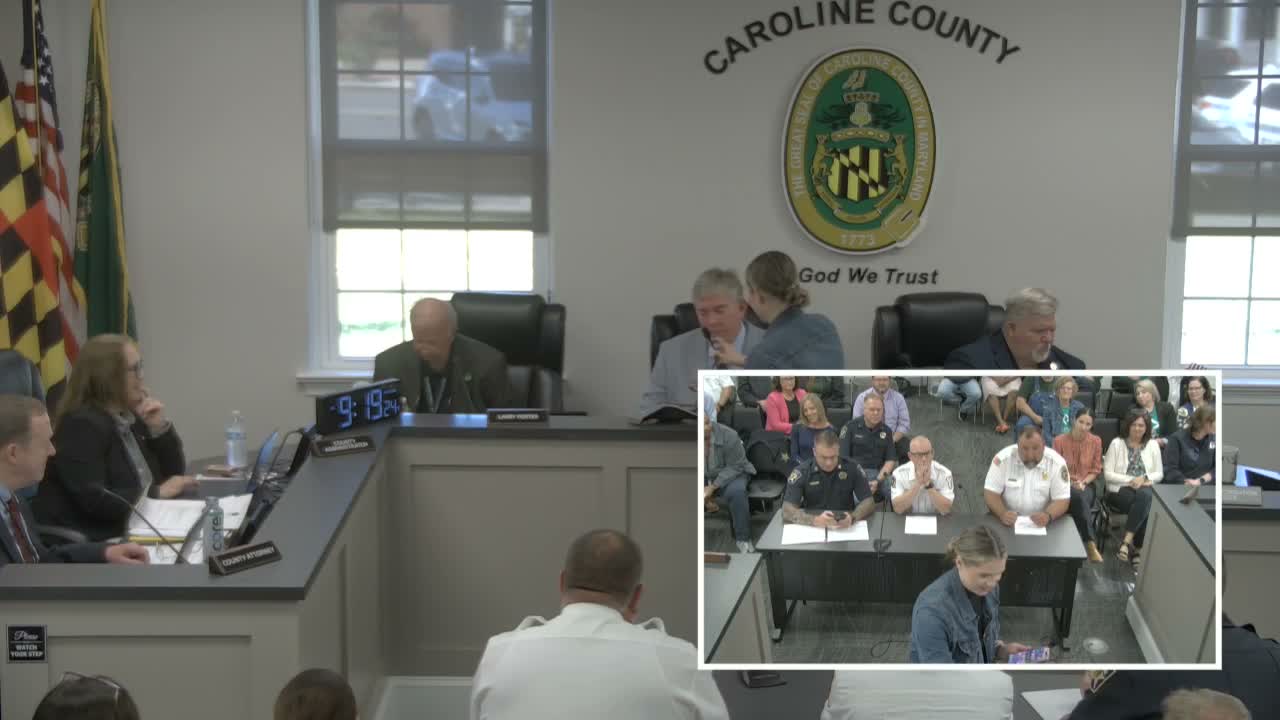
Captain Rodney Helmer, representing the Caroline County Sheriff’s Office, asked the county on May 12 to back Caroline Cares, a peer‑support program aimed at first responders across the county.
"Investing in Caroline Cares is an investment in the people who respond when our community needs help the most," Helmer said, describing high rates of trauma exposure, burnout and suicidality among law enforcement, fire, EMS and corrections staff and urging a sustainable local program rather than ad‑hoc responses.
Deputy Morton Dixon of corrections described data and personal experiences that he said illustrate elevated rates of depression, PTSD and premature mortality among correctional staff. "Stories like John are why this conversation matters," Dixon said, recounting a colleague who died soon after retiring and urging commissioners to support a first‑responder mental‑health team.
Milton Nagel, joining by phone as founder of the Lucas Nagel Memorial Fund, told commissioners the initiative grew out of personal loss and called for coordinated, confidential peer support for volunteer and career responders; Beth Ann Dorman of For All Seasons described a program model piloted in Talbot County that includes a four‑day training, quarterly refreshers and an open‑access pathway to clinical care.
Program costs discussed during the presentation put initial training and startup at roughly $50,000–$55,000, with Helmer and partners saying the training covers in‑person instruction and quarterly follow‑ups. Commissioners and staff asked about grant funding and sustainability; Helmer said the sheriff’s office had applied to a state police recruitment and retention grant and expected an answer soon and that the sheriff’s office could contribute roughly $20,000 if awarded.
Several commissioners expressed support for the effort and said the board could consider a modest contingency contribution in the immediate term. One commissioner summarized the board’s position as willing to use contingency funds this fiscal year and to consider a formal budget allocation next year, with an illustrative county contribution discussed in the $10,000–$20,000 range if fundraising falls short.
No formal appropriation or vote occurred at the May 12 meeting; commissioners directed staff to work with proponents on precise budget numbers and grant opportunities and to return with more detailed cost and funding plans.
What’s next: proponents will pursue outside grants and private funding while staff will prepare budget language and contingency options for commissioners to consider at future budget workshops.
"Investing in Caroline Cares is an investment in the people who respond when our community needs help the most," Helmer said, describing high rates of trauma exposure, burnout and suicidality among law enforcement, fire, EMS and corrections staff and urging a sustainable local program rather than ad‑hoc responses.
Deputy Morton Dixon of corrections described data and personal experiences that he said illustrate elevated rates of depression, PTSD and premature mortality among correctional staff. "Stories like John are why this conversation matters," Dixon said, recounting a colleague who died soon after retiring and urging commissioners to support a first‑responder mental‑health team.
Milton Nagel, joining by phone as founder of the Lucas Nagel Memorial Fund, told commissioners the initiative grew out of personal loss and called for coordinated, confidential peer support for volunteer and career responders; Beth Ann Dorman of For All Seasons described a program model piloted in Talbot County that includes a four‑day training, quarterly refreshers and an open‑access pathway to clinical care.
Program costs discussed during the presentation put initial training and startup at roughly $50,000–$55,000, with Helmer and partners saying the training covers in‑person instruction and quarterly follow‑ups. Commissioners and staff asked about grant funding and sustainability; Helmer said the sheriff’s office had applied to a state police recruitment and retention grant and expected an answer soon and that the sheriff’s office could contribute roughly $20,000 if awarded.
Several commissioners expressed support for the effort and said the board could consider a modest contingency contribution in the immediate term. One commissioner summarized the board’s position as willing to use contingency funds this fiscal year and to consider a formal budget allocation next year, with an illustrative county contribution discussed in the $10,000–$20,000 range if fundraising falls short.
No formal appropriation or vote occurred at the May 12 meeting; commissioners directed staff to work with proponents on precise budget numbers and grant opportunities and to return with more detailed cost and funding plans.
What’s next: proponents will pursue outside grants and private funding while staff will prepare budget language and contingency options for commissioners to consider at future budget workshops.
View the Full Meeting & All Its Details
This article offers just a summary. Unlock complete video, transcripts, and insights as a Founder Member.
✓
Watch full, unedited meeting videos
✓
Search every word spoken in unlimited transcripts
✓
AI summaries & real-time alerts (all government levels)
✓
Permanent access to expanding government content
30-day money-back guarantee
