Mitchell Behavioral Health reports increased mobile crisis use, seeks state funding for local service expansion
May 12, 2026 | Caroline County, Maryland
This article was created by AI summarizing key points discussed. AI makes mistakes, so for full details and context, please refer to the video of the full meeting. Please report any errors so we can fix them. Report an error »
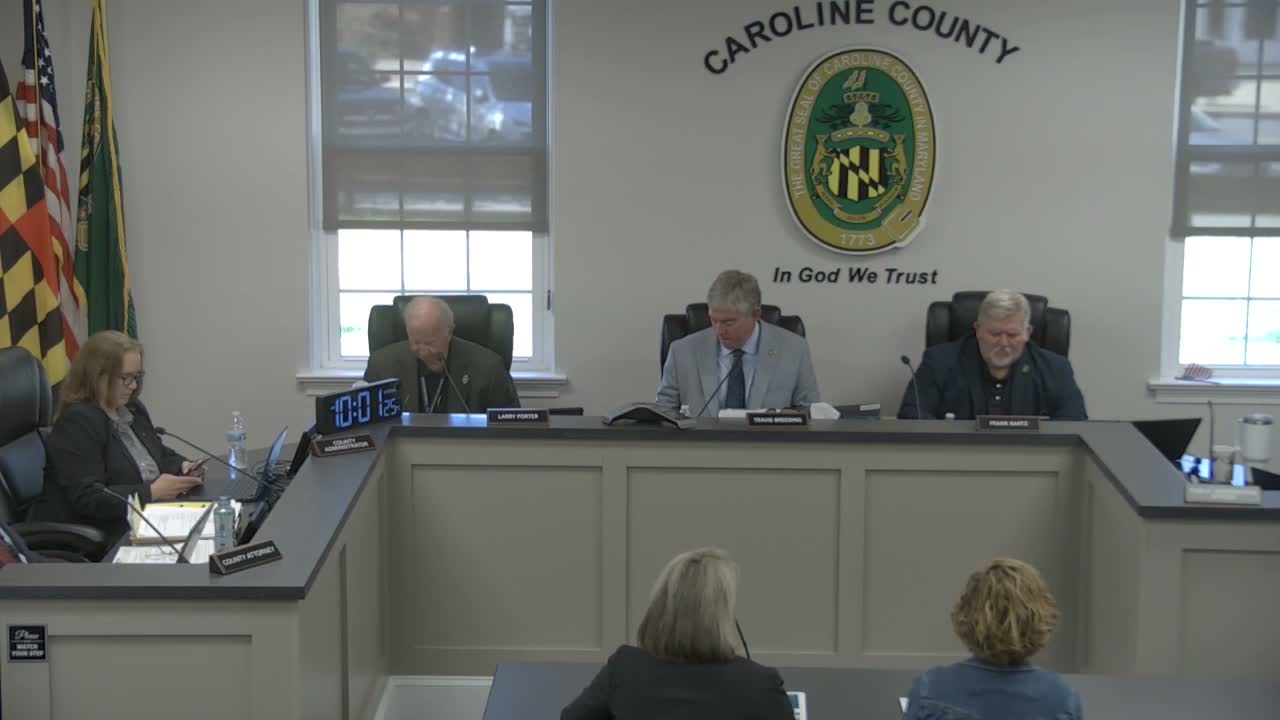
Katie Dilley, chief executive officer of Mitchell Behavioral Health, and Anne Sempers, behavioral‑health coordinator for wellness and recovery, presented the agency’s annual regional update to the Caroline County commissioners on May 12.
Dilley said Midshore Behavioral Health operates roughly $26,000,000 in combined state and federal grant funding across five counties and highlighted crisis‑response services run by an affiliated Sante Group, which operates a regional hotline that also serves as a 988 backup. "We have a budget close to 26,000,000 of a combination of state and federal funding that we procure through Midshore Behavioral Health into the community," Dilley said.
Sempers described operational metrics for the county: mobile crisis dispatches in Caroline County numbered 34 in FY25 and 82 so far in the first nine months of FY26. She also said a 750‑respondent needs assessment helped prioritize affordable housing and transportation as ongoing cross‑county barriers and identified alcohol as the primary substance‑use concern among local respondents.
Mitchell staff told commissioners they plan to pursue the second installment of Maryland’s Behavioral Health Transformation competitive procurement (approximately $16 million statewide) with county‑specific proposals for mobile treatment expansion and other services. The deadline for that procurement was noted in the meeting as May 26.
Sempers also outlined local initiatives Mitchell oversees: the Caroline County safe station (state opioid‑response funding), school‑based mental‑health initiatives funded by federal block grants, crisis beds and recovery housing supported by state grants, and community suicide‑prevention efforts including firearm‑safety campaigns and lethal‑means training.
Commissioners asked about overlap between local programs and emergency‑responder peer support; Mitchell staff said partnerships are possible and that some funds and initiatives are deliberately targeted (for example, suicide‑prevention dollars and gun‑safety work) while peer‑support training funded through Department of Labor will support broader workforce development.
What’s next: Mitchell will continue to coordinate regional grant responses and report back about competitive funding applications and local service expansions. Commissioners asked for a breakdown of federal/state/private funding percentages; Mitchell agreed to supply a more detailed funding mix on request.
Dilley said Midshore Behavioral Health operates roughly $26,000,000 in combined state and federal grant funding across five counties and highlighted crisis‑response services run by an affiliated Sante Group, which operates a regional hotline that also serves as a 988 backup. "We have a budget close to 26,000,000 of a combination of state and federal funding that we procure through Midshore Behavioral Health into the community," Dilley said.
Sempers described operational metrics for the county: mobile crisis dispatches in Caroline County numbered 34 in FY25 and 82 so far in the first nine months of FY26. She also said a 750‑respondent needs assessment helped prioritize affordable housing and transportation as ongoing cross‑county barriers and identified alcohol as the primary substance‑use concern among local respondents.
Mitchell staff told commissioners they plan to pursue the second installment of Maryland’s Behavioral Health Transformation competitive procurement (approximately $16 million statewide) with county‑specific proposals for mobile treatment expansion and other services. The deadline for that procurement was noted in the meeting as May 26.
Sempers also outlined local initiatives Mitchell oversees: the Caroline County safe station (state opioid‑response funding), school‑based mental‑health initiatives funded by federal block grants, crisis beds and recovery housing supported by state grants, and community suicide‑prevention efforts including firearm‑safety campaigns and lethal‑means training.
Commissioners asked about overlap between local programs and emergency‑responder peer support; Mitchell staff said partnerships are possible and that some funds and initiatives are deliberately targeted (for example, suicide‑prevention dollars and gun‑safety work) while peer‑support training funded through Department of Labor will support broader workforce development.
What’s next: Mitchell will continue to coordinate regional grant responses and report back about competitive funding applications and local service expansions. Commissioners asked for a breakdown of federal/state/private funding percentages; Mitchell agreed to supply a more detailed funding mix on request.
View the Full Meeting & All Its Details
This article offers just a summary. Unlock complete video, transcripts, and insights as a Founder Member.
✓
Watch full, unedited meeting videos
✓
Search every word spoken in unlimited transcripts
✓
AI summaries & real-time alerts (all government levels)
✓
Permanent access to expanding government content
30-day money-back guarantee
