Brentwood budget committee hears that town spent nearly $1M on trash and recycling in 2025; officials weigh compost, PAYT and transfer-station options
May 12, 2026 | Brentwood Town, Rockingham County, New Hampshire
This article was created by AI summarizing key points discussed. AI makes mistakes, so for full details and context, please refer to the video of the full meeting. Please report any errors so we can fix them. Report an error »
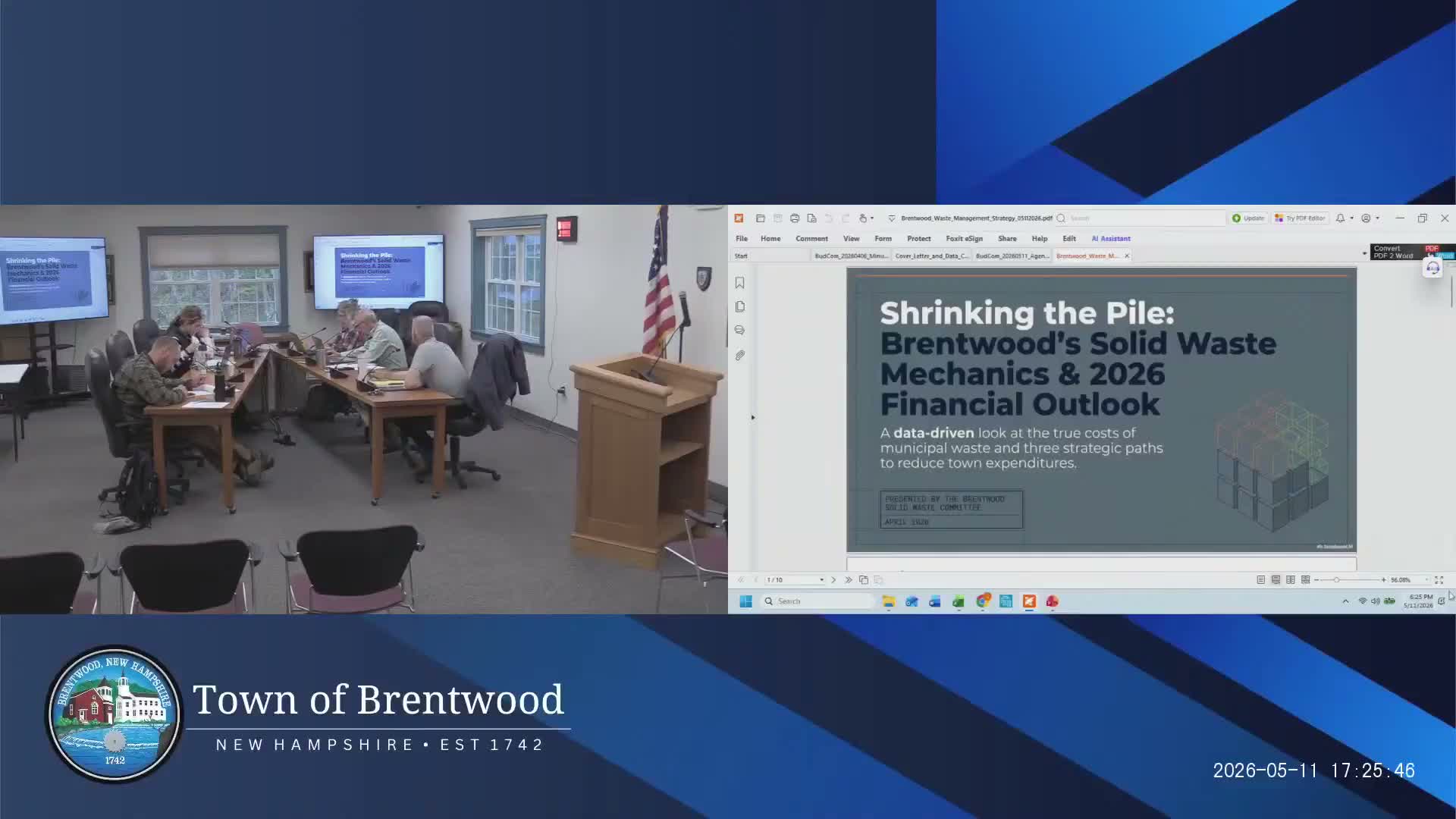
Gabby, chair of Brentwood''s trash committee, told the budget committee on May 11 that the town spent nearly $1 million on solid-waste services in 2025, including about $379,000 for collection and $129,000 in tipping fees for landfill disposal, plus roughly $151,000 for recycling collection and $48,000 for recycling processing.
That combination, Gabby said, means recycling currently costs more per ton than landfill disposal when collection and processing are combined; the committee''s contract sets a $170/ton benchmark before revenue sharing, but the average market value for recyclables last year was about $32/ton. "So not only are we paying for the sorting and collection, we also are at risk for what the market does," Gabby said.
Why it matters: Brentwood pays disposal tipping fees by weight, so heavy, wet materials such as food scraps make up about 40% of trash tonnage, Gabby said. The committee reviewed modeled scenarios for reducing weight: a low'effort voluntary food'scrap diversion that the presenter modeled as a 20% weight reduction (estimated disposal savings of more than $25,000 a year with no contract change); a pay'as'you'throw (PAYT) bag system modeled at a 40% reduction (estimated savings of more than $50,000 a year) but raising equity, enforcement and outreach concerns; and a higher'effort option to build a transfer station or expand highway-shed operations that would require capital and staffing but could give the town greater control over disposal.
Committee members asked operational and contract questions. The town has about 2.5 years remaining on the Casella collection contract, members were told, and the contract includes escalation clauses and other terms that may limit immediate changes to collection method. One select'board member estimated Brentwood pays roughly $48,000 a year extra to maintain manual pickup rather than automated pickup.
Gabby said the committee has launched a community survey (about 60 responses to date), attended local events and is preparing public education materials and potential pilots. She encouraged the committee to consider partnerships with Swayze School, where a nutrition director is running a composting program and could reach several hundred households.
What's next: The committee asked town staff for contract timing and for guidance about when to issue RFPs; members also recommended additional public outreach and pilot programs before recommending any large operational changes.
"These are not finalized scenarios by any means," Gabby said. "We're continuing to gather information and want to pilot options that people are willing to use."
That combination, Gabby said, means recycling currently costs more per ton than landfill disposal when collection and processing are combined; the committee''s contract sets a $170/ton benchmark before revenue sharing, but the average market value for recyclables last year was about $32/ton. "So not only are we paying for the sorting and collection, we also are at risk for what the market does," Gabby said.
Why it matters: Brentwood pays disposal tipping fees by weight, so heavy, wet materials such as food scraps make up about 40% of trash tonnage, Gabby said. The committee reviewed modeled scenarios for reducing weight: a low'effort voluntary food'scrap diversion that the presenter modeled as a 20% weight reduction (estimated disposal savings of more than $25,000 a year with no contract change); a pay'as'you'throw (PAYT) bag system modeled at a 40% reduction (estimated savings of more than $50,000 a year) but raising equity, enforcement and outreach concerns; and a higher'effort option to build a transfer station or expand highway-shed operations that would require capital and staffing but could give the town greater control over disposal.
Committee members asked operational and contract questions. The town has about 2.5 years remaining on the Casella collection contract, members were told, and the contract includes escalation clauses and other terms that may limit immediate changes to collection method. One select'board member estimated Brentwood pays roughly $48,000 a year extra to maintain manual pickup rather than automated pickup.
Gabby said the committee has launched a community survey (about 60 responses to date), attended local events and is preparing public education materials and potential pilots. She encouraged the committee to consider partnerships with Swayze School, where a nutrition director is running a composting program and could reach several hundred households.
What's next: The committee asked town staff for contract timing and for guidance about when to issue RFPs; members also recommended additional public outreach and pilot programs before recommending any large operational changes.
"These are not finalized scenarios by any means," Gabby said. "We're continuing to gather information and want to pilot options that people are willing to use."
Don't Miss a Word: See the Full Meeting!
Go beyond summaries. Unlock every video, transcript, and key insight with a Founder Membership.
✓
Get instant access to full meeting videos
✓
Search and clip any phrase from complete transcripts
✓
Receive AI-powered summaries & custom alerts
✓
Enjoy lifetime, unrestricted access to government data
30-day money-back guarantee
