Kalamazoo commission adopts $19 million project plan to finish lead service line replacements
May 12, 2026 | Kalamazoo City, Kalamazoo County, Michigan
This article was created by AI summarizing key points discussed. AI makes mistakes, so for full details and context, please refer to the video of the full meeting. Please report any errors so we can fix them. Report an error »
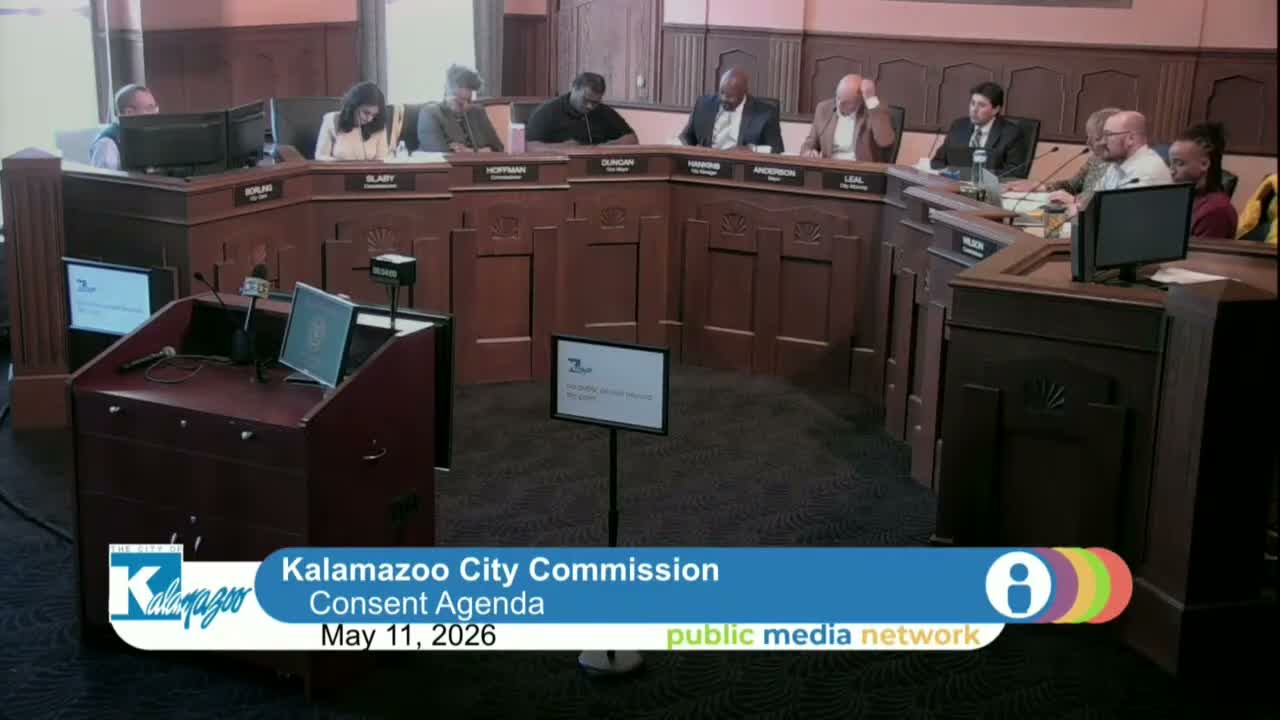
The Kalamazoo City Commission on Monday adopted a project plan authorizing an application for Drinking Water State Revolving Fund financing to accelerate lead and galvanized service line replacements across the utility service area.
James J. Baker, the city director (authorized project representative), told commissioners the $19,000,000 scope would be submitted to Michigan’s DWSRF program and — depending on loan terms and principal forgiveness — could mean a roughly 7% citywide rate increase in 2027. Baker illustrated the project-level impact as about $1.55 per residential equivalent unit per month (about $4.65 per quarter) under a 20-year loan at 3% interest, and said the utility does not bill individual homeowners for the ~$10,000 cost of a single service-line replacement.
Baker said the project plan focuses on replacing lead and non-copper (including galvanized) lines and described the selection process as driven by the city’s asset-management plan and capital-improvement priorities. “This project plan is really specifically about lead service line replacement, which also includes galvanized pipe replacement,” Baker said. He explained crews generally avoid large front-yard excavation by pulling the old line and spooling in new copper using a small street-side dig and short in-home work.
Why it matters: Director Baker said the program has already completed 6,715 replacements — about 67% of a 10,000-home goal — and the work aims to address environmental and public-health risks associated with legacy plumbing. The program is competitive for DWSRF funding and requires public review; comments received at the meeting will be incorporated into the project plan submitted to the Michigan Department of Environment, Great Lakes and Energy (EGLE).
Commissioners pressed staff on community outreach and language access for notification and scheduling; Baker said the program uses mailers, door hangers, contractor schedulers and radio and social-media partnerships (including paid advertising relationships with Townsquare Media) to reach residents. He credited assistant city engineer Anna Crandall with running the mapping and identification effort: “She’s got a map of little red dots on it in all that area… those red dots are Anna’s dots of homes that are known to have lead or believed to have lead,” Baker said.
Public comment at the meeting raised broader concerns about how city funds are prioritized; several speakers argued for more spending on housing and neighborhood services. The commission discussed program scale and schedule: Baker said the city has a multiyear plan and that, if funded, the DWSRF-backed phase would be bid out next year and could take about two years to complete. If everything goes as planned, he said, the city should be finished with lead service line replacements by roughly 2029–2030.
The vote: The commission adopted the resolution to submit the project plan and seek DWSRF funding. The vote carried unanimously.
What’s next: Staff will incorporate tonight’s comments into the online project plan and submit the application to EGLE; the state’s intended-use plan published in late summer will show whether the city receives funding and any principal-forgiveness amount that would change rate impacts.
James J. Baker, the city director (authorized project representative), told commissioners the $19,000,000 scope would be submitted to Michigan’s DWSRF program and — depending on loan terms and principal forgiveness — could mean a roughly 7% citywide rate increase in 2027. Baker illustrated the project-level impact as about $1.55 per residential equivalent unit per month (about $4.65 per quarter) under a 20-year loan at 3% interest, and said the utility does not bill individual homeowners for the ~$10,000 cost of a single service-line replacement.
Baker said the project plan focuses on replacing lead and non-copper (including galvanized) lines and described the selection process as driven by the city’s asset-management plan and capital-improvement priorities. “This project plan is really specifically about lead service line replacement, which also includes galvanized pipe replacement,” Baker said. He explained crews generally avoid large front-yard excavation by pulling the old line and spooling in new copper using a small street-side dig and short in-home work.
Why it matters: Director Baker said the program has already completed 6,715 replacements — about 67% of a 10,000-home goal — and the work aims to address environmental and public-health risks associated with legacy plumbing. The program is competitive for DWSRF funding and requires public review; comments received at the meeting will be incorporated into the project plan submitted to the Michigan Department of Environment, Great Lakes and Energy (EGLE).
Commissioners pressed staff on community outreach and language access for notification and scheduling; Baker said the program uses mailers, door hangers, contractor schedulers and radio and social-media partnerships (including paid advertising relationships with Townsquare Media) to reach residents. He credited assistant city engineer Anna Crandall with running the mapping and identification effort: “She’s got a map of little red dots on it in all that area… those red dots are Anna’s dots of homes that are known to have lead or believed to have lead,” Baker said.
Public comment at the meeting raised broader concerns about how city funds are prioritized; several speakers argued for more spending on housing and neighborhood services. The commission discussed program scale and schedule: Baker said the city has a multiyear plan and that, if funded, the DWSRF-backed phase would be bid out next year and could take about two years to complete. If everything goes as planned, he said, the city should be finished with lead service line replacements by roughly 2029–2030.
The vote: The commission adopted the resolution to submit the project plan and seek DWSRF funding. The vote carried unanimously.
What’s next: Staff will incorporate tonight’s comments into the online project plan and submit the application to EGLE; the state’s intended-use plan published in late summer will show whether the city receives funding and any principal-forgiveness amount that would change rate impacts.
View the Full Meeting & All Its Details
This article offers just a summary. Unlock complete video, transcripts, and insights as a Founder Member.
✓
Watch full, unedited meeting videos
✓
Search every word spoken in unlimited transcripts
✓
AI summaries & real-time alerts (all government levels)
✓
Permanent access to expanding government content
30-day money-back guarantee
