Austin ISD previews $181 million budget gap; trustees consider staffing, planning-time and stipend changes
May 11, 2026 | AUSTIN ISD, School Districts, Texas
This article was created by AI summarizing key points discussed. AI makes mistakes, so for full details and context, please refer to the video of the full meeting. Please report any errors so we can fix them. Report an error »
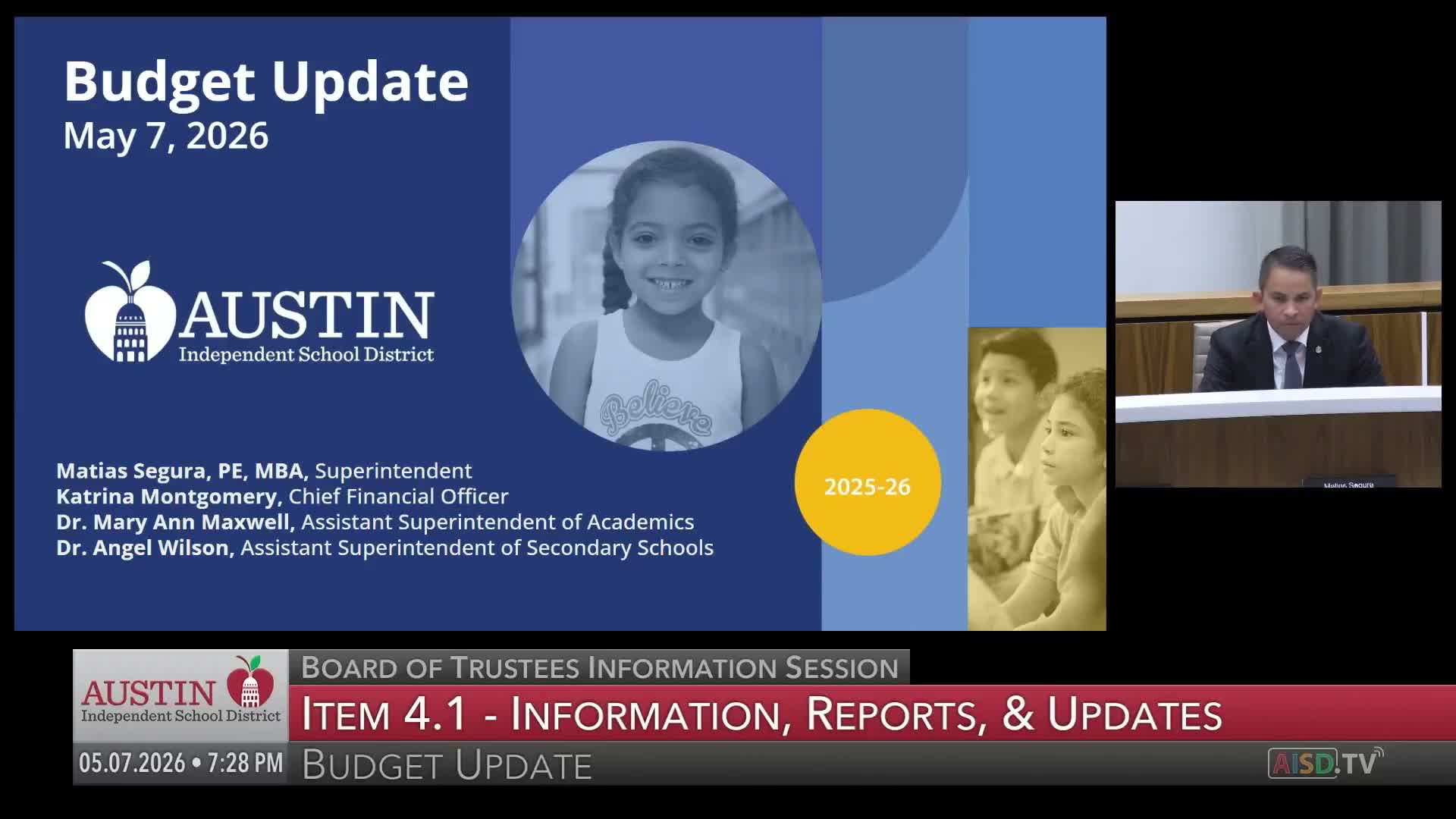
Austin Independent School District officials on May 7 presented a preliminary FY26–27 budget showing a $181 million gross deficit and sketched a package of potential reductions that would affect staffing, stipends and secondary planning time.
Katrina Montgomery, the district’s chief financial officer, told the board the district’s revenue estimate is $1.4 billion with $604 million in recapture and $1.031 billion in operating expenditures, leaving a $181 million gap. Montgomery said updated assumptions (property values and average daily attendance both projected at -3 percent) trim about $14.6 million from earlier estimates and yield a much smaller net deficit, but staff recommended the board adopt a plan to close the remaining shortfall by June 18 when the district must adopt a budget.
"This is difficult work," Superintendent Segura said. He framed the shortfall as the product of rising costs and flat state funding and emphasized that the district must present a responsible recommended budget May 21 and adopt it in June to avoid penalties and oversight.
District leaders described a multi‑pronged approach to reductions: re‑examining more than $30 million in stipends, consolidating duplicative software platforms and vendor contracts, targeting non‑staff operating savings, and reworking staffing allocations tied to enrollment and a Support and Resource Index (SRI) that prioritizes historically underserved campuses.
Dr. Mary Anne Maxwell, assistant superintendent for academics, walked trustees through proposed staffing and scheduling changes. The plan would generally protect Band 1 campuses (those serving the most historically underserved students) and campuses with unacceptable accountability ratings, while phasing in higher student‑to‑teacher ratios or reduced planning time at other campuses over two years. For secondary schools, the proposed model would staff foundation (core) courses at a 6.5‑of‑8 or 6‑of‑8 model and move other courses to 7‑of‑8 in the second year, with exception authority reserved for the superintendent.
Maxwell said the two‑year phasing is intended to limit disruption: "These are all terrible choices to have to make," she said. "We're trying to protect our youngest learners and the most vulnerable campuses."
Trustees pressed staff for precise dollar figures tied to each proposed change. Several trustees and many public commenters urged the board to prioritize preserving teachers’ planning time, cautioning that cutting planning periods for fine‑arts, CTE and special‑education teachers could increase burnout and force experienced staff to leave.
Trustee comments repeatedly asked for: (1) a line‑by‑line dollar estimate for every proposed change; (2) projections of out‑year fund balance and the budget’s trajectory under different reserve targets; and (3) clear descriptions of the trade‑offs so trustees can evaluate the academic and operational impacts before votes. Trustee requests included a public forecast of the net effect of moving to a 15% unassigned fund balance target versus higher levels.
Montgomery said the administration will present a recommended budget at the May 21 meeting and continue sharing appendices with department‑level details and the projected impacts. She also described an engagement calendar that includes public sessions May 9 and May 12, a work session May 14 and the recommended budget on May 21.
Several commenters and staff highlighted alternatives and one‑time options, including property monetization and bond re‑appropriation, and asked whether additional property sales could buy more time. Montgomery said the real‑estate team estimated approximately $45 million in property monetization potential but cautioned that bond proceeds are statutorily limited to capital improvements and cannot be used for payroll or ongoing operating costs.
Montgomery and Segura emphasized that any recommended budget must balance legal and auditing constraints, comply with board policy and preserve statutory requirements (for example, required class sizes in pre‑K and compliance obligations for special education). The board’s next steps include receiving the recommended budget May 21 and a June 18 adoption vote.
The board did not take final action at the May 7 information session; trustees said they want more granular fiscal backup and clearer academic impact estimates before voting. The board recessed to executive session and adjourned at 11:23 p.m.
Ending: The administration will release the recommended budget May 21; trustees directed staff to return with dollarized trade‑offs, program baselines and more granular vacancy and allocation data ahead of any final vote.
Katrina Montgomery, the district’s chief financial officer, told the board the district’s revenue estimate is $1.4 billion with $604 million in recapture and $1.031 billion in operating expenditures, leaving a $181 million gap. Montgomery said updated assumptions (property values and average daily attendance both projected at -3 percent) trim about $14.6 million from earlier estimates and yield a much smaller net deficit, but staff recommended the board adopt a plan to close the remaining shortfall by June 18 when the district must adopt a budget.
"This is difficult work," Superintendent Segura said. He framed the shortfall as the product of rising costs and flat state funding and emphasized that the district must present a responsible recommended budget May 21 and adopt it in June to avoid penalties and oversight.
District leaders described a multi‑pronged approach to reductions: re‑examining more than $30 million in stipends, consolidating duplicative software platforms and vendor contracts, targeting non‑staff operating savings, and reworking staffing allocations tied to enrollment and a Support and Resource Index (SRI) that prioritizes historically underserved campuses.
Dr. Mary Anne Maxwell, assistant superintendent for academics, walked trustees through proposed staffing and scheduling changes. The plan would generally protect Band 1 campuses (those serving the most historically underserved students) and campuses with unacceptable accountability ratings, while phasing in higher student‑to‑teacher ratios or reduced planning time at other campuses over two years. For secondary schools, the proposed model would staff foundation (core) courses at a 6.5‑of‑8 or 6‑of‑8 model and move other courses to 7‑of‑8 in the second year, with exception authority reserved for the superintendent.
Maxwell said the two‑year phasing is intended to limit disruption: "These are all terrible choices to have to make," she said. "We're trying to protect our youngest learners and the most vulnerable campuses."
Trustees pressed staff for precise dollar figures tied to each proposed change. Several trustees and many public commenters urged the board to prioritize preserving teachers’ planning time, cautioning that cutting planning periods for fine‑arts, CTE and special‑education teachers could increase burnout and force experienced staff to leave.
Trustee comments repeatedly asked for: (1) a line‑by‑line dollar estimate for every proposed change; (2) projections of out‑year fund balance and the budget’s trajectory under different reserve targets; and (3) clear descriptions of the trade‑offs so trustees can evaluate the academic and operational impacts before votes. Trustee requests included a public forecast of the net effect of moving to a 15% unassigned fund balance target versus higher levels.
Montgomery said the administration will present a recommended budget at the May 21 meeting and continue sharing appendices with department‑level details and the projected impacts. She also described an engagement calendar that includes public sessions May 9 and May 12, a work session May 14 and the recommended budget on May 21.
Several commenters and staff highlighted alternatives and one‑time options, including property monetization and bond re‑appropriation, and asked whether additional property sales could buy more time. Montgomery said the real‑estate team estimated approximately $45 million in property monetization potential but cautioned that bond proceeds are statutorily limited to capital improvements and cannot be used for payroll or ongoing operating costs.
Montgomery and Segura emphasized that any recommended budget must balance legal and auditing constraints, comply with board policy and preserve statutory requirements (for example, required class sizes in pre‑K and compliance obligations for special education). The board’s next steps include receiving the recommended budget May 21 and a June 18 adoption vote.
The board did not take final action at the May 7 information session; trustees said they want more granular fiscal backup and clearer academic impact estimates before voting. The board recessed to executive session and adjourned at 11:23 p.m.
Ending: The administration will release the recommended budget May 21; trustees directed staff to return with dollarized trade‑offs, program baselines and more granular vacancy and allocation data ahead of any final vote.
View the Full Meeting & All Its Details
This article offers just a summary. Unlock complete video, transcripts, and insights as a Founder Member.
✓
Watch full, unedited meeting videos
✓
Search every word spoken in unlimited transcripts
✓
AI summaries & real-time alerts (all government levels)
✓
Permanent access to expanding government content
30-day money-back guarantee
