Apex planners approve UDO changes to create B-3 and HI districts, allow detention centers in HI with separation standards and authorize permanent food-truck "c3
May 12, 2026 | Apex, Wake County, North Carolina
This article was created by AI summarizing key points discussed. AI makes mistakes, so for full details and context, please refer to the video of the full meeting. Please report any errors so we can fix them. Report an error »
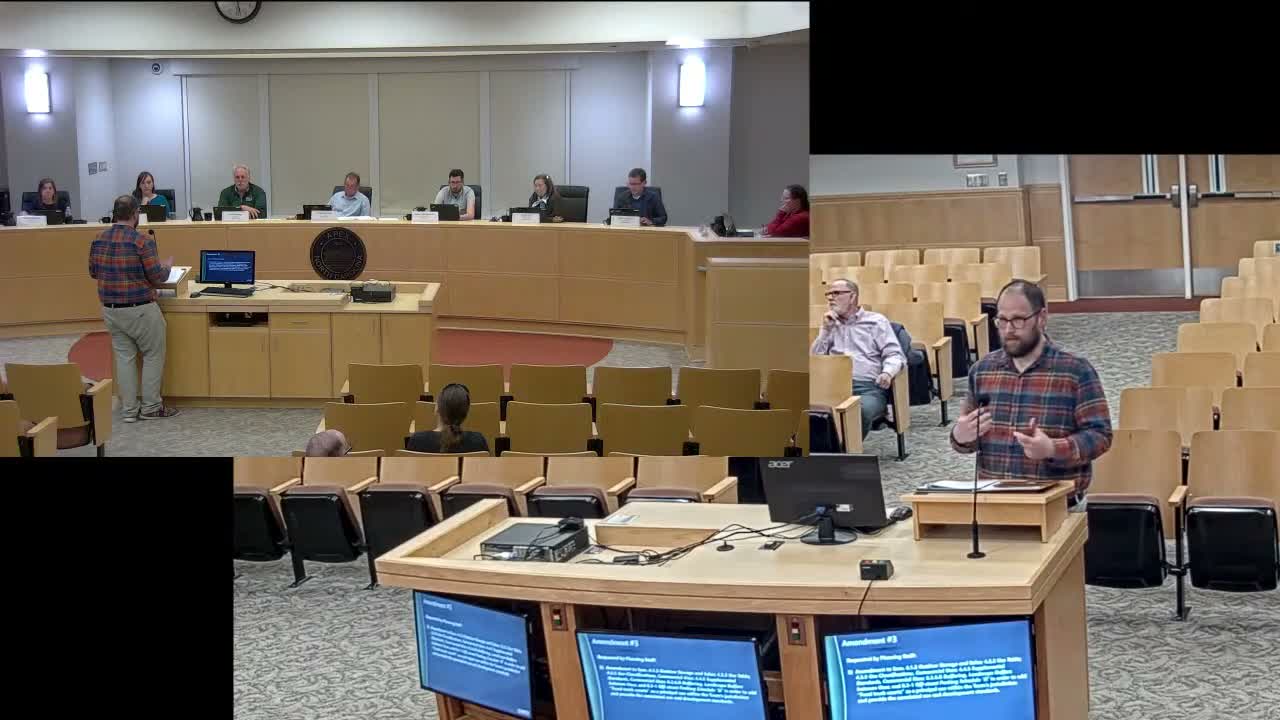
The Apex Planning Board on May 11 approved three separate amendments to the town's Unified Development Ordinance (UDO): establishing a Transitional Business (B-3) district and a Heavy Industrial (HI) district; permitting detention centers, jails or similar correctional facilities only in the HI district with supplemental standards; and creating a permanent "food-truck court" use with design and operational requirements.
Planning staff explained the first amendment would add two new base zoning districts to provide a transitional option along auto-oriented commercial corridors (B-3) and a place for higher-intensity industrial uses (HI). "The B-3 is intended to provide a transitional area between higher-intensity vehicle corridors and lower-intensity zoning districts," Bruce (planning staff) said. The B-3 listing includes numerous commercial uses (accessory apartments, restaurants, artisan studios, small retail, farmers markets) that are similar to existing B-2 uses but intended for higher-quality, site-specific development.
The second amendment would allow detention centers, jails, prisons or correctional facilities only in the new Heavy Industrial district and impose supplemental standards. Staff listed key thresholds: "the site shall be a minimum of 10 acres" and the facility "will be located with a minimum of a quarter mile or 1,320 feet away from any public or private school, daycare, place of worship, or any property zoned or used for residential purposes," plus a required 60-foot opaque buffer around the site. Mayor Pro Tem Mahaffey told the board the change is in part a response to nearby jurisdictions and examples in the region; staff clarified there are currently no heavy-industrial parcels in Apex and the amendment is intended as a code clarification and readiness step rather than immediate local proposals.
During the board deliberations a member moved to increase the minimum separation distance to 1,600 feet; the board approved that change and then carried the amendment to permit detention facilities in HI with the larger separation.
The third amendment sets standards for a permanent food-truck court, defined as an establishment with three or more mobile food vendors that operate with an on-site permanent anchor (restaurant, bar, microbrewery, etc.). Proposed standards include site-plan-designated vendor pads, permanent restrooms (no porta-potties), permanent power to each vendor (no individual generators), a 10-foot clearance around vendor vehicles, separation of vendor areas from parking by fencing or planters, limits on sandwich-board signage, and parking and bicycle-space calculations tied to vendor stalls and indoor dining area.
Bruce said staff consulted property owners and other municipalities with similar provisions while drafting the food-truck language and emphasized the ordinance is intended to encourage higher-quality, permanent food-court developments rather than ad-hoc parking-lot assemblages of trucks. Board members debated whether the requirements would raise development costs and how the rule would affect existing vendor locations; staff said temporary events and festival exemptions remain available through the town code.
Board votes: the first UDO amendment (B-3 and HI districts) passed; the amendment to permit detention facilities in HI passed after the separation distance was increased to 1,600 feet; and the food-truck-court amendment passed on a 7-2 vote after two members recorded dissenting votes.
Next steps: the amendments will be forwarded to town council for consideration; site-specific rezoning and conditional zoning processes will determine where and how the new uses would be applied.
Planning staff explained the first amendment would add two new base zoning districts to provide a transitional option along auto-oriented commercial corridors (B-3) and a place for higher-intensity industrial uses (HI). "The B-3 is intended to provide a transitional area between higher-intensity vehicle corridors and lower-intensity zoning districts," Bruce (planning staff) said. The B-3 listing includes numerous commercial uses (accessory apartments, restaurants, artisan studios, small retail, farmers markets) that are similar to existing B-2 uses but intended for higher-quality, site-specific development.
The second amendment would allow detention centers, jails, prisons or correctional facilities only in the new Heavy Industrial district and impose supplemental standards. Staff listed key thresholds: "the site shall be a minimum of 10 acres" and the facility "will be located with a minimum of a quarter mile or 1,320 feet away from any public or private school, daycare, place of worship, or any property zoned or used for residential purposes," plus a required 60-foot opaque buffer around the site. Mayor Pro Tem Mahaffey told the board the change is in part a response to nearby jurisdictions and examples in the region; staff clarified there are currently no heavy-industrial parcels in Apex and the amendment is intended as a code clarification and readiness step rather than immediate local proposals.
During the board deliberations a member moved to increase the minimum separation distance to 1,600 feet; the board approved that change and then carried the amendment to permit detention facilities in HI with the larger separation.
The third amendment sets standards for a permanent food-truck court, defined as an establishment with three or more mobile food vendors that operate with an on-site permanent anchor (restaurant, bar, microbrewery, etc.). Proposed standards include site-plan-designated vendor pads, permanent restrooms (no porta-potties), permanent power to each vendor (no individual generators), a 10-foot clearance around vendor vehicles, separation of vendor areas from parking by fencing or planters, limits on sandwich-board signage, and parking and bicycle-space calculations tied to vendor stalls and indoor dining area.
Bruce said staff consulted property owners and other municipalities with similar provisions while drafting the food-truck language and emphasized the ordinance is intended to encourage higher-quality, permanent food-court developments rather than ad-hoc parking-lot assemblages of trucks. Board members debated whether the requirements would raise development costs and how the rule would affect existing vendor locations; staff said temporary events and festival exemptions remain available through the town code.
Board votes: the first UDO amendment (B-3 and HI districts) passed; the amendment to permit detention facilities in HI passed after the separation distance was increased to 1,600 feet; and the food-truck-court amendment passed on a 7-2 vote after two members recorded dissenting votes.
Next steps: the amendments will be forwarded to town council for consideration; site-specific rezoning and conditional zoning processes will determine where and how the new uses would be applied.
View the Full Meeting & All Its Details
This article offers just a summary. Unlock complete video, transcripts, and insights as a Founder Member.
✓
Watch full, unedited meeting videos
✓
Search every word spoken in unlimited transcripts
✓
AI summaries & real-time alerts (all government levels)
✓
Permanent access to expanding government content
30-day money-back guarantee
