Grand County narrows water plan to demand-side measures, asks staff to revise draft
May 12, 2026 | Grand County Commission, Grand County Boards and Commissions, Grand County, Utah
This article was created by AI summarizing key points discussed. AI makes mistakes, so for full details and context, please refer to the video of the full meeting. Please report any errors so we can fix them. Report an error »
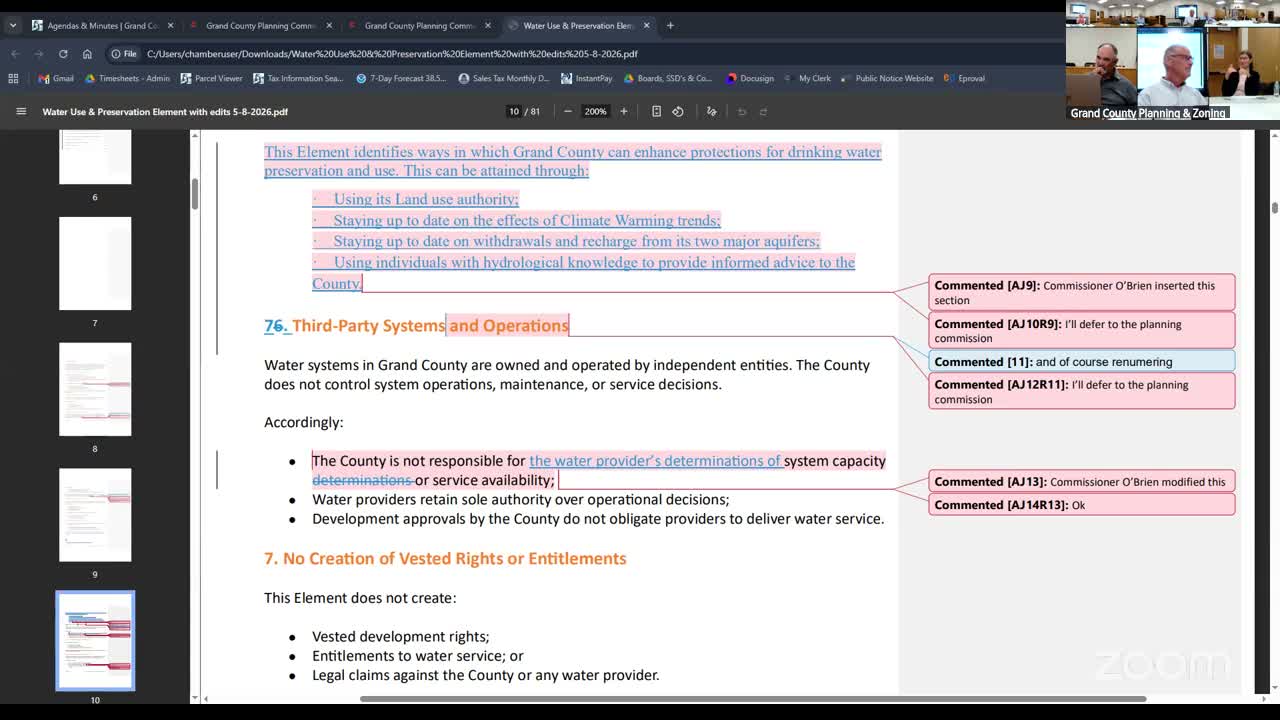
Grand County commissioners agreed on a narrower scope for the county's draft Water Use and Preservation Element, instructing staff to remove supply- and climate-focused language and emphasize demand-reduction measures.
At the meeting, a staff member said the document was never intended to be "a peer reviewed water supply document" and framed it as a demand-focused planning element that guides land-use decisions and county priorities. Commissioners debated whether references to climate change and long-term supply should remain; several said those topics were politically charged and outside the county's role as a non–water provider.
"Let's see if we can get away from talking about supply because I think this is a fine document in saying how can we decrease demand," one commissioner said, urging the group to focus the element on achievable local actions such as water-wise landscaping and infrastructure maintenance. Another commissioner argued the element should meet the state's minimum requirements without importing broader, supply-side debates.
The commission defined three practical guardrails for revision: do not include climate-change language framed as supply projections; do not add supply-side policy that would be the purview of water providers; and focus the element on demand-reduction and preservation measures. The chair and commissioners agreed staff should apply those guardrails and circulate a revised draft for review.
Staff was directed to return a revised draft to the commission for discussion in approximately two weeks and to prepare the item for a public hearing scheduled for June 8, pending the review process. The chair summarized the action as a consensus direction to refine the draft to the agreed scope and clarified that citations and specific data points would be checked or removed where necessary.
What the commission decided is procedural direction to staff, not a formal ordinance or regulation. The commission did not vote on new code changes at this meeting; instead, it asked staff to produce a clearer, shorter demand-focused draft and to identify definitive sources for any data presented. The next meeting will focus on the revised draft and any lingering technical issues raised during the review, such as the presentation of reduction scenarios in the draft's charts and tables.
The commission adjourned after setting the follow-up schedule.
At the meeting, a staff member said the document was never intended to be "a peer reviewed water supply document" and framed it as a demand-focused planning element that guides land-use decisions and county priorities. Commissioners debated whether references to climate change and long-term supply should remain; several said those topics were politically charged and outside the county's role as a non–water provider.
"Let's see if we can get away from talking about supply because I think this is a fine document in saying how can we decrease demand," one commissioner said, urging the group to focus the element on achievable local actions such as water-wise landscaping and infrastructure maintenance. Another commissioner argued the element should meet the state's minimum requirements without importing broader, supply-side debates.
The commission defined three practical guardrails for revision: do not include climate-change language framed as supply projections; do not add supply-side policy that would be the purview of water providers; and focus the element on demand-reduction and preservation measures. The chair and commissioners agreed staff should apply those guardrails and circulate a revised draft for review.
Staff was directed to return a revised draft to the commission for discussion in approximately two weeks and to prepare the item for a public hearing scheduled for June 8, pending the review process. The chair summarized the action as a consensus direction to refine the draft to the agreed scope and clarified that citations and specific data points would be checked or removed where necessary.
What the commission decided is procedural direction to staff, not a formal ordinance or regulation. The commission did not vote on new code changes at this meeting; instead, it asked staff to produce a clearer, shorter demand-focused draft and to identify definitive sources for any data presented. The next meeting will focus on the revised draft and any lingering technical issues raised during the review, such as the presentation of reduction scenarios in the draft's charts and tables.
The commission adjourned after setting the follow-up schedule.
Don't Miss a Word: See the Full Meeting!
Go beyond summaries. Unlock every video, transcript, and key insight with a Founder Membership.
✓
Get instant access to full meeting videos
✓
Search and clip any phrase from complete transcripts
✓
Receive AI-powered summaries & custom alerts
✓
Enjoy lifetime, unrestricted access to government data
30-day money-back guarantee
