Board advances draft WUI code requiring more wildfire-resistant siding and decks, keeps HVAC measures optional
May 11, 2026 | Flagstaff City, Coconino County, Arizona
This article was created by AI summarizing key points discussed. AI makes mistakes, so for full details and context, please refer to the video of the full meeting. Please report any errors so we can fix them. Report an error »
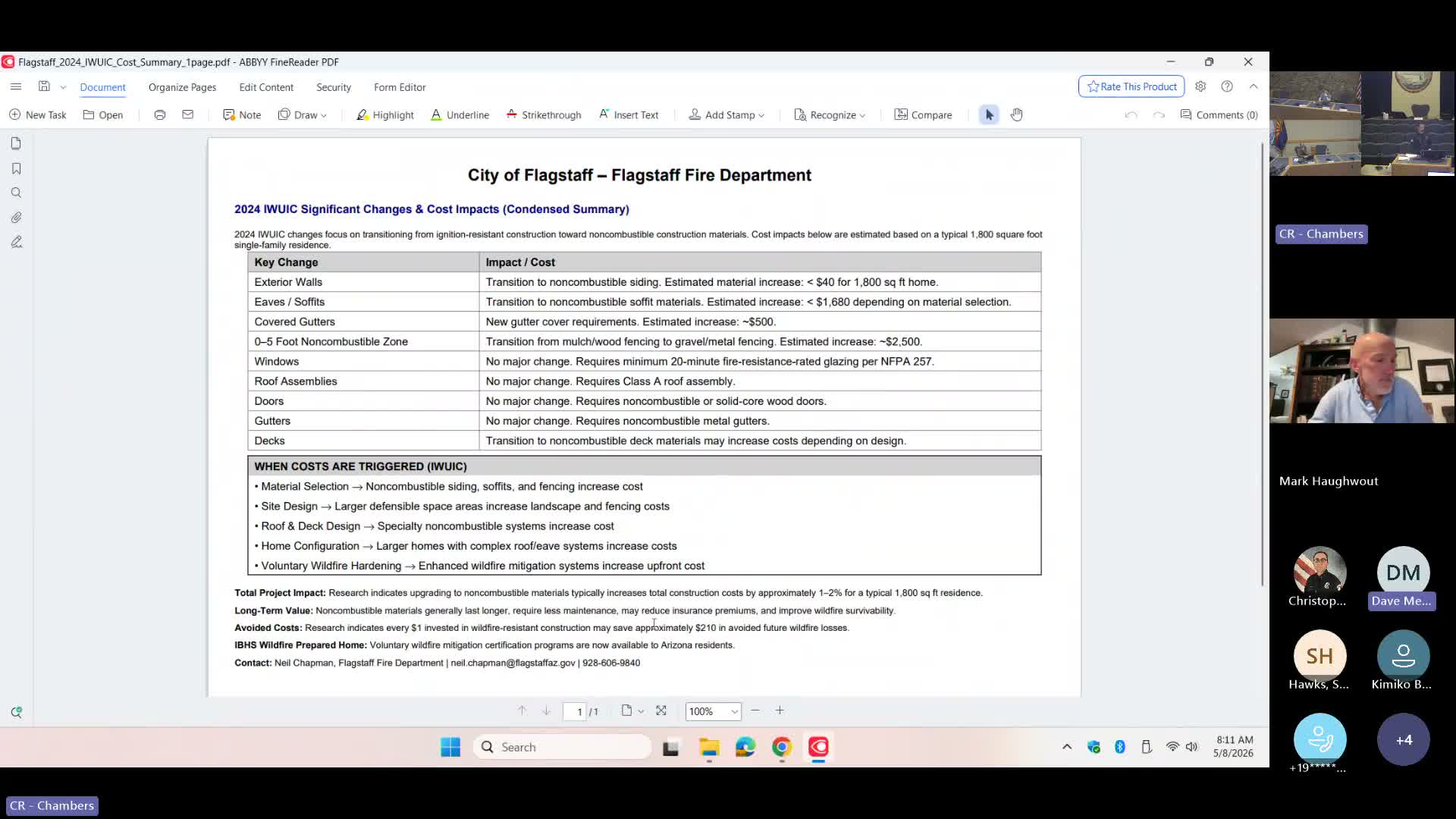
The Flagstaff City Board of Appeals on Tuesday voted to recommend moving forward with draft amendments to the Wildland-Urban Interface (WUI) code that would increase noncombustible construction standards for new residential siding and decks, while leaving proposed HVAC filtration changes as optional and for further study.
Neil Chapman, the staff presenter, introduced outside researchers who helped compile local cost comparisons and risk analyses. Kamiko Barrett of the Alliance for Wildfire Resilience said the group’s sample analyses — which included sites in the Intermountain West and California — show new-construction cost increases for wildfire-resistant assemblies generally in the 2–3% range depending on the components. "For new home construction…that cost comparison is very negotiable — or negligible, I should really say — it elevated costs around 2 to 3%," Barrett said, attributing the smaller percentage in part to Flagstaff’s already-elevated baseline standards.
Steve Hock, senior director for wildfire at the Insurance Institute for Business and Home Safety (IBHS), told the board insurers look at the standard to which a home was built and that third-party verification matters: "When a homeowner has our certificate of designation that it has met that standard and has been verified, they find a lot of value in it," he said, arguing that verified resilient construction can make homes more insurable.
A public participant sharply challenged the presenters’ cost figures during discussion about siding and exterior insulation, calling the presented numbers "completely inaccurate" and saying proposed 2-inch foam exterior wraps and related installation would cost far more than shown. The participant left the meeting mid-discussion, temporarily causing the board to lose quorum; staff later confirmed a caller rejoined and the meeting resumed.
Board members debated trade-offs between short-term construction cost increases and long-term avoided losses from wildfire and post-fire impacts. Mark Shirey moved to advance the draft amendments; the motion was seconded and passed on a voice vote. Board members emphasized the measure applies to new construction and additions, not retroactive requirements for existing homes, and directed staff to factor public outreach feedback into the final recommendation.
On HVAC filtration, Chapman proposed code changes to enlarge filter cabinets (to 3–4 inches) so homeowners could insert HEPA-rated furnace filters without damaging blowers. Board members and staff, including Rick Stenonis speaking as a building official, agreed the mechanical code implications are complex and that a prescriptive, mandatory filtration standard is not ready for adoption. The board favored optional guidance and homeowner education instead of a binding requirement.
Staff said it will incorporate comments collected at two public outreach sessions scheduled for the following week and reconvene the board to decide whether further appeal hearings are necessary. The board adjourned with plans to return after public outreach and staff clarifications.
The board’s action is procedural (a recommendation to proceed with amendments); any final code change would require subsequent review and formal adoption steps.
Neil Chapman, the staff presenter, introduced outside researchers who helped compile local cost comparisons and risk analyses. Kamiko Barrett of the Alliance for Wildfire Resilience said the group’s sample analyses — which included sites in the Intermountain West and California — show new-construction cost increases for wildfire-resistant assemblies generally in the 2–3% range depending on the components. "For new home construction…that cost comparison is very negotiable — or negligible, I should really say — it elevated costs around 2 to 3%," Barrett said, attributing the smaller percentage in part to Flagstaff’s already-elevated baseline standards.
Steve Hock, senior director for wildfire at the Insurance Institute for Business and Home Safety (IBHS), told the board insurers look at the standard to which a home was built and that third-party verification matters: "When a homeowner has our certificate of designation that it has met that standard and has been verified, they find a lot of value in it," he said, arguing that verified resilient construction can make homes more insurable.
A public participant sharply challenged the presenters’ cost figures during discussion about siding and exterior insulation, calling the presented numbers "completely inaccurate" and saying proposed 2-inch foam exterior wraps and related installation would cost far more than shown. The participant left the meeting mid-discussion, temporarily causing the board to lose quorum; staff later confirmed a caller rejoined and the meeting resumed.
Board members debated trade-offs between short-term construction cost increases and long-term avoided losses from wildfire and post-fire impacts. Mark Shirey moved to advance the draft amendments; the motion was seconded and passed on a voice vote. Board members emphasized the measure applies to new construction and additions, not retroactive requirements for existing homes, and directed staff to factor public outreach feedback into the final recommendation.
On HVAC filtration, Chapman proposed code changes to enlarge filter cabinets (to 3–4 inches) so homeowners could insert HEPA-rated furnace filters without damaging blowers. Board members and staff, including Rick Stenonis speaking as a building official, agreed the mechanical code implications are complex and that a prescriptive, mandatory filtration standard is not ready for adoption. The board favored optional guidance and homeowner education instead of a binding requirement.
Staff said it will incorporate comments collected at two public outreach sessions scheduled for the following week and reconvene the board to decide whether further appeal hearings are necessary. The board adjourned with plans to return after public outreach and staff clarifications.
The board’s action is procedural (a recommendation to proceed with amendments); any final code change would require subsequent review and formal adoption steps.
Don't Miss a Word: See the Full Meeting!
Go beyond summaries. Unlock every video, transcript, and key insight with a Founder Membership.
✓
Get instant access to full meeting videos
✓
Search and clip any phrase from complete transcripts
✓
Receive AI-powered summaries & custom alerts
✓
Enjoy lifetime, unrestricted access to government data
30-day money-back guarantee
