District 28 parents and leaders urge caution as DOE rolls out AI guidance
May 11, 2026 | New York City Geographic District #28, School Districts, New York
This article was created by AI summarizing key points discussed. AI makes mistakes, so for full details and context, please refer to the video of the full meeting. Please report any errors so we can fix them. Report an error »
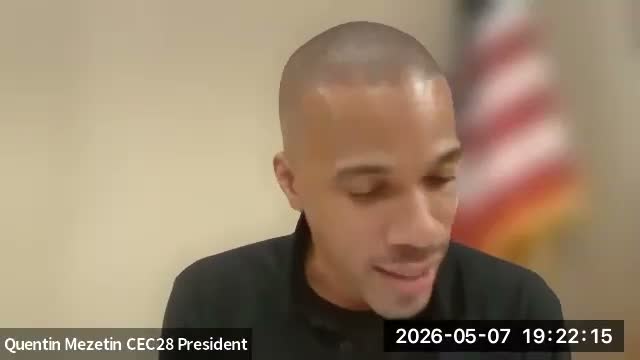
CEC District 28 members and parents pressed for clearer, family‑facing restrictions and stronger privacy safeguards as the New York City Department of Education (DOE) solicits feedback on draft artificial‑intelligence guidance.
At the CEC’s May 7 meeting, a parent and council member identified as Cecily described a home project she made with multiple AI tools to preserve bedtime storytime for a child on nights she travels. “This is how I use AI to incorporate some of the stories for storytelling,” Cecily said, adding that home uses differ from classroom adoption and that schools must set higher standards for student use.
Other parents struck a more cautionary tone. Leonie Jameson, who said she served on the DOE AI working group, told the council the group was promised input before guidance was released but did not receive it. She said the state controller’s audit found gaps in DOE privacy practices, noting that “over a 100 student data breaches have occurred in the last few years.” Jameson urged privacy impact statements, algorithmic‑bias testing and data‑security audits before schools adopt AI tools that collect student information.
Several council members echoed the call for caution. First Vice President Lauren Clavin said many parents across the city want stronger guardrails and pointed to organized petitions and a citywide group asking for a moratorium until educational benefits and harms are better understood. “Show us the evidence that this is beneficial,” she said.
District staff asked families to use the DOE feedback window; Dr. Benoit of the district office reminded attendees that the initial comment period was open through May 8 and that a more detailed “AI playbook” is expected in June with family‑notification processes and a proposed tool scorecard.
Parents and council members flagged several recurring concerns: the risk of students becoming dependent on AI for basic skills; the need for age‑appropriate rules (elementary students need different limits than older students); and the absence of a central inventory of EdTech tools in schools. Jameson said some teachers were assigning off‑the‑shelf AI products that advise they are inappropriate for children under 13 without parental consent.
The council did not vote on policy changes; instead members urged families to submit feedback to DOE and to participate in future guidance windows. District staff said the June playbook will include more detail on notifications, acceptable uses and evidence requirements.
At the CEC’s May 7 meeting, a parent and council member identified as Cecily described a home project she made with multiple AI tools to preserve bedtime storytime for a child on nights she travels. “This is how I use AI to incorporate some of the stories for storytelling,” Cecily said, adding that home uses differ from classroom adoption and that schools must set higher standards for student use.
Other parents struck a more cautionary tone. Leonie Jameson, who said she served on the DOE AI working group, told the council the group was promised input before guidance was released but did not receive it. She said the state controller’s audit found gaps in DOE privacy practices, noting that “over a 100 student data breaches have occurred in the last few years.” Jameson urged privacy impact statements, algorithmic‑bias testing and data‑security audits before schools adopt AI tools that collect student information.
Several council members echoed the call for caution. First Vice President Lauren Clavin said many parents across the city want stronger guardrails and pointed to organized petitions and a citywide group asking for a moratorium until educational benefits and harms are better understood. “Show us the evidence that this is beneficial,” she said.
District staff asked families to use the DOE feedback window; Dr. Benoit of the district office reminded attendees that the initial comment period was open through May 8 and that a more detailed “AI playbook” is expected in June with family‑notification processes and a proposed tool scorecard.
Parents and council members flagged several recurring concerns: the risk of students becoming dependent on AI for basic skills; the need for age‑appropriate rules (elementary students need different limits than older students); and the absence of a central inventory of EdTech tools in schools. Jameson said some teachers were assigning off‑the‑shelf AI products that advise they are inappropriate for children under 13 without parental consent.
The council did not vote on policy changes; instead members urged families to submit feedback to DOE and to participate in future guidance windows. District staff said the June playbook will include more detail on notifications, acceptable uses and evidence requirements.
Don't Miss a Word: See the Full Meeting!
Go beyond summaries. Unlock every video, transcript, and key insight with a Founder Membership.
✓
Get instant access to full meeting videos
✓
Search and clip any phrase from complete transcripts
✓
Receive AI-powered summaries & custom alerts
✓
Enjoy lifetime, unrestricted access to government data
30-day money-back guarantee
