Upland council restores mobile‑home rent‑review ordinance with modified transfer rule in 3–2 vote
May 11, 2026 | Upland, San Bernardino County, California
This article was created by AI summarizing key points discussed. AI makes mistakes, so for full details and context, please refer to the video of the full meeting. Please report any errors so we can fix them. Report an error »
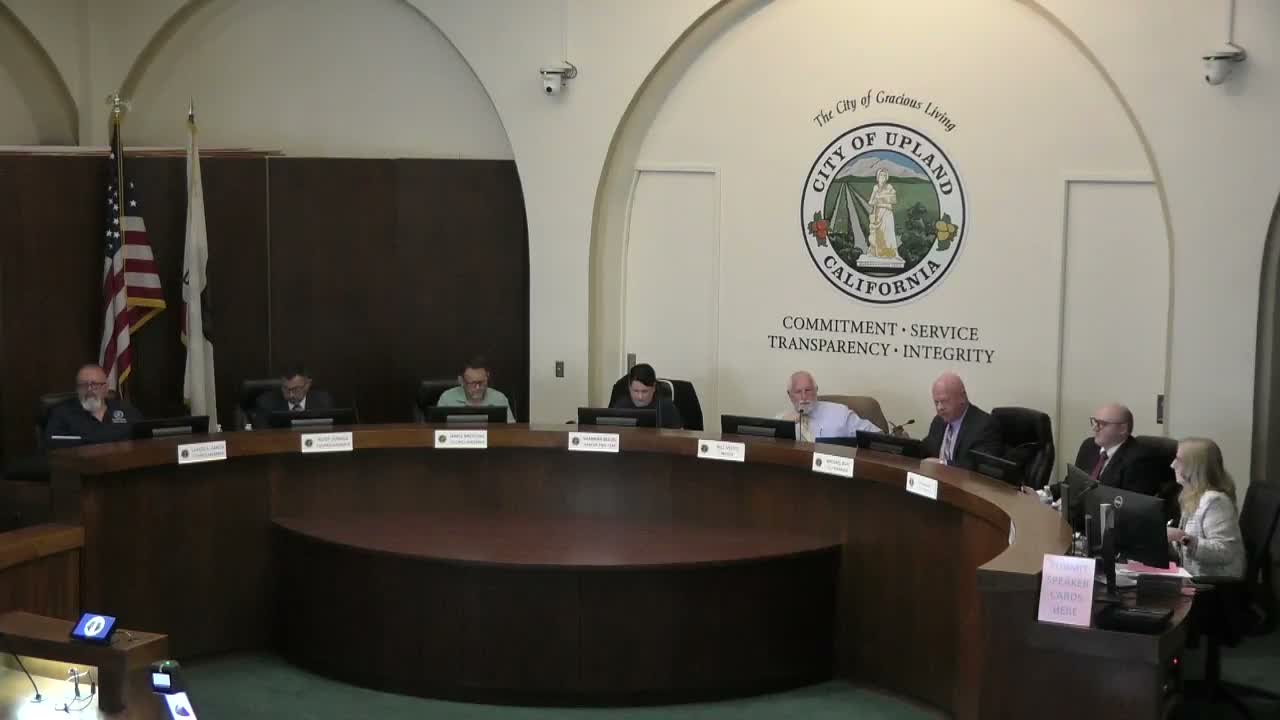
The Upland City Council voted 3–2 on May 11 to introduce by title a restored mobile‑home rent‑review ordinance that returns long‑standing protections for residents but substitutes the revised ordinance’s transfer provision allowing larger rent adjustments at change of ownership.
City Manager Michael Blay opened the agenda item by acknowledging staff errors that led to the ordinance’s prior repeal and urging the council to correct that mistake. “I did a poor job of informing the council of all of the elements of this rescinded ordinance,” Blay said, adding, “I’m responsible for this situation we're in tonight.” His statement preceded a lengthy public comment period during which residents and park representatives urged contrasting outcomes.
Resident speakers told the council the rescission removed a promise long held by mobile‑home owners who own their homes but lease the land. “This so close to Mother's Day, look around the room. Many of the people affected by this decision are your mothers, your grandmothers, your neighbors,” said a resident who asked the council to “support exhibit A,” the stronger restoring option. Park managers and owners warned of sharply rising costs, aging infrastructure and the risk that parks could be sold or redeveloped if revenues remain insufficient. Brian Bender, general manager of El Dorado Mobile Home Park, said the park’s average space rent is about $840 and that insurance and other costs have increased dramatically in recent years.
Development Services Director Robert (Bob) Dahlquist told the council staff prepared two draft ordinances for consideration: a restoring ordinance that largely reinserts the prior Chapter 5.68 with procedural updates, and a revised ordinance that reorganizes administration and expands the mechanics for obtaining a fair rate of return. Dahlquist told the council the city has six mobile‑home parks with roughly 869 spaces and summarized core provisions that will remain common to both drafts: an annual CPI‑linked cap, a fair‑rate review process for larger increases tied to operating and capital needs, vacancy control language and an appeals/hearing mechanism.
Council members spent more than an hour debating whether to promptly reinstate the protections residents lost or take additional time to seek a negotiated memorandum of understanding. A substitute motion that would introduce the restoring ordinance but replace its vacancy/transfer section with the revised ordinance’s transfer language — effectively preserving protections for current residents while allowing higher rent resets at change of ownership — was moved and seconded. The measure passed on a 3–2 vote; the clerk announced the motion carried and the council waived further reading.
The council did not record roll‑call votes by name in the public record during the motion, only the final tally of three in favor and two opposed. Council members noted that the ordinance’s procedural introduction triggers a posting period and administrative steps; one council member said the ordinance’s posting process requires 30 days before certain changes fully take effect.
What the ordinance does and does not do: It restores a local rent‑review framework that allows a base cap tied to CPI while preserving a process for park owners to seek increases above that cap when they can demonstrate capital needs, utility cost pass‑throughs or other operating pressures. The substitute language modified the vacancy/transfer protection so that new purchasers may be subject to market rate at turnover in certain circumstances; the draft retains exclusions for transfers to a conservator, guardian, trustee, interspousal or parent/child transfers as described by staff.
Next steps: The council introduced the ordinance by title only (first reading) and will follow the city’s ordinance process for subsequent readings, posting and implementation. Staff said the ordinance drafts and the staff report will remain available on the city website for public review. The council recessed after the vote and moved to subsequent agenda items.
Reporting note: Quotes and attributions in this article are drawn from the city council meeting transcript and public comment provided at the May 11 meeting.
City Manager Michael Blay opened the agenda item by acknowledging staff errors that led to the ordinance’s prior repeal and urging the council to correct that mistake. “I did a poor job of informing the council of all of the elements of this rescinded ordinance,” Blay said, adding, “I’m responsible for this situation we're in tonight.” His statement preceded a lengthy public comment period during which residents and park representatives urged contrasting outcomes.
Resident speakers told the council the rescission removed a promise long held by mobile‑home owners who own their homes but lease the land. “This so close to Mother's Day, look around the room. Many of the people affected by this decision are your mothers, your grandmothers, your neighbors,” said a resident who asked the council to “support exhibit A,” the stronger restoring option. Park managers and owners warned of sharply rising costs, aging infrastructure and the risk that parks could be sold or redeveloped if revenues remain insufficient. Brian Bender, general manager of El Dorado Mobile Home Park, said the park’s average space rent is about $840 and that insurance and other costs have increased dramatically in recent years.
Development Services Director Robert (Bob) Dahlquist told the council staff prepared two draft ordinances for consideration: a restoring ordinance that largely reinserts the prior Chapter 5.68 with procedural updates, and a revised ordinance that reorganizes administration and expands the mechanics for obtaining a fair rate of return. Dahlquist told the council the city has six mobile‑home parks with roughly 869 spaces and summarized core provisions that will remain common to both drafts: an annual CPI‑linked cap, a fair‑rate review process for larger increases tied to operating and capital needs, vacancy control language and an appeals/hearing mechanism.
Council members spent more than an hour debating whether to promptly reinstate the protections residents lost or take additional time to seek a negotiated memorandum of understanding. A substitute motion that would introduce the restoring ordinance but replace its vacancy/transfer section with the revised ordinance’s transfer language — effectively preserving protections for current residents while allowing higher rent resets at change of ownership — was moved and seconded. The measure passed on a 3–2 vote; the clerk announced the motion carried and the council waived further reading.
The council did not record roll‑call votes by name in the public record during the motion, only the final tally of three in favor and two opposed. Council members noted that the ordinance’s procedural introduction triggers a posting period and administrative steps; one council member said the ordinance’s posting process requires 30 days before certain changes fully take effect.
What the ordinance does and does not do: It restores a local rent‑review framework that allows a base cap tied to CPI while preserving a process for park owners to seek increases above that cap when they can demonstrate capital needs, utility cost pass‑throughs or other operating pressures. The substitute language modified the vacancy/transfer protection so that new purchasers may be subject to market rate at turnover in certain circumstances; the draft retains exclusions for transfers to a conservator, guardian, trustee, interspousal or parent/child transfers as described by staff.
Next steps: The council introduced the ordinance by title only (first reading) and will follow the city’s ordinance process for subsequent readings, posting and implementation. Staff said the ordinance drafts and the staff report will remain available on the city website for public review. The council recessed after the vote and moved to subsequent agenda items.
Reporting note: Quotes and attributions in this article are drawn from the city council meeting transcript and public comment provided at the May 11 meeting.
Don't Miss a Word: See the Full Meeting!
Go beyond summaries. Unlock every video, transcript, and key insight with a Founder Membership.
✓
Get instant access to full meeting videos
✓
Search and clip any phrase from complete transcripts
✓
Receive AI-powered summaries & custom alerts
✓
Enjoy lifetime, unrestricted access to government data
30-day money-back guarantee
