Committee keeps Good Samaritan eviction protection but flags implementation questions; removes some landlord‑tenant provisions for further work
May 12, 2026 | Economic Development, Housing & General Affairs, SENATE, Committees, Legislative , Vermont
This article was created by AI summarizing key points discussed. AI makes mistakes, so for full details and context, please refer to the video of the full meeting. Please report any errors so we can fix them. Report an error »
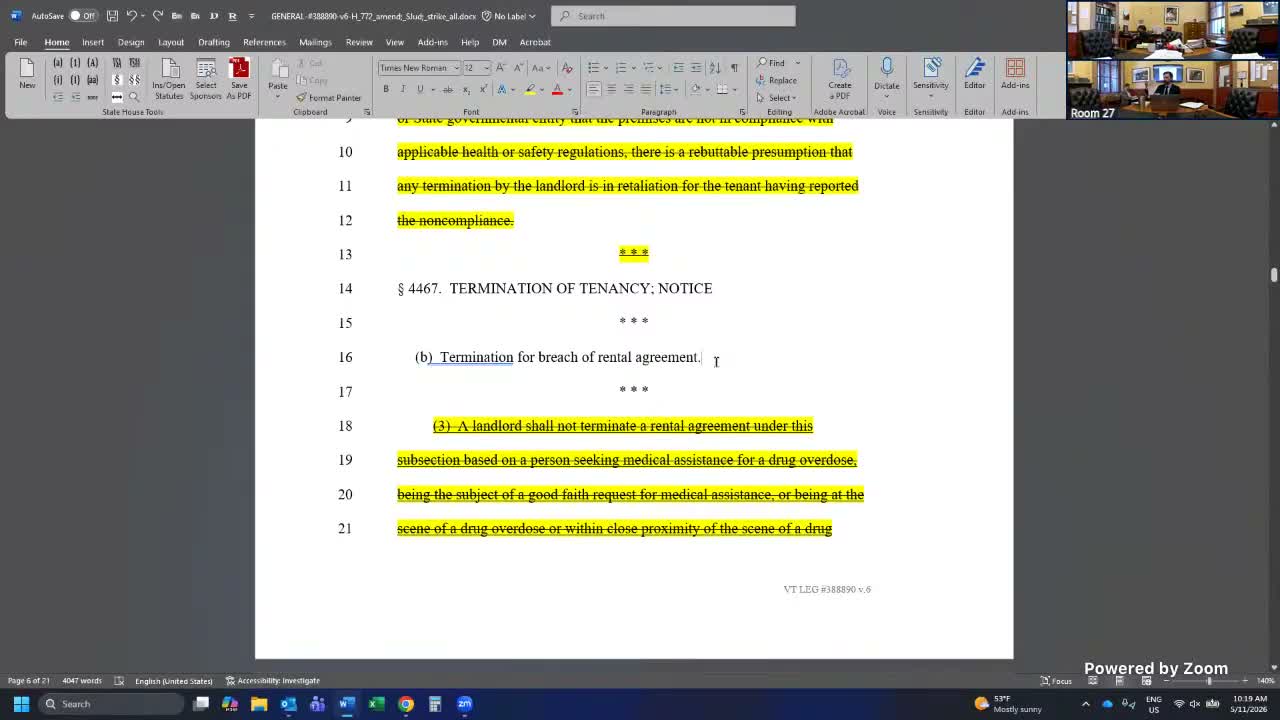
The committee paused its H.775 work and turned to the landlord‑tenant package, focusing on a narrow set of measures the chair said could be moved quickly: Good Samaritan protections, no‑trespass language, a residential rental docket study, and bifurcation of rental agreements in cases of domestic abuse.
Cameron reviewed draft language from the judiciary report and the committee discussed several contested elements. One high‑profile item is a provision that would bar a landlord from terminating a rental agreement ‘‘because someone has called 911 to seek medical assistance for a drug overdose.’’ Cameron summarized the provision as protecting those who seek emergency medical help: "a landlord cannot terminate the rental agreement because of the seeking of medical assistance for a drug overdose." Supporters argued the rule could save lives by removing disincentives to call for emergency help; critics worried about the landlord’s ability to address repeated dangerous conduct or to protect other tenants and asked how evidence and enforcement would work.
Witness Chris Donnelly, invited to comment, told the committee that tools in the bill were intended to address the sort of situations landlords describe as a "drug house," while also protecting lives: "We need to protect our lives, but we need the other tools ... to actually address the issues that you're describing." Committee members and court officials advised that the judiciary can provide procedural and operational information for a proposed residential rental docket but cannot ethically offer advisory legal opinions about hypothetical statutory outcomes. Tom Sone (chief superior judge) and Terry Corson (state court administrator) said the court could report on procedural capacity and timelines but should not be asked to predict how statutes would be adjudicated.
Based on time constraints and the complexity of several policy areas, the committee agreed to set aside several provisions for further work: an age‑restricted housing rent‑increase reporting provision, a proposed expansion of the application‑fee definition that would reach third‑party background checks, and a security‑deposit cap. Members said these subjects require deeper study and stakeholder engagement. Instead, the committee asked the court and staff to rework the residential rental docket language so the report provides procedural assessments (staffing and scheduling to support expedited hearings) without straying into advisory legal opinions or crafting policy balancing tests reserved to the legislature.
Next steps: Cameron and court staff will refine the docket study language outside the hearing, remove requests that would amount to advisory opinions, and return suggested wording to the committee. The committee also asked advocates and landlords to continue dialogue on how to balance life‑saving Good Samaritan protections with practical enforcement in repeat‑offense situations.
Notable quotes from the hearing included a member urging restraint when life is at stake: "We do not want people to die," and a court official explaining institutional boundaries: "I don't think courts can be asked to predict how they would rule — that's a legislative policy decision."
Cameron reviewed draft language from the judiciary report and the committee discussed several contested elements. One high‑profile item is a provision that would bar a landlord from terminating a rental agreement ‘‘because someone has called 911 to seek medical assistance for a drug overdose.’’ Cameron summarized the provision as protecting those who seek emergency medical help: "a landlord cannot terminate the rental agreement because of the seeking of medical assistance for a drug overdose." Supporters argued the rule could save lives by removing disincentives to call for emergency help; critics worried about the landlord’s ability to address repeated dangerous conduct or to protect other tenants and asked how evidence and enforcement would work.
Witness Chris Donnelly, invited to comment, told the committee that tools in the bill were intended to address the sort of situations landlords describe as a "drug house," while also protecting lives: "We need to protect our lives, but we need the other tools ... to actually address the issues that you're describing." Committee members and court officials advised that the judiciary can provide procedural and operational information for a proposed residential rental docket but cannot ethically offer advisory legal opinions about hypothetical statutory outcomes. Tom Sone (chief superior judge) and Terry Corson (state court administrator) said the court could report on procedural capacity and timelines but should not be asked to predict how statutes would be adjudicated.
Based on time constraints and the complexity of several policy areas, the committee agreed to set aside several provisions for further work: an age‑restricted housing rent‑increase reporting provision, a proposed expansion of the application‑fee definition that would reach third‑party background checks, and a security‑deposit cap. Members said these subjects require deeper study and stakeholder engagement. Instead, the committee asked the court and staff to rework the residential rental docket language so the report provides procedural assessments (staffing and scheduling to support expedited hearings) without straying into advisory legal opinions or crafting policy balancing tests reserved to the legislature.
Next steps: Cameron and court staff will refine the docket study language outside the hearing, remove requests that would amount to advisory opinions, and return suggested wording to the committee. The committee also asked advocates and landlords to continue dialogue on how to balance life‑saving Good Samaritan protections with practical enforcement in repeat‑offense situations.
Notable quotes from the hearing included a member urging restraint when life is at stake: "We do not want people to die," and a court official explaining institutional boundaries: "I don't think courts can be asked to predict how they would rule — that's a legislative policy decision."
Don't Miss a Word: See the Full Meeting!
Go beyond summaries. Unlock every video, transcript, and key insight with a Founder Membership.
✓
Get instant access to full meeting videos
✓
Search and clip any phrase from complete transcripts
✓
Receive AI-powered summaries & custom alerts
✓
Enjoy lifetime, unrestricted access to government data
30-day money-back guarantee
