House committee hears Department of Public Safety budget requests, flags new accounting rule
May 12, 2026 | House of Representatives, House, Committees, Legislative, Puerto Rico, International
This article was created by AI summarizing key points discussed. AI makes mistakes, so for full details and context, please refer to the video of the full meeting. Please report any errors so we can fix them. Report an error »
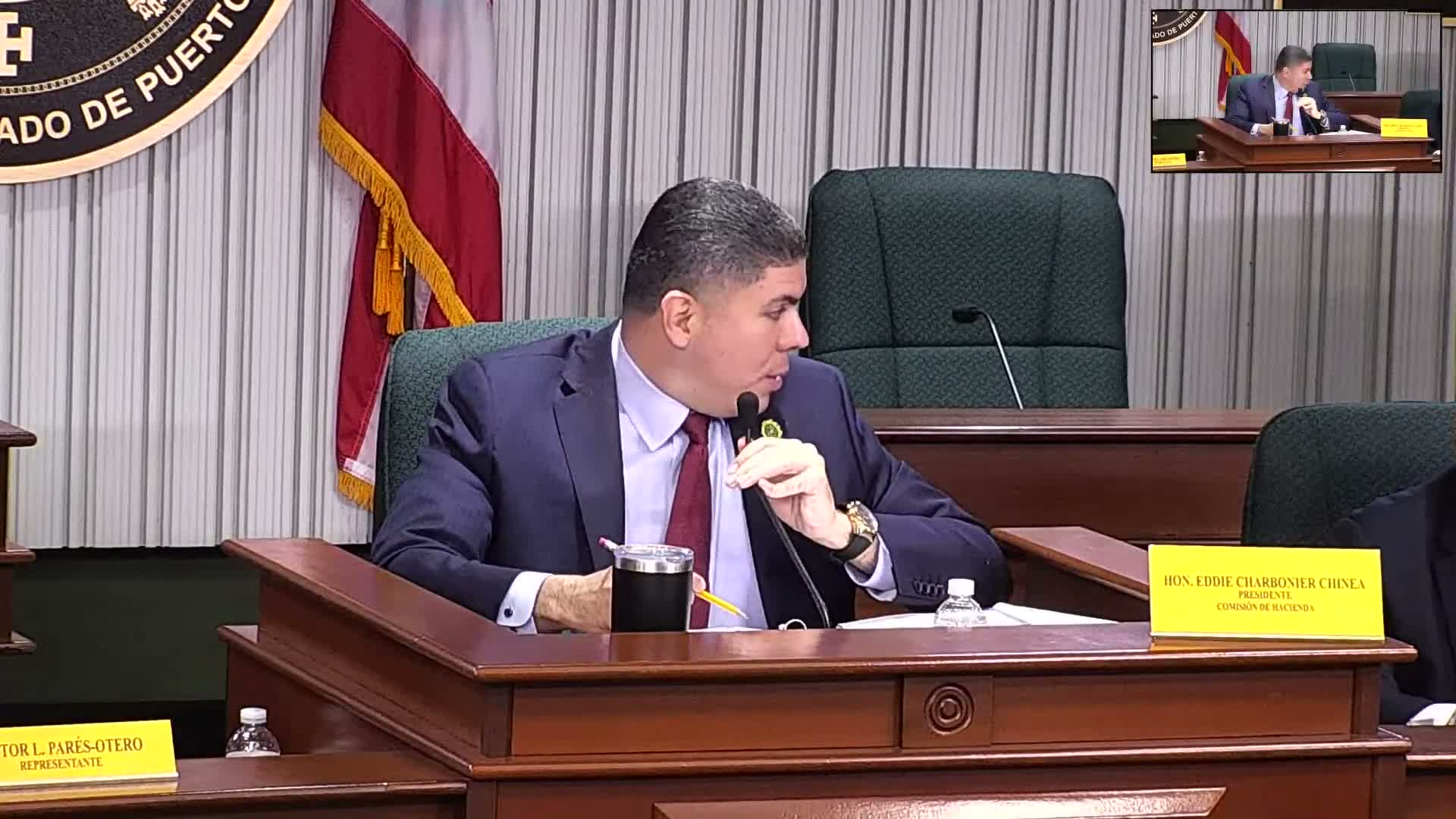
The House Committee on Hacienda heard a full briefing May 11 on Joint Resolution C‑60, the proposed fiscal 2026‑27 budget for Puerto Rico's Department of Public Safety (DPS). Secretary Arturo Garfer told the committee the department and its components — police, fire, emergency management and emergency medical services — need sustained, recurrent funds to preserve operations and complete large capital projects.
Garfer said the Fiscal Oversight and Management Board's recent adoption of what he described as a "Standard Acrowell Accounting" practice restricts the use of prior‑year, agency‑generated special revenues that historically funded fleet replacements, equipment and training. He said that change poses a direct operational risk to several negociados, notably the Fire Corps, Emergency Medical Services and the 9‑1‑1 system, and asked the legislature to account for those limits while reviewing the resolution (Secretary Garfer, SEG 038–156).
Police Superintendent Joseph González presented the police agency's first independent budget under Law 83 and listed the department's proposed FY26‑27 total at about $846 million, down from the prior year's $860 million baseline largely because of the police separation and elimination of pay‑go items. He said the draft budget is almost entirely state‑funded in the near term and that federal contributions make up a small share (Superintendent Joseph González, SEG 181–187; SEG 1826–1830).
Officials said the DPS currently manages 81 federal projects with committed funding of about $281 million, including an interoperability program (about $117 million) and a Safe Room project (about $25.3 million). Garfer and González said some FEMA funds remain delayed by federal administrative processing (SEG 493–524; SEG 507–521).
The hearing closed with the committee requesting follow‑up documentation: itemized vacancy lists by negociado, a breakdown of special fund sources and uses, and details on capital and contract schedules to allow fiscal staff and members to vet carryforward needs against the new accounting treatment (Chair, SEG 3450–3797).
Garfer said the Fiscal Oversight and Management Board's recent adoption of what he described as a "Standard Acrowell Accounting" practice restricts the use of prior‑year, agency‑generated special revenues that historically funded fleet replacements, equipment and training. He said that change poses a direct operational risk to several negociados, notably the Fire Corps, Emergency Medical Services and the 9‑1‑1 system, and asked the legislature to account for those limits while reviewing the resolution (Secretary Garfer, SEG 038–156).
Police Superintendent Joseph González presented the police agency's first independent budget under Law 83 and listed the department's proposed FY26‑27 total at about $846 million, down from the prior year's $860 million baseline largely because of the police separation and elimination of pay‑go items. He said the draft budget is almost entirely state‑funded in the near term and that federal contributions make up a small share (Superintendent Joseph González, SEG 181–187; SEG 1826–1830).
Officials said the DPS currently manages 81 federal projects with committed funding of about $281 million, including an interoperability program (about $117 million) and a Safe Room project (about $25.3 million). Garfer and González said some FEMA funds remain delayed by federal administrative processing (SEG 493–524; SEG 507–521).
The hearing closed with the committee requesting follow‑up documentation: itemized vacancy lists by negociado, a breakdown of special fund sources and uses, and details on capital and contract schedules to allow fiscal staff and members to vet carryforward needs against the new accounting treatment (Chair, SEG 3450–3797).
Don't Miss a Word: See the Full Meeting!
Go beyond summaries. Unlock every video, transcript, and key insight with a Founder Membership.
✓
Get instant access to full meeting videos
✓
Search and clip any phrase from complete transcripts
✓
Receive AI-powered summaries & custom alerts
✓
Enjoy lifetime, unrestricted access to government data
30-day money-back guarantee
