Dunn County committee advances land‑division ordinance amendments tied to state Act 68
May 11, 2026 | Dunn County, Wisconsin
This article was created by AI summarizing key points discussed. AI makes mistakes, so for full details and context, please refer to the video of the full meeting. Please report any errors so we can fix them. Report an error »
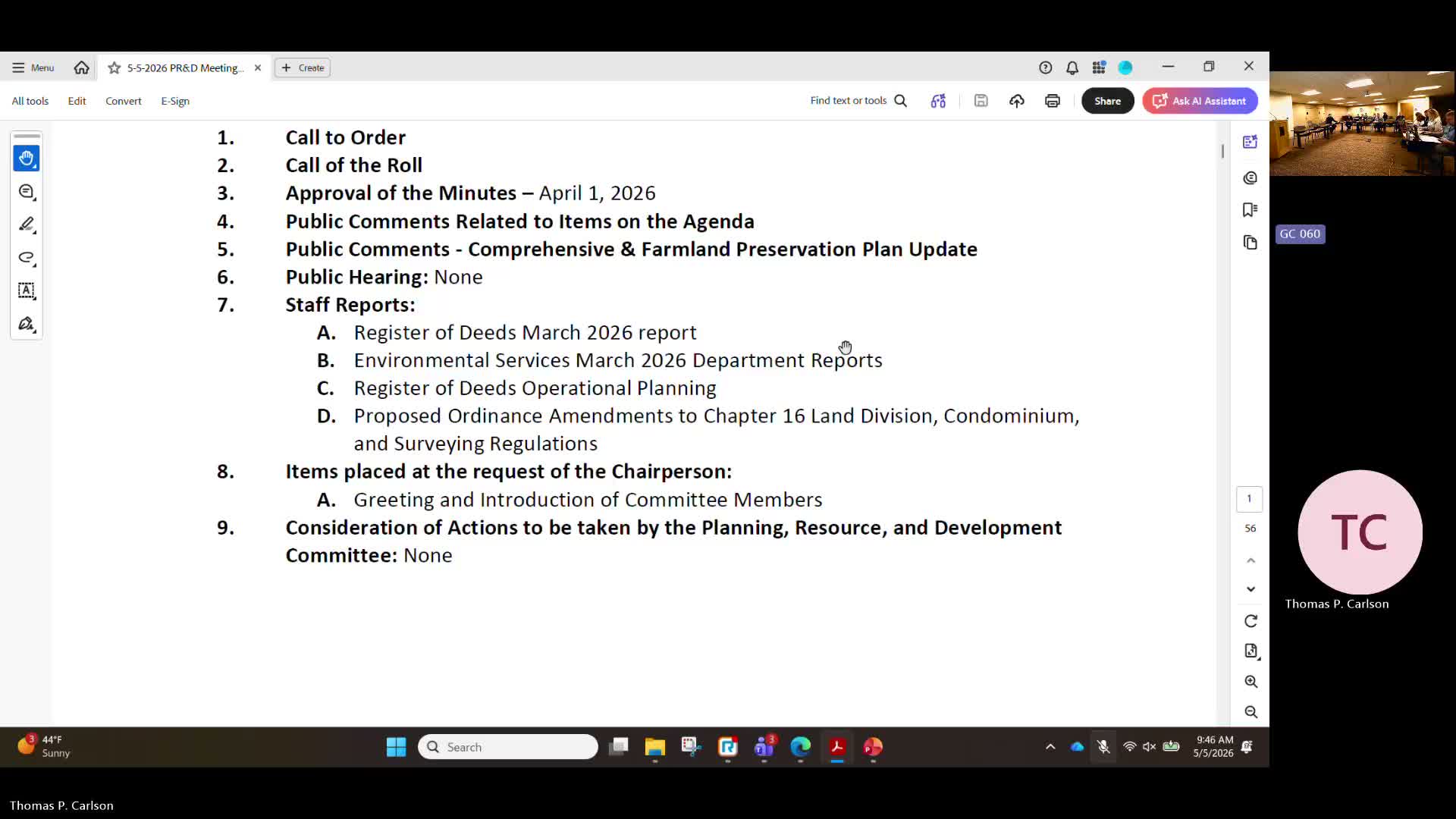
Dunn County staff presented a package of proposed edits to the county’s land‑division, condominium and surveying ordinance driven in part by Wisconsin’s recently enacted Act 68, and the Planning, Resource & Development Committee agreed to send the draft to a Class 2 public notice and hold a public hearing in June.
Tom Carlson, the county surveyor, told the committee that some changes are mandatory under Act 68 and others are county‑initiated clarifications. "Act 68 got passed by the Wisconsin Legislature in December 2025 and that's going to be take effect July 1," Carlson said, and staff included the act and explanatory materials in the meeting packet.
Why it matters: several of the mandated changes affect how quickly plats and maps must be reviewed and what the county may require as a condition for approval. Carlson warned that Act 68 shortens the final‑plat review window "from 60 days down to 10, which makes it very difficult," and said the draft ordinance includes language intended to keep the county in compliance while making the rules operationally feasible.
Key changes outlined by staff include:
- Terminology and scope: the ordinance replaces a "variance" label for certain land‑division requests with the term "modification of provisions" to avoid confusion with zoning variances handled by the Board of Adjustment. Carlson said this is primarily a wording change so land‑division relief routes are clearer.
- Definitions and scope cleanup: the draft adds several technical definitions (for example, "closed depression" and "agricultural‑related structure") and removes a stand‑alone "environmentally sensitive area" rule (a 75‑foot wetland buffer) because, staff said, site‑specific regulation properly belongs in zoning.
- Plat and CSM process: certified survey maps (CSMs) will continue to be reviewed by Environmental & Soil staff in most cases; plats (preliminary and final) follow committee review. Carlson flagged the compressed statutory timeline for final plats under Act 68 as a primary driver of the amendment work.
- Public improvements: the draft clarifies the distinction between requiring a subdivider to "agree to" public improvements and actually requiring that infrastructure be installed before approval or recording. Assistant corporation counsel April Land explained that the change responds to statutory language and preserves the county’s ability to require financial security while complying with Act 68.
- Private access and lot form rules: the proposal lowers the required right‑of‑way for private roads or access easements that serve no more than two lots from 66 feet to 33 feet to avoid unnecessarily encumbering farmland; it also removes the county’s 4:1 depth‑to‑width ratio so certain flag lots may be created without a modification application.
- Agricultural structure notice: newly created lots that include existing agricultural structures may be subject to NR151 standards and staff may require a note on the map to warn prospective buyers about resource‑management obligations (for example, existing manure pits).
- Fee schedule adjustments: staff proposed removing a redundant $35 soil‑boring review line from the land‑division fee schedule because that charge is already collected through the zoning office’s process.
What the committee decided: with no formal objection, members agreed to authorize staff to publish the required Class 2 notice and plan a public hearing at the committee’s first June meeting, with the county board to consider first and second readings and adoption in the weeks after the hearing. Carlson said the timeline for board action would aim for a first reading in June and second reading and adoption in July, subject to public comment and scheduling.
Claims and clarifications: several supervisors pressed staff on practical effects — for example, whether the new wording would allow the county to require sewer connections when municipal services are nearby. Carlson and counsel said that the ordinance distinguishes "requiring agreement to install improvements" (which can include financial assurances) from mandating actual installation at the time of submission; counsel noted state statute leaves "reasonable time" undefined and will likely require case‑by‑case judgment.
Next steps: staff will publish the Class 2 notice, hold the public hearing in June and bring any public comments or recommended revisions back to the committee before county board readings. The ordinance packet included the draft text, a marked‑up version showing changes driven by Act 68 and a cover memo explaining significant edits.
Ending: The committee voiced general consensus to move the draft forward to notice and hearing; no formal vote was recorded during the discussion.
Tom Carlson, the county surveyor, told the committee that some changes are mandatory under Act 68 and others are county‑initiated clarifications. "Act 68 got passed by the Wisconsin Legislature in December 2025 and that's going to be take effect July 1," Carlson said, and staff included the act and explanatory materials in the meeting packet.
Why it matters: several of the mandated changes affect how quickly plats and maps must be reviewed and what the county may require as a condition for approval. Carlson warned that Act 68 shortens the final‑plat review window "from 60 days down to 10, which makes it very difficult," and said the draft ordinance includes language intended to keep the county in compliance while making the rules operationally feasible.
Key changes outlined by staff include:
- Terminology and scope: the ordinance replaces a "variance" label for certain land‑division requests with the term "modification of provisions" to avoid confusion with zoning variances handled by the Board of Adjustment. Carlson said this is primarily a wording change so land‑division relief routes are clearer.
- Definitions and scope cleanup: the draft adds several technical definitions (for example, "closed depression" and "agricultural‑related structure") and removes a stand‑alone "environmentally sensitive area" rule (a 75‑foot wetland buffer) because, staff said, site‑specific regulation properly belongs in zoning.
- Plat and CSM process: certified survey maps (CSMs) will continue to be reviewed by Environmental & Soil staff in most cases; plats (preliminary and final) follow committee review. Carlson flagged the compressed statutory timeline for final plats under Act 68 as a primary driver of the amendment work.
- Public improvements: the draft clarifies the distinction between requiring a subdivider to "agree to" public improvements and actually requiring that infrastructure be installed before approval or recording. Assistant corporation counsel April Land explained that the change responds to statutory language and preserves the county’s ability to require financial security while complying with Act 68.
- Private access and lot form rules: the proposal lowers the required right‑of‑way for private roads or access easements that serve no more than two lots from 66 feet to 33 feet to avoid unnecessarily encumbering farmland; it also removes the county’s 4:1 depth‑to‑width ratio so certain flag lots may be created without a modification application.
- Agricultural structure notice: newly created lots that include existing agricultural structures may be subject to NR151 standards and staff may require a note on the map to warn prospective buyers about resource‑management obligations (for example, existing manure pits).
- Fee schedule adjustments: staff proposed removing a redundant $35 soil‑boring review line from the land‑division fee schedule because that charge is already collected through the zoning office’s process.
What the committee decided: with no formal objection, members agreed to authorize staff to publish the required Class 2 notice and plan a public hearing at the committee’s first June meeting, with the county board to consider first and second readings and adoption in the weeks after the hearing. Carlson said the timeline for board action would aim for a first reading in June and second reading and adoption in July, subject to public comment and scheduling.
Claims and clarifications: several supervisors pressed staff on practical effects — for example, whether the new wording would allow the county to require sewer connections when municipal services are nearby. Carlson and counsel said that the ordinance distinguishes "requiring agreement to install improvements" (which can include financial assurances) from mandating actual installation at the time of submission; counsel noted state statute leaves "reasonable time" undefined and will likely require case‑by‑case judgment.
Next steps: staff will publish the Class 2 notice, hold the public hearing in June and bring any public comments or recommended revisions back to the committee before county board readings. The ordinance packet included the draft text, a marked‑up version showing changes driven by Act 68 and a cover memo explaining significant edits.
Ending: The committee voiced general consensus to move the draft forward to notice and hearing; no formal vote was recorded during the discussion.
View the Full Meeting & All Its Details
This article offers just a summary. Unlock complete video, transcripts, and insights as a Founder Member.
✓
Watch full, unedited meeting videos
✓
Search every word spoken in unlimited transcripts
✓
AI summaries & real-time alerts (all government levels)
✓
Permanent access to expanding government content
30-day money-back guarantee
