Dunn County staff outline service‑tier budgeting and conservation priorities; registrar of deeds and conservation staff report operational metrics
May 11, 2026 | Dunn County, Wisconsin
This article was created by AI summarizing key points discussed. AI makes mistakes, so for full details and context, please refer to the video of the full meeting. Please report any errors so we can fix them. Report an error »
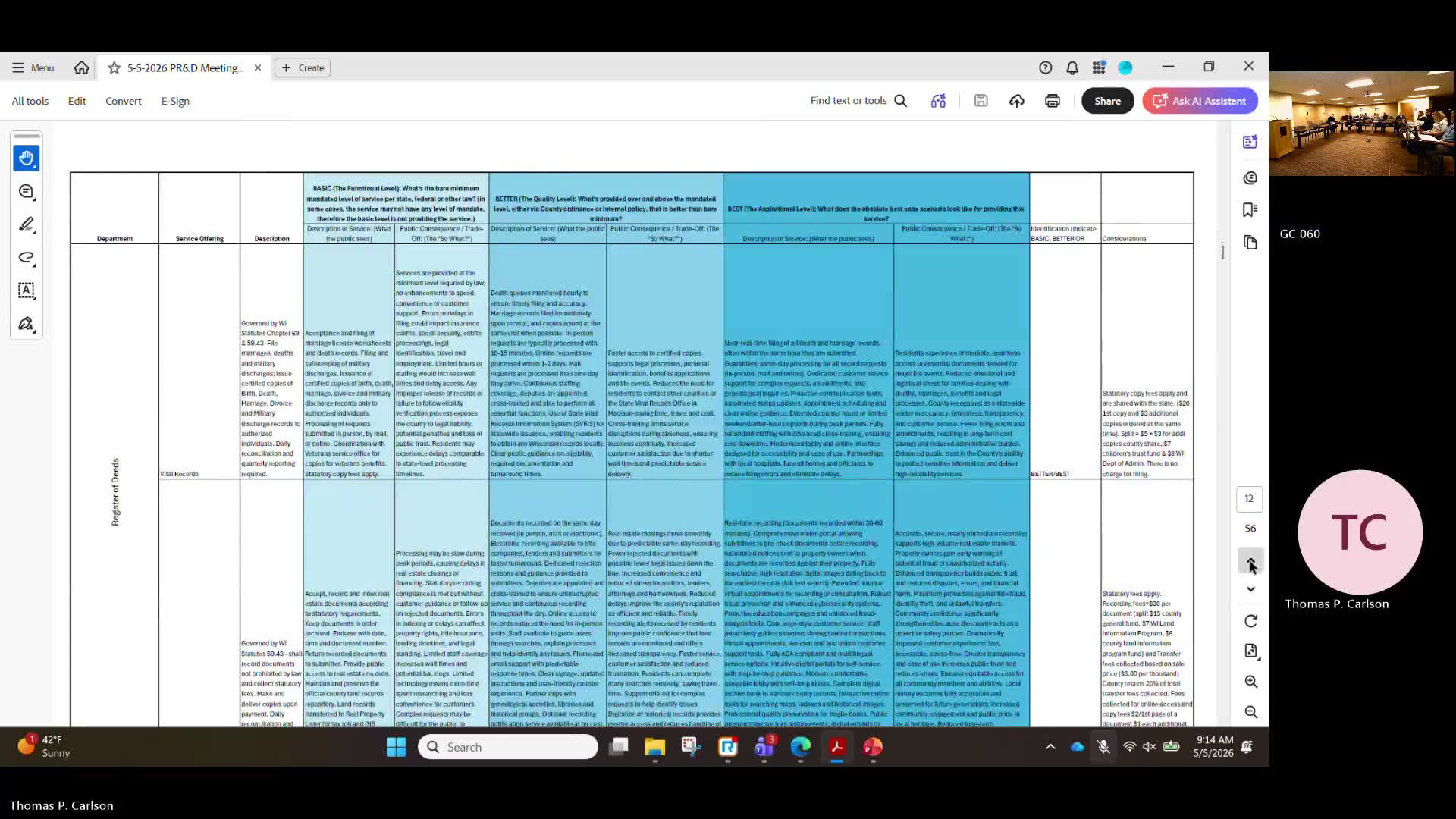
Dunn County department heads presented an "operational planning" service catalog and related updates to help standing committees set acceptable service tiers ahead of budget workshops. The exercise asks departments to describe mandated (basic), "better" and "best" service levels so the county board can later use those definitions when balancing priorities and budgets.
Jenna (county staff) described the timeline: departments will present tiered service descriptions at standing committee meetings in May, the committee will run an opportunities/threats exercise in June with Extension, and budget figures are expected by July for August workshops. She said the process is intended to give department heads clearer direction about which service levels the board considers acceptable.
Registrar of Deeds: Heather reviewed March operational measures and service‑tier detail. She reported seven vital‑records filings for marriage/death activity in March, 109 ownership transfers and that the office tracks in‑person customer counts. Heather noted a recent outreach change: the office shifted from a full mailing to a postcard that "reached just under 5,000 households" this year to publicize sanitation and permitting information. She also flagged the FinCEN real‑estate reporting rule (effective March 1) as a federal reporting change that could affect certain nonstandard real‑estate transactions and said most reporting responsibility rests with lenders and title firms.
Heather walked the committee through service‑catalog examples: mandated duties (vesting in statute, daily reconciliation and quarterly reporting), "better" options like faster access and online access, and "best" aspirations such as near‑immediate recording. She explained statutory recording and copy fees: a $30 recording fee per document, and $2 for the first page with $1 for each additional page. Heather said she expects a retirement in the office later this year and hopes the county will hire to maintain coverage — possibly by replacing a full‑time position with part‑time hours depending on budget direction.
Environmental/land and water conservation: Chase Cummings (county conservationist) explained that PR&D serves concurrently as the county Land Conservation Committee under Chapter 92 of state statutes and described a county‑level land and water plan update due to the state land and water board in October. Chase emphasized nutrient management rules: state agronomic performance standards require landowners managing nutrient applications to follow nutrient management plans; Dunn County’s Chapter 10 mirrors state code and requires plans meet NRCS 590 and NR151 where applicable.
Chase said county enforcement focuses first on voluntary compliance and complaint‑driven follow up, with cost‑share programs (often covering about 70% of plan development) available for some landowners. He told the committee that Dunn County currently receives plans covering approximately 24–26% of cropland acreage (he cited an estimate of about 63,000–64,000 acres covered by submitted plans) and that the county will examine how to increase plan coverage as part of the land and water plan rewrite.
Why this matters: the operational‑planning exercise is intended to give the board a clearer set of tradeoffs before budget choices; registrars’ staffing and digitization choices affect how quickly residents can access time‑sensitive records; and nutrient‑management coverage affects water quality and county compliance with state environmental standards.
Next steps: PR&D will continue reviewing the service catalog at subsequent meetings; Heather said remaining Environmental Services service catalog items will appear on the next PR&D agenda. Chase said the land and water plan rewrite will proceed through focus groups and the committee will see draft material before an October state submission.
Ending: Committee members asked for follow up on precise counts (for example, how many farms submit plans) and staff offered to provide more granular acreage and plan‑count numbers in future reports.
Jenna (county staff) described the timeline: departments will present tiered service descriptions at standing committee meetings in May, the committee will run an opportunities/threats exercise in June with Extension, and budget figures are expected by July for August workshops. She said the process is intended to give department heads clearer direction about which service levels the board considers acceptable.
Registrar of Deeds: Heather reviewed March operational measures and service‑tier detail. She reported seven vital‑records filings for marriage/death activity in March, 109 ownership transfers and that the office tracks in‑person customer counts. Heather noted a recent outreach change: the office shifted from a full mailing to a postcard that "reached just under 5,000 households" this year to publicize sanitation and permitting information. She also flagged the FinCEN real‑estate reporting rule (effective March 1) as a federal reporting change that could affect certain nonstandard real‑estate transactions and said most reporting responsibility rests with lenders and title firms.
Heather walked the committee through service‑catalog examples: mandated duties (vesting in statute, daily reconciliation and quarterly reporting), "better" options like faster access and online access, and "best" aspirations such as near‑immediate recording. She explained statutory recording and copy fees: a $30 recording fee per document, and $2 for the first page with $1 for each additional page. Heather said she expects a retirement in the office later this year and hopes the county will hire to maintain coverage — possibly by replacing a full‑time position with part‑time hours depending on budget direction.
Environmental/land and water conservation: Chase Cummings (county conservationist) explained that PR&D serves concurrently as the county Land Conservation Committee under Chapter 92 of state statutes and described a county‑level land and water plan update due to the state land and water board in October. Chase emphasized nutrient management rules: state agronomic performance standards require landowners managing nutrient applications to follow nutrient management plans; Dunn County’s Chapter 10 mirrors state code and requires plans meet NRCS 590 and NR151 where applicable.
Chase said county enforcement focuses first on voluntary compliance and complaint‑driven follow up, with cost‑share programs (often covering about 70% of plan development) available for some landowners. He told the committee that Dunn County currently receives plans covering approximately 24–26% of cropland acreage (he cited an estimate of about 63,000–64,000 acres covered by submitted plans) and that the county will examine how to increase plan coverage as part of the land and water plan rewrite.
Why this matters: the operational‑planning exercise is intended to give the board a clearer set of tradeoffs before budget choices; registrars’ staffing and digitization choices affect how quickly residents can access time‑sensitive records; and nutrient‑management coverage affects water quality and county compliance with state environmental standards.
Next steps: PR&D will continue reviewing the service catalog at subsequent meetings; Heather said remaining Environmental Services service catalog items will appear on the next PR&D agenda. Chase said the land and water plan rewrite will proceed through focus groups and the committee will see draft material before an October state submission.
Ending: Committee members asked for follow up on precise counts (for example, how many farms submit plans) and staff offered to provide more granular acreage and plan‑count numbers in future reports.
View the Full Meeting & All Its Details
This article offers just a summary. Unlock complete video, transcripts, and insights as a Founder Member.
✓
Watch full, unedited meeting videos
✓
Search every word spoken in unlimited transcripts
✓
AI summaries & real-time alerts (all government levels)
✓
Permanent access to expanding government content
30-day money-back guarantee
