Howard County residents and developers clash over moratorium on Tiber and Plum Tree watershed development
May 12, 2026 | Howard County, Maryland
This article was created by AI summarizing key points discussed. AI makes mistakes, so for full details and context, please refer to the video of the full meeting. Please report any errors so we can fix them. Report an error »
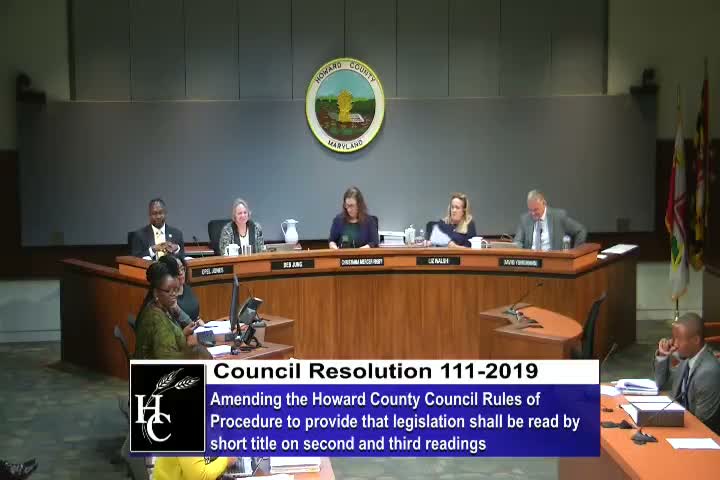
Howard County held an evening public hearing dominated by sharply divided testimony over whether to extend and tighten development limits for properties draining to the Tiber Branch and Plum Tree Branch watersheds.
Supporters of an extension told the County Council that stronger rules are needed to prevent further loss of life and property in Ellicott City. Amy Lynn, who identified herself as an Ellicott City historic-community resident, urged the council to halt all development in the watersheds and said of current practice, “It’s simply outright corruption to allow developers to pay their way out of environmental regulations.” Other residents described repeated basement flooding, delays to urgent repairs and continuing safety risks, and asked for exemptions narrowly tailored for homeowners making essential repairs.
Opponents, including neighborhood associations and project proponents, argued the moratorium is already harming planned mitigation and affordable-housing projects. Bruce Taylor, representing several community associations and developers, cited the county’s 2017 hydrology study and said development built to current standards can “actually help” Ellicott City by retaining stormwater on-site and contributing infrastructure and tax revenue. Small builders and lot owners described projects stalled for years, lost market opportunities and steep carrying costs.
Several speakers sought a middle ground: endorsing stronger stormwater standards while urging clearer grandfathering and case-by-case exemptions for infill or repairs. Joel Hurwitz and other testifiers said they would support a temporary extension if the council advances companion bills that raise stormwater standards and clarify mitigation priorities.
Why it matters: The debate centers on competing aims—protecting the historic downtown and downstream neighborhoods from flash floods while preserving the ability to proceed with redevelopment that proponents say can add housing and pay for mitigation. Council members repeatedly signaled they will review technical input and hold work sessions before voting.
What happens next: The council recessed the hearing and scheduled continuation dates for remaining signers; several related bills and resolutions (including CB 38, CB 40 and CR 122/123) remain pending and will be discussed at follow-up meetings.
Supporters of an extension told the County Council that stronger rules are needed to prevent further loss of life and property in Ellicott City. Amy Lynn, who identified herself as an Ellicott City historic-community resident, urged the council to halt all development in the watersheds and said of current practice, “It’s simply outright corruption to allow developers to pay their way out of environmental regulations.” Other residents described repeated basement flooding, delays to urgent repairs and continuing safety risks, and asked for exemptions narrowly tailored for homeowners making essential repairs.
Opponents, including neighborhood associations and project proponents, argued the moratorium is already harming planned mitigation and affordable-housing projects. Bruce Taylor, representing several community associations and developers, cited the county’s 2017 hydrology study and said development built to current standards can “actually help” Ellicott City by retaining stormwater on-site and contributing infrastructure and tax revenue. Small builders and lot owners described projects stalled for years, lost market opportunities and steep carrying costs.
Several speakers sought a middle ground: endorsing stronger stormwater standards while urging clearer grandfathering and case-by-case exemptions for infill or repairs. Joel Hurwitz and other testifiers said they would support a temporary extension if the council advances companion bills that raise stormwater standards and clarify mitigation priorities.
Why it matters: The debate centers on competing aims—protecting the historic downtown and downstream neighborhoods from flash floods while preserving the ability to proceed with redevelopment that proponents say can add housing and pay for mitigation. Council members repeatedly signaled they will review technical input and hold work sessions before voting.
What happens next: The council recessed the hearing and scheduled continuation dates for remaining signers; several related bills and resolutions (including CB 38, CB 40 and CR 122/123) remain pending and will be discussed at follow-up meetings.
View the Full Meeting & All Its Details
This article offers just a summary. Unlock complete video, transcripts, and insights as a Founder Member.
✓
Watch full, unedited meeting videos
✓
Search every word spoken in unlimited transcripts
✓
AI summaries & real-time alerts (all government levels)
✓
Permanent access to expanding government content
30-day money-back guarantee
