County staff recommends higher stormwater fees and new short-duration standards; builders warn of costs
May 12, 2026 | Howard County, Maryland
This article was created by AI summarizing key points discussed. AI makes mistakes, so for full details and context, please refer to the video of the full meeting. Please report any errors so we can fix them. Report an error »
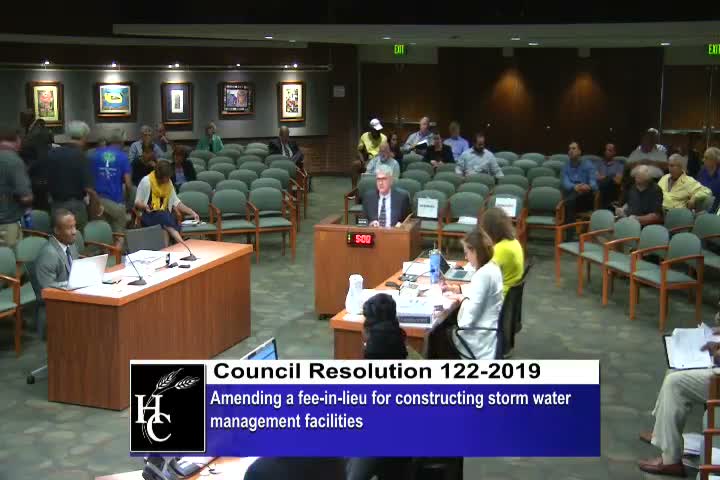
Deputy Director of Planning and Zoning Peter Conrad told the County Council that CR 122 would update the county’s fee-in-lieu schedule — raising the fee for non-environmental site design (ESD) devices from approximately $72,000 to $175,000 per acre-foot of storage — to reflect current construction costs and ensure mitigation funding is available.
Conrad also outlined CR 123, an amendment to the Howard County Design Manual that would require on-site management for a 3.55-hour/6.6-inch storm (the event used to model the July 30, 2016 flood). He said the resolution establishes a hierarchy of mitigation priorities: (1) on-site management for the new listed storms; (2) on-site management of the 24-hour, 100-year event; (3) in limited cases, fee-in-lieu applied to county mitigation projects within the same watershed; and (4) use of an established stormwater bank only when on-site and same-watershed options are exhausted.
Clean Water Action and other environmental groups supported the changes as necessary to protect Ellicott City and downstream communities; they urged stronger enforcement of the requirement that fees be spent in the watershed where collected. Environmental speakers highlighted public-health risks from floodwater (including sewage overflows) and argued that waivers and fees in lieu currently undermine written protections.
Industry groups and many developers opposed the proposed fee increases and the tight new standards. Representatives from the Maryland Building Industry Association and regional builders said the fee hike and expanded on-site retention requirements would make many projects infeasible or radically more expensive. Several developers testified that some pending projects already engineered to different standards would face sudden, substantial additional costs if CR 123 applies retroactively.
Why it matters: Raising fees and adding short-duration design storms would change the economics of development in affected watersheds, fund mitigation projects and potentially reduce flood risk, but could delay projects and shift costs to builders and, ultimately, buyers unless the council specifies grandfathering or transition rules.
What happens next: Staff recommended the resolutions be supported, but councilmembers asked for more detailed cost and legal analyses. The council will review written testimony and hold follow-up work sessions before any vote.
Conrad also outlined CR 123, an amendment to the Howard County Design Manual that would require on-site management for a 3.55-hour/6.6-inch storm (the event used to model the July 30, 2016 flood). He said the resolution establishes a hierarchy of mitigation priorities: (1) on-site management for the new listed storms; (2) on-site management of the 24-hour, 100-year event; (3) in limited cases, fee-in-lieu applied to county mitigation projects within the same watershed; and (4) use of an established stormwater bank only when on-site and same-watershed options are exhausted.
Clean Water Action and other environmental groups supported the changes as necessary to protect Ellicott City and downstream communities; they urged stronger enforcement of the requirement that fees be spent in the watershed where collected. Environmental speakers highlighted public-health risks from floodwater (including sewage overflows) and argued that waivers and fees in lieu currently undermine written protections.
Industry groups and many developers opposed the proposed fee increases and the tight new standards. Representatives from the Maryland Building Industry Association and regional builders said the fee hike and expanded on-site retention requirements would make many projects infeasible or radically more expensive. Several developers testified that some pending projects already engineered to different standards would face sudden, substantial additional costs if CR 123 applies retroactively.
Why it matters: Raising fees and adding short-duration design storms would change the economics of development in affected watersheds, fund mitigation projects and potentially reduce flood risk, but could delay projects and shift costs to builders and, ultimately, buyers unless the council specifies grandfathering or transition rules.
What happens next: Staff recommended the resolutions be supported, but councilmembers asked for more detailed cost and legal analyses. The council will review written testimony and hold follow-up work sessions before any vote.
Don't Miss a Word: See the Full Meeting!
Go beyond summaries. Unlock every video, transcript, and key insight with a Founder Membership.
✓
Get instant access to full meeting videos
✓
Search and clip any phrase from complete transcripts
✓
Receive AI-powered summaries & custom alerts
✓
Enjoy lifetime, unrestricted access to government data
30-day money-back guarantee
