Clark County planners review 2026 stormwater code update; phosphorus rules to expand
May 11, 2026 | La Center, Clark County, Washington
This article was created by AI summarizing key points discussed. AI makes mistakes, so for full details and context, please refer to the video of the full meeting. Please report any errors so we can fix them. Report an error »
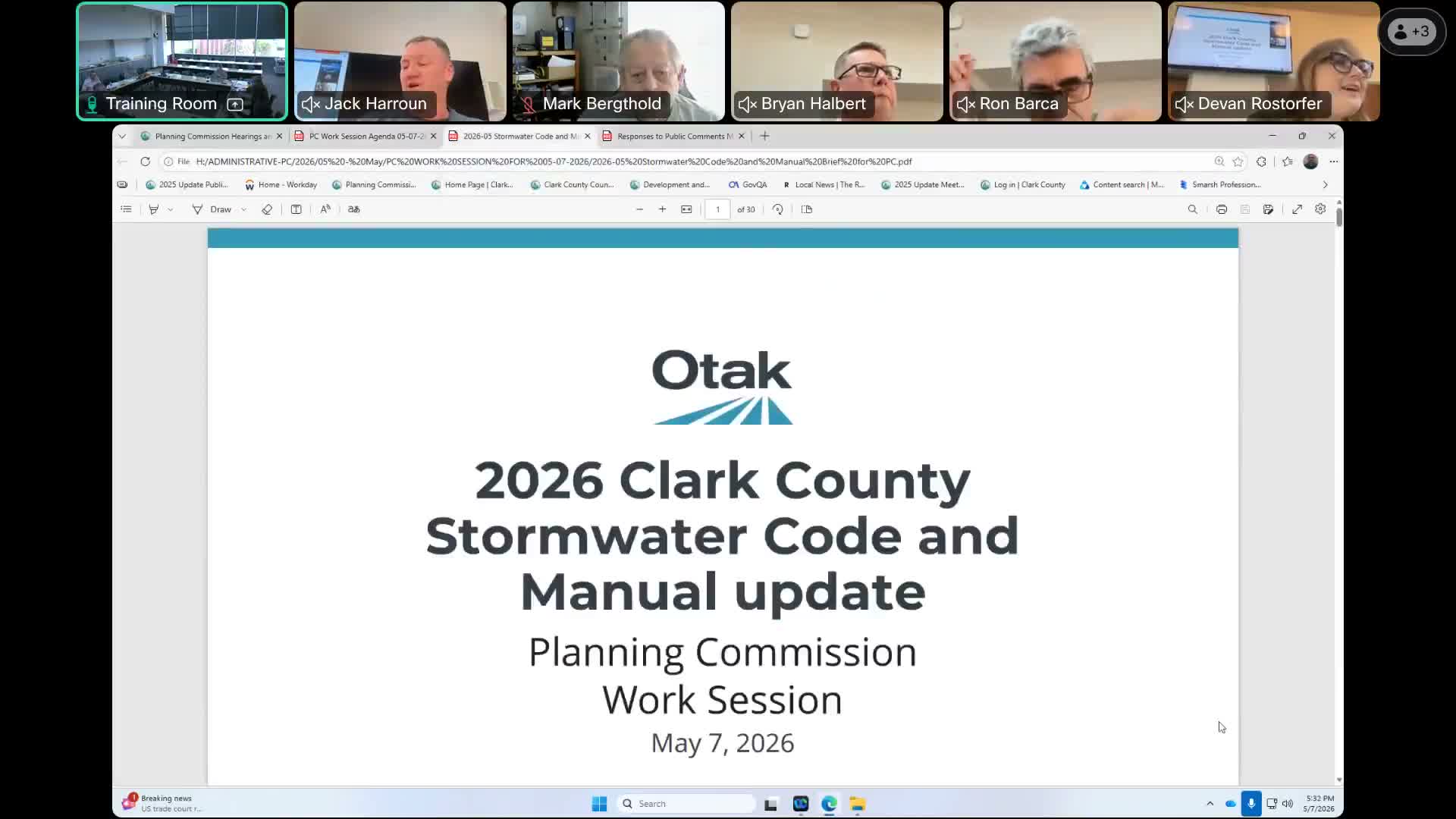
Clark County planning commissioners heard a presentation May 7 on proposed 2026 updates to the county stormwater code and manual designed to meet the county’s Phase 1 municipal stormwater permit and strengthen protections for water bodies including Vancouver Lake and Lake River. Devin Rostopher, Clean Water Division manager in Public Works, told the commission the draft was released for public review in March and April and that the county must complete the update by the Ecology permit deadline of June 30, 2026, so changes can take effect July 1.
Trista Koblowski, senior stormwater planner at OTEC, walked commissioners through the scope and drivers of the update, saying it responds to Appendix 10 of the permit and to technical and user feedback collected since 2024. "The permit mandates that the county maintain a compliant stormwater code and manual," Koblowski said, and staff aim to "apply best available science" while improving clarity and enforceability.
Koblowski highlighted four substantive changes the county is proposing. First, the draft would limit use of deep underground injection control wells for flow control; "we're proposing to not recognize them as an allowable or an approvable BMP for flow control purposes," she said, distinguishing deep wells (which can reach about 100 feet) from shallower dry wells. Second, staff would require more consistent testing and stronger design standards for infiltration facilities to reduce clogging and long-term failure. Third, the county proposes to remove an alternative flow-control standard unique to the Mill Creek watershed and align Mill Creek’s standard with countywide requirements. Fourth, the draft expands where phosphorus treatment is required and adds a high-performance bioretention soil mix as a new treatment option for phosphorus-sensitive waters.
Staff showed a map of the drainage areas where phosphorus control would be required and said the proposal extends existing requirements in places such as Lacamas Creek to include Lake River and Vancouver Lake drainages. Koblowski said the phosphorus requirement would apply to sites that trigger Minimum Requirement 6—typically projects with about 5,000 square feet or more of new or replaced hard surface—and that infiltration that provides sufficient soil treatment may eliminate the need for a separate phosphorus-treatment BMP.
Commissioners pressed staff on practical implications. Vice Chair Jack Caroon raised concerns about costs for small projects, describing instances where residential developers face additional engineering fees: "I'm paying a civil to look at the same chart ... So I'm winding up with 2 different professionals," he said, and cited paying about $6,500 for civil design on a recent project. Staff responded that the requirement for a licensed engineer to size and submit facility designs for projects over the threshold comes from state guidance and that exemptions in Book 1 are verbatim from the permit.
On outreach, staff said the update has been shaped by targeted technical review—seven meetings with the development and engineering advisory board and invited reviews by DEEB and the Clean Water Commission—and that only a small number of public comments were received in the March–April general review. Rostopher said the county will continue outreach via SEPA notification lists, a regional stormwater partners list, social media and targeted training for county reviewers, contractors and maintenance staff to improve implementation.
Staff also discussed non-code efforts to reduce phosphorus and bacteria: Rostopher described a local partnership called "Poop Smart Clark," administered by the Clark Conservation District, that conducts source testing (including DNA) and offers outreach and financial assistance for septic and agricultural practices. When asked about tribal lands, Katie Joel (DPA) noted sovereign tribal lands are not subject to county regulations.
The planning commission hearing on the draft is scheduled for May 21, 2026; a council work session is set for May 20 and the council public hearing and adoption are planned for June 16, ahead of the county’s June 30 permit deadline. Staff said SEPA and Commerce reviews are ongoing and a SEPA determination of nonsignificance is expected. Commissioners were told that hearing materials will show the changes in strikeout-and-underline format.
The work session produced no motions or votes; staff said they will incorporate technical comments and provide written follow-up where more detail is needed. The planning commission will consider the draft at the May 21 hearing, with final decisions expected through the council adoption process in June.
Trista Koblowski, senior stormwater planner at OTEC, walked commissioners through the scope and drivers of the update, saying it responds to Appendix 10 of the permit and to technical and user feedback collected since 2024. "The permit mandates that the county maintain a compliant stormwater code and manual," Koblowski said, and staff aim to "apply best available science" while improving clarity and enforceability.
Koblowski highlighted four substantive changes the county is proposing. First, the draft would limit use of deep underground injection control wells for flow control; "we're proposing to not recognize them as an allowable or an approvable BMP for flow control purposes," she said, distinguishing deep wells (which can reach about 100 feet) from shallower dry wells. Second, staff would require more consistent testing and stronger design standards for infiltration facilities to reduce clogging and long-term failure. Third, the county proposes to remove an alternative flow-control standard unique to the Mill Creek watershed and align Mill Creek’s standard with countywide requirements. Fourth, the draft expands where phosphorus treatment is required and adds a high-performance bioretention soil mix as a new treatment option for phosphorus-sensitive waters.
Staff showed a map of the drainage areas where phosphorus control would be required and said the proposal extends existing requirements in places such as Lacamas Creek to include Lake River and Vancouver Lake drainages. Koblowski said the phosphorus requirement would apply to sites that trigger Minimum Requirement 6—typically projects with about 5,000 square feet or more of new or replaced hard surface—and that infiltration that provides sufficient soil treatment may eliminate the need for a separate phosphorus-treatment BMP.
Commissioners pressed staff on practical implications. Vice Chair Jack Caroon raised concerns about costs for small projects, describing instances where residential developers face additional engineering fees: "I'm paying a civil to look at the same chart ... So I'm winding up with 2 different professionals," he said, and cited paying about $6,500 for civil design on a recent project. Staff responded that the requirement for a licensed engineer to size and submit facility designs for projects over the threshold comes from state guidance and that exemptions in Book 1 are verbatim from the permit.
On outreach, staff said the update has been shaped by targeted technical review—seven meetings with the development and engineering advisory board and invited reviews by DEEB and the Clean Water Commission—and that only a small number of public comments were received in the March–April general review. Rostopher said the county will continue outreach via SEPA notification lists, a regional stormwater partners list, social media and targeted training for county reviewers, contractors and maintenance staff to improve implementation.
Staff also discussed non-code efforts to reduce phosphorus and bacteria: Rostopher described a local partnership called "Poop Smart Clark," administered by the Clark Conservation District, that conducts source testing (including DNA) and offers outreach and financial assistance for septic and agricultural practices. When asked about tribal lands, Katie Joel (DPA) noted sovereign tribal lands are not subject to county regulations.
The planning commission hearing on the draft is scheduled for May 21, 2026; a council work session is set for May 20 and the council public hearing and adoption are planned for June 16, ahead of the county’s June 30 permit deadline. Staff said SEPA and Commerce reviews are ongoing and a SEPA determination of nonsignificance is expected. Commissioners were told that hearing materials will show the changes in strikeout-and-underline format.
The work session produced no motions or votes; staff said they will incorporate technical comments and provide written follow-up where more detail is needed. The planning commission will consider the draft at the May 21 hearing, with final decisions expected through the council adoption process in June.
Don't Miss a Word: See the Full Meeting!
Go beyond summaries. Unlock every video, transcript, and key insight with a Founder Membership.
✓
Get instant access to full meeting videos
✓
Search and clip any phrase from complete transcripts
✓
Receive AI-powered summaries & custom alerts
✓
Enjoy lifetime, unrestricted access to government data
30-day money-back guarantee
