Stokes County board hears vendor's pitch for automated speed enforcement in school zones
May 12, 2026 | Stokes County, North Carolina
This article was created by AI summarizing key points discussed. AI makes mistakes, so for full details and context, please refer to the video of the full meeting. Please report any errors so we can fix them. Report an error »
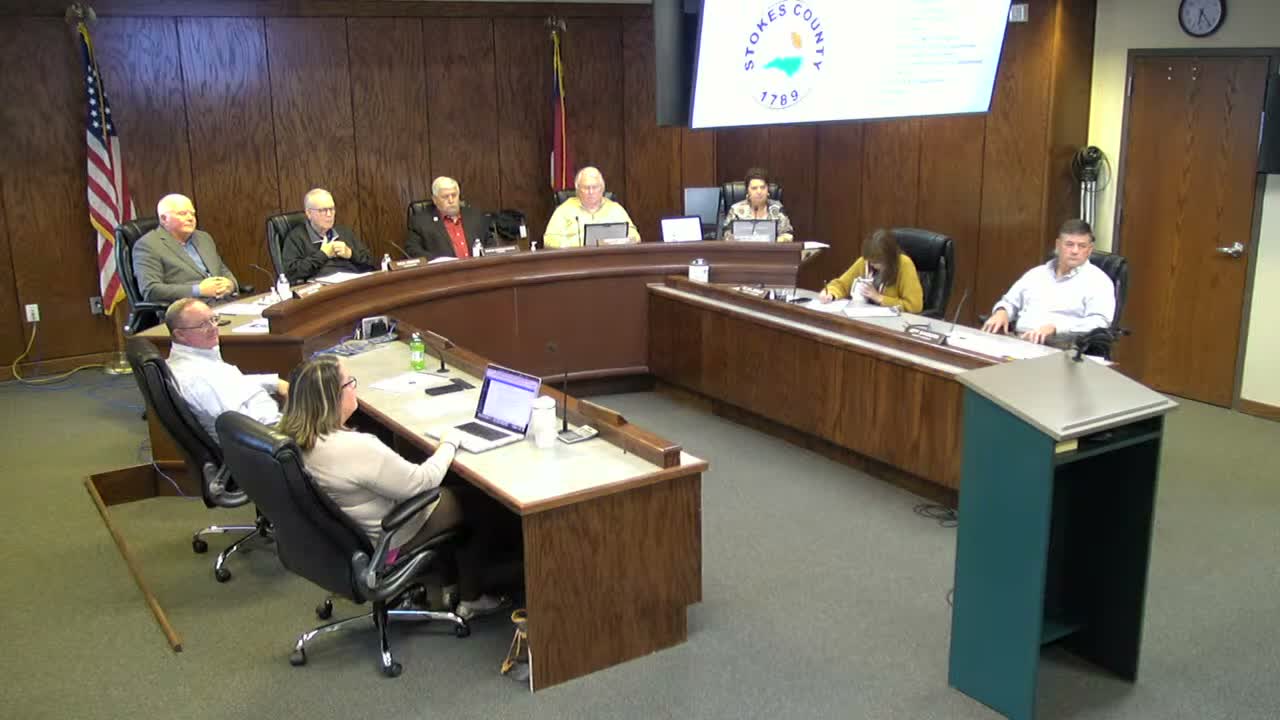
A vendor representing Blue Line Solutions told the Stokes County Board of Commissioners on Tuesday that an automated speed enforcement program could sharply reduce school-zone speeding after an initial public-information and warning period.
Randy Campbell, introduced to the board by local organizer Katie Teter, said preliminary speed studies in Chestnut Grove and Mount Olive school zones captured 9,784 vehicles over five school days and identified 2,520 motorists exceeding the posted limit by 11 miles per hour or more. He said 1,796 drivers were 11'0 over, 665 were 15'0 over and 59 were 21+ over.
"We give you a cornerstone of data so you can see what the problem looks like," Campbell said, describing a five-day capture and a 30-day warning period before any civil citations would be processed.
Why it matters: The North Carolina General Assembly recently authorized local automated speed enforcement in school zones (the vendor referenced a Senate bill that took effect in 2025). The program shifts enforcement toward engineering and education, the presenter said, and the vendor emphasized that its model includes a transparent public-information campaign and a warning period intended to avoid perceptions of revenue-driven enforcement.
How it would work: Campbell described single-beam fixed lidar and camera housings that capture rear-vehicle images only (he said the system does not collect facial imagery) and said the vendor performs regular self-calibrations and provides a court unit for evidentiary packets. He said a network operations center in Chattanooga monitors equipment and that equipment and signage installation would be provided at no up-front cost to the county under the vendor's typical contract.
Legal and operational issues raised: Under the statute the board would need to adopt a local ordinance and stakeholders (the county board, the local board of education and the sheriff's office) commonly negotiate a memorandum of understanding about revenue distribution and operational roles. Campbell said Blue Line typically takes a 30% share of the $250 civil penalty per citation; the remaining balance flows to the jurisdiction according to the local agreement. Campbell also said an approving officer from the sheriff's office signs each citation and appears at the administrative hearing.
Board concerns and next steps: Commissioners pressed for clarity on zone markings and signage (NCDOT is a stakeholder for school-zone design), device calibration and documentation that would be available to defendants, who reviews rebuttal affidavits, and the magistrate/court process and capacity to hear civil appeals. Campbell said the vendor provides training for approving officers and court support, and that enforcement windows would be managed to match local school calendars.
What the board decided: Commissioners did not vote on the program. They asked staff to coordinate with the county manager and county attorney, and to meet the school board and the sheriff to discuss an MOU and the ordinance the statute requires before placing the item on a future discussion agenda.
Randy Campbell, introduced to the board by local organizer Katie Teter, said preliminary speed studies in Chestnut Grove and Mount Olive school zones captured 9,784 vehicles over five school days and identified 2,520 motorists exceeding the posted limit by 11 miles per hour or more. He said 1,796 drivers were 11'0 over, 665 were 15'0 over and 59 were 21+ over.
"We give you a cornerstone of data so you can see what the problem looks like," Campbell said, describing a five-day capture and a 30-day warning period before any civil citations would be processed.
Why it matters: The North Carolina General Assembly recently authorized local automated speed enforcement in school zones (the vendor referenced a Senate bill that took effect in 2025). The program shifts enforcement toward engineering and education, the presenter said, and the vendor emphasized that its model includes a transparent public-information campaign and a warning period intended to avoid perceptions of revenue-driven enforcement.
How it would work: Campbell described single-beam fixed lidar and camera housings that capture rear-vehicle images only (he said the system does not collect facial imagery) and said the vendor performs regular self-calibrations and provides a court unit for evidentiary packets. He said a network operations center in Chattanooga monitors equipment and that equipment and signage installation would be provided at no up-front cost to the county under the vendor's typical contract.
Legal and operational issues raised: Under the statute the board would need to adopt a local ordinance and stakeholders (the county board, the local board of education and the sheriff's office) commonly negotiate a memorandum of understanding about revenue distribution and operational roles. Campbell said Blue Line typically takes a 30% share of the $250 civil penalty per citation; the remaining balance flows to the jurisdiction according to the local agreement. Campbell also said an approving officer from the sheriff's office signs each citation and appears at the administrative hearing.
Board concerns and next steps: Commissioners pressed for clarity on zone markings and signage (NCDOT is a stakeholder for school-zone design), device calibration and documentation that would be available to defendants, who reviews rebuttal affidavits, and the magistrate/court process and capacity to hear civil appeals. Campbell said the vendor provides training for approving officers and court support, and that enforcement windows would be managed to match local school calendars.
What the board decided: Commissioners did not vote on the program. They asked staff to coordinate with the county manager and county attorney, and to meet the school board and the sheriff to discuss an MOU and the ordinance the statute requires before placing the item on a future discussion agenda.
View the Full Meeting & All Its Details
This article offers just a summary. Unlock complete video, transcripts, and insights as a Founder Member.
✓
Watch full, unedited meeting videos
✓
Search every word spoken in unlimited transcripts
✓
AI summaries & real-time alerts (all government levels)
✓
Permanent access to expanding government content
30-day money-back guarantee
