Belgrade staff say MS4 designation likely; council leans toward midlevel stormwater utility plan
May 11, 2026 | Belgrade, Gallatin County, Montana
This article was created by AI summarizing key points discussed. AI makes mistakes, so for full details and context, please refer to the video of the full meeting. Please report any errors so we can fix them. Report an error »
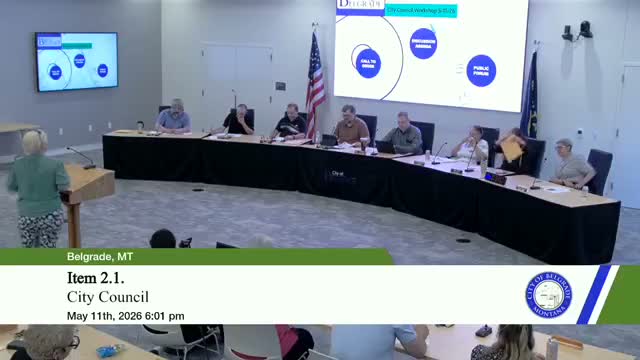
Belgrade public works director Kamri Iulia told the City Council on Wednesday that the city is expected to be designated a municipal separate storm sewer system (MS4) under forthcoming state permit changes and will need a formal program to meet new compliance requirements.
Iulia said Belgrade received informal notification from the Montana Department of Environmental Quality in February 2025 and that DEQ’s rulemaking includes a public hearing May 22; if adopted on schedule the updated general permit language could be published in the administrative rules this fall and the city would then have roughly 180 days to apply for permit coverage. “When we submit that application for general permit coverage, we have to supply them with a document that’s called a notice of intent,” Iulia said, adding that the city should expect an annual permit fee of about $8,000 and a large GIS mapping effort covering infrastructure inside the city and within a one‑mile buffer.
Why it matters: MS4 regulation shifts substantial responsibility to local governments, Iulia said, requiring minimum control measures (public education, illicit discharge detection, construction and post‑construction stormwater controls, pollution prevention and maintenance), routine sampling after qualifying storms and a multi‑year timeline for full implementation. She warned that noncompliance can trigger administrative penalties, higher reporting requirements or third‑party Clean Water Act suits and can complicate development approvals.
Council reaction: Jason Guppy, mayor, thanked staff and said he was “leaning towards at the moment … Scenario 2,” a middle option that funds a modest operations team, a dedicated permitting position and professional services for a rate study and master planning. Several other council members voiced similar support for a phased or midlevel approach while urging stronger public outreach and an equity review of residential versus commercial rates.
Budget and rate options: Iulia presented three scenarios. Scenario 1 (a bare‑minimum operating budget) would fund a small crew and minimal repairs at roughly $1,000,000 a year. Scenario 2 adds a dedicated vac‑jetter, full permitting staff and professional services (rate and impact‑fee studies) with an estimated $1.6 million annual cost. Scenario 3 expands staffing, equipment and capital reserves, arriving near $1.9 million a year. Using a zoning‑based equivalent impact factor, Iulia showed sample monthly bills for a typical single‑family lot of about $8.68 under Scenario 1, $13.81 under Scenario 2 and $16.17 under Scenario 3.
Implementation details and open questions: Among the immediate tasks Iulia listed were the notice of intent, fee payment, and the GIS mapping requirement that covers public and private infrastructure in a one‑mile buffer around the city. She said one unresolved question in DEQ’s rulemaking is how outfalls will be classified as “state waters,” and that the city needs legal clarification on whether it will be required to regulate discharges within the one‑mile buffer or whether enforcement will rest with Gallatin County; staff said an interlocal agreement with the county is likely.
Next steps: Staff recommended drafting stormwater code changes and establishing a utility, with a proposed first reading in June and a public hearing in July (a 30‑day wait would make new rates effective in August, if adopted). The city manager and public works staff said they will refine scenarios (including a possible intermediate “1.5” option), evaluate rate spreads between residential and commercial customers, and return during the budget process with more detailed proposals and public‑engagement plans. The council scheduled further review and closed the workshop with direction to proceed to public hearings and further study.
No formal motion or vote on a utility or rates was taken at the workshop.
Iulia said Belgrade received informal notification from the Montana Department of Environmental Quality in February 2025 and that DEQ’s rulemaking includes a public hearing May 22; if adopted on schedule the updated general permit language could be published in the administrative rules this fall and the city would then have roughly 180 days to apply for permit coverage. “When we submit that application for general permit coverage, we have to supply them with a document that’s called a notice of intent,” Iulia said, adding that the city should expect an annual permit fee of about $8,000 and a large GIS mapping effort covering infrastructure inside the city and within a one‑mile buffer.
Why it matters: MS4 regulation shifts substantial responsibility to local governments, Iulia said, requiring minimum control measures (public education, illicit discharge detection, construction and post‑construction stormwater controls, pollution prevention and maintenance), routine sampling after qualifying storms and a multi‑year timeline for full implementation. She warned that noncompliance can trigger administrative penalties, higher reporting requirements or third‑party Clean Water Act suits and can complicate development approvals.
Council reaction: Jason Guppy, mayor, thanked staff and said he was “leaning towards at the moment … Scenario 2,” a middle option that funds a modest operations team, a dedicated permitting position and professional services for a rate study and master planning. Several other council members voiced similar support for a phased or midlevel approach while urging stronger public outreach and an equity review of residential versus commercial rates.
Budget and rate options: Iulia presented three scenarios. Scenario 1 (a bare‑minimum operating budget) would fund a small crew and minimal repairs at roughly $1,000,000 a year. Scenario 2 adds a dedicated vac‑jetter, full permitting staff and professional services (rate and impact‑fee studies) with an estimated $1.6 million annual cost. Scenario 3 expands staffing, equipment and capital reserves, arriving near $1.9 million a year. Using a zoning‑based equivalent impact factor, Iulia showed sample monthly bills for a typical single‑family lot of about $8.68 under Scenario 1, $13.81 under Scenario 2 and $16.17 under Scenario 3.
Implementation details and open questions: Among the immediate tasks Iulia listed were the notice of intent, fee payment, and the GIS mapping requirement that covers public and private infrastructure in a one‑mile buffer around the city. She said one unresolved question in DEQ’s rulemaking is how outfalls will be classified as “state waters,” and that the city needs legal clarification on whether it will be required to regulate discharges within the one‑mile buffer or whether enforcement will rest with Gallatin County; staff said an interlocal agreement with the county is likely.
Next steps: Staff recommended drafting stormwater code changes and establishing a utility, with a proposed first reading in June and a public hearing in July (a 30‑day wait would make new rates effective in August, if adopted). The city manager and public works staff said they will refine scenarios (including a possible intermediate “1.5” option), evaluate rate spreads between residential and commercial customers, and return during the budget process with more detailed proposals and public‑engagement plans. The council scheduled further review and closed the workshop with direction to proceed to public hearings and further study.
No formal motion or vote on a utility or rates was taken at the workshop.
Don't Miss a Word: See the Full Meeting!
Go beyond summaries. Unlock every video, transcript, and key insight with a Founder Membership.
✓
Get instant access to full meeting videos
✓
Search and clip any phrase from complete transcripts
✓
Receive AI-powered summaries & custom alerts
✓
Enjoy lifetime, unrestricted access to government data
30-day money-back guarantee
