Salinas planning staff lays out Chinatown predevelopment plan; 88‑unit PUD continued to May 20
May 11, 2026 | Salinas, Monterey County, California
This article was created by AI summarizing key points discussed. AI makes mistakes, so for full details and context, please refer to the video of the full meeting. Please report any errors so we can fix them. Report an error »
Salinas planning manager Grant Leonard presented a multi‑site predevelopment update on May 6, detailing designs, financing approaches and next steps to advance affordable housing and cultural preservation in the city’s Chinatown neighborhood.
Leonard told the Planning Commission the city has pursued predevelopment work on multiple properties along Soledad Street after years of private disinvestment. “In 2024, we were successful in securing a $1,500,000 grant to complete predevelopment work for those sites,” Leonard said, describing work to secure entitlements, complete environmental clearances and prepare projects to attract a developer.
The proposal covers several parcels, including 34–40 Soledad, 37–39 Soledad (home to the Republic Cafe) and 45 Soledad. Leonard said one mixed‑use development would include roughly 55 housing units and about 6,000 square feet of ground‑floor commercial space, while a separate senior building would add about 30 units and roughly 2,000 square feet of retail. The projects emphasize historically informed architecture — tiles, clay rooflines, lanterns and a “moon gate” concept — intended to reflect Chinatown’s blended Spanish and Asian design heritage.
The city also intends to stabilize and restore the Republic Cafe (37 Soledad), which Leonard said is listed on the National Register of Historic Places, with the adjacent 39 Soledad found eligible for designation. Leonard described a two‑phase restoration: immediate stabilization, including fire‑suppression and facade work, followed by a full interior remodel to support commercial use and a small cultural museum or community space.
Commissioners pressed staff on several practical concerns. Commissioner Rook asked whether an elevator would be added to the Republic Cafe reconstruction; Leonard said an elevator is not part of the current restoration plan because adding one would be structurally difficult and cost‑prohibitive. Rook also questioned whether the project’s environmental review could be construed as exempt under CEQA and warned it “could be a lawsuit waiting to happen.” Leonard responded that the team is following CEQA standards and is designing to the Secretary of the Interior’s standards for historic renovation.
Funding and sustainability were recurring themes. Leonard said the AMBAG grant covered most predevelopment costs (he estimated roughly 90–95 percent) and that remaining work will rely on a mix of the Chinatown capital improvement program, federal and state housing grants (including possible CDBG, HOME and PLHA funding), local housing trust funds and potential federal earmarks. On the museum’s likely usage, Leonard said no formal facility‑use study has yet been published but noted substantial stakeholder outreach and that market documentation can be shared on request.
Commissioners and staff discussed homelessness and displacement risks as construction proceeds. Leonard and a city agency official described parallel efforts — a new shelter (the Share Center opened in partnership with Monterey County), permanent supportive housing at Fairview opening this month, efforts to retain a Homekey site and the potential renovation of the El Rey Motel to provide a low‑barrier navigation center — intended to give people alternatives to congregating in a single neighborhood.
Public comment included a request from Daniel Alvarez, representing carpenters in Santa Cruz and Monterey counties, to prioritize “responsible contractors” so local workers can be hired rather than commuting to the Bay Area.
Leonard said the city will finish entitlements and building permits for initial stabilization this quarter, issue a request for proposals for developers this summer, and procure contractors for immediate stabilization work on 37–39 Soledad. The Planning Commission opened a related public‑hearing item — a plan unit development and conditional use permit for an 88‑unit affordable multifamily building with a 4,335‑square‑foot daycare at 200 Casentini Street — but continued that item to the May 20 Planning Commission meeting for further consideration.
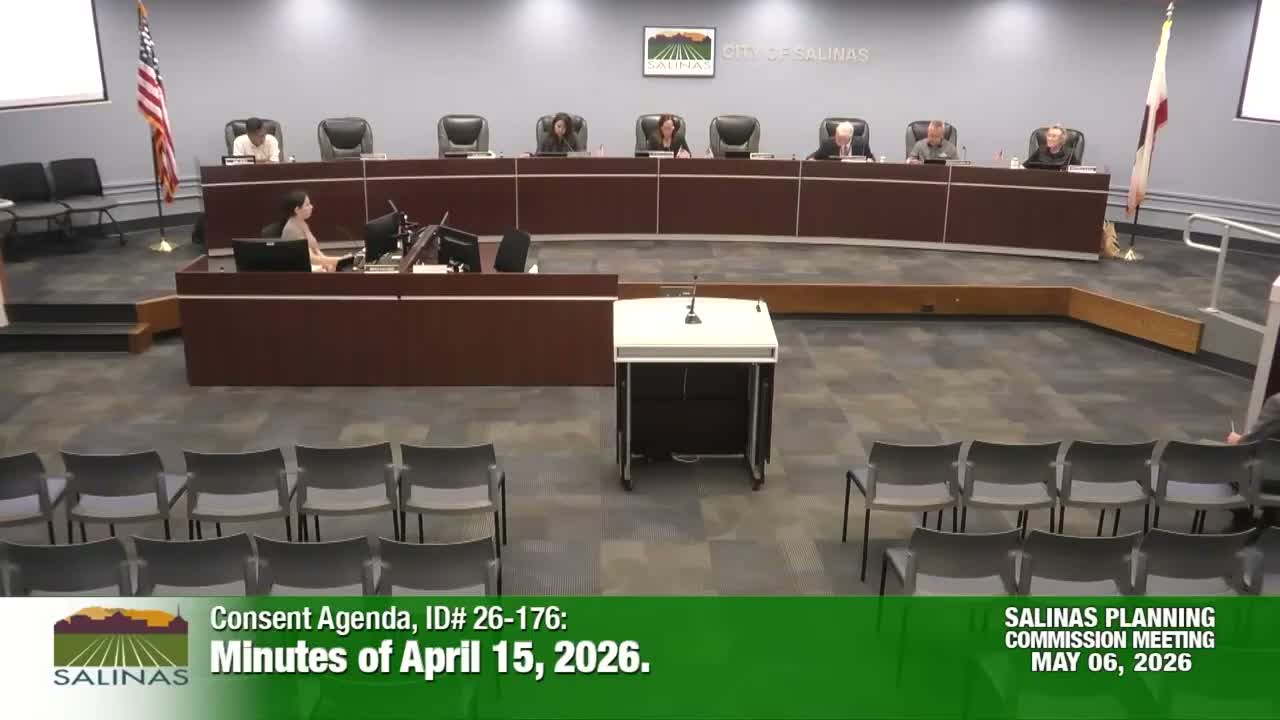
In less formal business, the commission approved the minutes from the April 15 meeting (Consent ID 26‑176) after a motion by Commissioner Purnell and a second from Commissioner Mora. The meeting concluded with commissioners paying tribute to the late Commissioner Meeks and holding a moment of silence in his honor.
Next steps: staff will finalize entitlements and building permits for the Chinatown projects, publish the market/ outreach materials upon request, issue a developer RFP over the summer and return the continued 200 Casentini public‑hearing item to the commission on May 20.
Leonard told the Planning Commission the city has pursued predevelopment work on multiple properties along Soledad Street after years of private disinvestment. “In 2024, we were successful in securing a $1,500,000 grant to complete predevelopment work for those sites,” Leonard said, describing work to secure entitlements, complete environmental clearances and prepare projects to attract a developer.
The proposal covers several parcels, including 34–40 Soledad, 37–39 Soledad (home to the Republic Cafe) and 45 Soledad. Leonard said one mixed‑use development would include roughly 55 housing units and about 6,000 square feet of ground‑floor commercial space, while a separate senior building would add about 30 units and roughly 2,000 square feet of retail. The projects emphasize historically informed architecture — tiles, clay rooflines, lanterns and a “moon gate” concept — intended to reflect Chinatown’s blended Spanish and Asian design heritage.
The city also intends to stabilize and restore the Republic Cafe (37 Soledad), which Leonard said is listed on the National Register of Historic Places, with the adjacent 39 Soledad found eligible for designation. Leonard described a two‑phase restoration: immediate stabilization, including fire‑suppression and facade work, followed by a full interior remodel to support commercial use and a small cultural museum or community space.
Commissioners pressed staff on several practical concerns. Commissioner Rook asked whether an elevator would be added to the Republic Cafe reconstruction; Leonard said an elevator is not part of the current restoration plan because adding one would be structurally difficult and cost‑prohibitive. Rook also questioned whether the project’s environmental review could be construed as exempt under CEQA and warned it “could be a lawsuit waiting to happen.” Leonard responded that the team is following CEQA standards and is designing to the Secretary of the Interior’s standards for historic renovation.
Funding and sustainability were recurring themes. Leonard said the AMBAG grant covered most predevelopment costs (he estimated roughly 90–95 percent) and that remaining work will rely on a mix of the Chinatown capital improvement program, federal and state housing grants (including possible CDBG, HOME and PLHA funding), local housing trust funds and potential federal earmarks. On the museum’s likely usage, Leonard said no formal facility‑use study has yet been published but noted substantial stakeholder outreach and that market documentation can be shared on request.
Commissioners and staff discussed homelessness and displacement risks as construction proceeds. Leonard and a city agency official described parallel efforts — a new shelter (the Share Center opened in partnership with Monterey County), permanent supportive housing at Fairview opening this month, efforts to retain a Homekey site and the potential renovation of the El Rey Motel to provide a low‑barrier navigation center — intended to give people alternatives to congregating in a single neighborhood.
Public comment included a request from Daniel Alvarez, representing carpenters in Santa Cruz and Monterey counties, to prioritize “responsible contractors” so local workers can be hired rather than commuting to the Bay Area.
Leonard said the city will finish entitlements and building permits for initial stabilization this quarter, issue a request for proposals for developers this summer, and procure contractors for immediate stabilization work on 37–39 Soledad. The Planning Commission opened a related public‑hearing item — a plan unit development and conditional use permit for an 88‑unit affordable multifamily building with a 4,335‑square‑foot daycare at 200 Casentini Street — but continued that item to the May 20 Planning Commission meeting for further consideration.
In less formal business, the commission approved the minutes from the April 15 meeting (Consent ID 26‑176) after a motion by Commissioner Purnell and a second from Commissioner Mora. The meeting concluded with commissioners paying tribute to the late Commissioner Meeks and holding a moment of silence in his honor.
Next steps: staff will finalize entitlements and building permits for the Chinatown projects, publish the market/ outreach materials upon request, issue a developer RFP over the summer and return the continued 200 Casentini public‑hearing item to the commission on May 20.
View the Full Meeting & All Its Details
This article offers just a summary. Unlock complete video, transcripts, and insights as a Founder Member.
✓
Watch full, unedited meeting videos
✓
Search every word spoken in unlimited transcripts
✓
AI summaries & real-time alerts (all government levels)
✓
Permanent access to expanding government content
30-day money-back guarantee
