Guam education leaders seek $307 million for FY2027 as senators press on staffing, maintenance and procurement
May 11, 2026 | General Government Operations and Appropriations , Legislative, Guam, International
This article was created by AI summarizing key points discussed. AI makes mistakes, so for full details and context, please refer to the video of the full meeting. Please report any errors so we can fix them. Report an error »
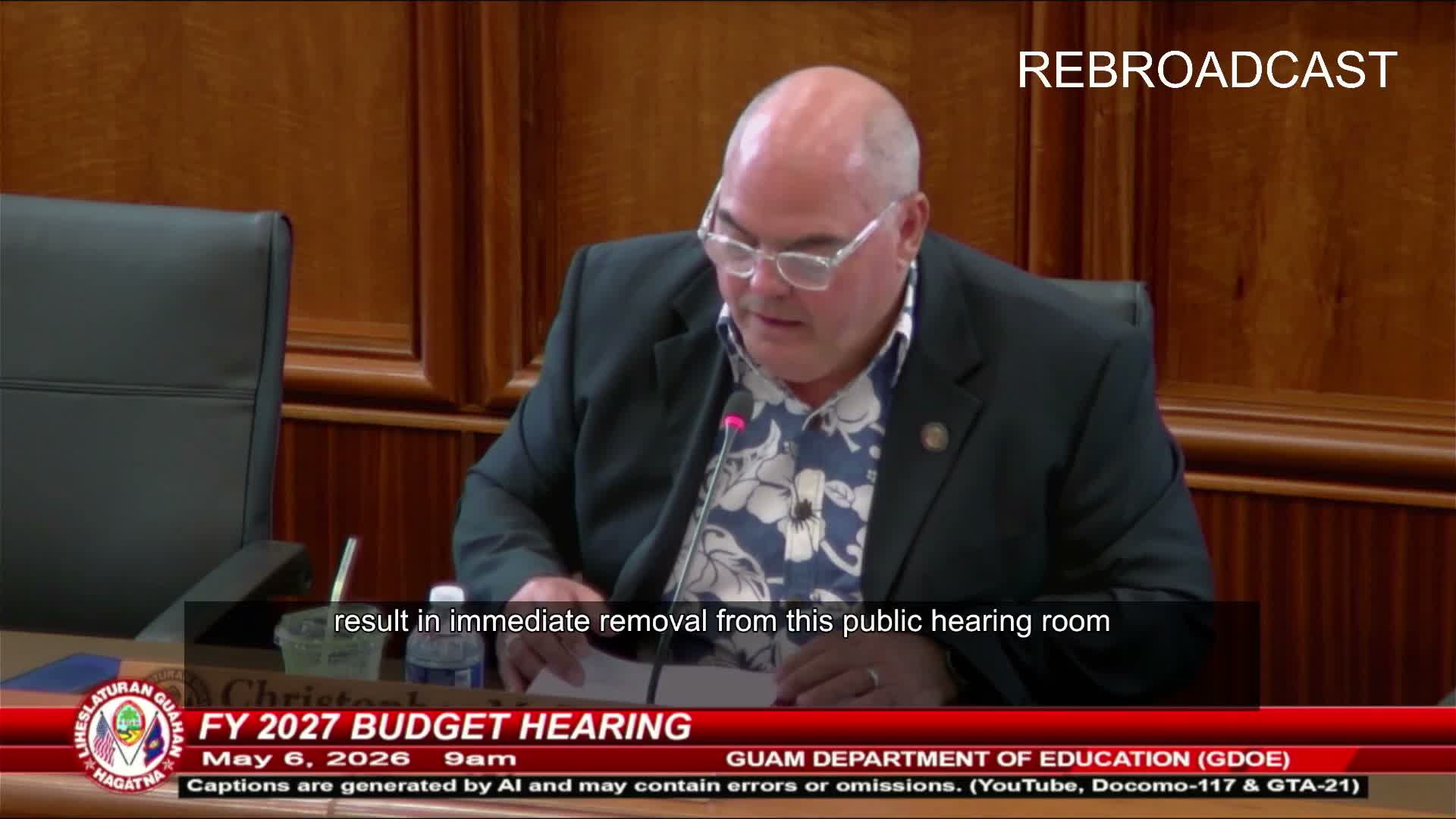
The Guam Department of Education asked the Guam LegislatureCommittee on Finance and Government Operations on May 6 for a $307,000,000 operating budget for fiscal year 2027, with officials saying personnel costs account for about 86.5% of the request and citing $23.5 million in unfunded facilities and security needs.
GDOE Superintendent Gwenison Halfadeh told the committee GDOE operates 39 schools serving roughly 23,121 students and employs about 3,245 personnel. The FY2027 request, she said, reflects mandated staffing and recent pay plans: "personnel is the largest...that's about 86.5% of our budget," she said. The department identified unfunded costs of $12,000,000 for ADA compliance, $10,000,000 for deferred maintenance and $1,500,000 for security improvements.
Why it matters: senators pressed the department on a constellation of fiscal and operational questions that affect whether the higher request is justified. Committee members pointed to a roughly 26% decline in enrollment since the system's peak and asked how GDOE will reconcile higher per‑student costs and a proposed increase of hundreds of full‑time equivalents with ongoing problems executing appropriations and federal grants.
Senator Vince Borja, the panel's education oversight member, noted the budget digest flagged that GDOE had not provided program‑by‑program appropriation breakdowns; the superintendent said the department will supply a detailed object‑category and program breakdown for the record. Borja also cited the department's Q1 fiscal execution report showing low execution (about 20%) and a footnoted lapse figure; GDOE officials said they would clarify the variance with staff and look into the apparent discrepancy.
Procurement and unfinished contracts drew repeated scrutiny. Committee members asked why invoices for a 12‑school refurbishment totaling an estimated $20 million to $30 million are on hold; GDOE officials said those payments are paused because procurement procedures were not followed during the prior procurement and legal review is required. "The invoices are out there...the implications are that if you don't pay us tomorrow, we will start charging interest and late fees," an agency official said, adding the department is holding payments while legal questions are resolved.
Federal funds and ARP timing: GDOE told the committee it has about $83 million in federal grants across multiyear awards but warned that ARP-era deadlines caused about $3 million in returned ARP funds and roughly $20 million of prior invoices that now require local funds because ARP availability expired. The department said it is prioritizing obligating multiyear grant dollars and training procurement staff to clear a queue of outstanding requisitions.
Staffing and vacancies: senators pressed the superintendent on teacher vacancies. GDOE officials reported about 116 vacancies across elementary, middle and high schools but said many of those positions are being covered by limited‑term or substitute teachers; the FY2027 request lists 13 teacher vacancies in the formal schedule because several roles are already filled with noncertified staff. The budget seeks roughly 442 additional FTEs in FY2027, including 334 CBA positions for schools and about 30 central positions for auditors, carpenters and maintenance staff.
On school reconfiguration and lease revenue: to respond to underused facilities, the superintendent said the department is pursuing cross‑leveling master schedules, decommissioning underutilized buildings in phases and seeking legislative changes to ease leasing (appraisal) requirements so DOE can lease vacant properties at prevailing rates to generate revenue. GDOE and the board pointed to savings from demolishing condemned classrooms in‑house as an example of internal cost reductions if facilities staff are properly equipped.
School safety funds and special education: Senators asked why roughly $1,042,577 of a $1,500,000 School Resource Officer appropriation remained unspent; GDOE said SRO positions remain in place but would investigate the unspent balance. The department also described federal consolidated grant programs that fund dropout‑prevention and testing programs; GDOE said those federal programs — not local appropriations — finance screening tools and social workers for reengagement.
Next steps: senators instructed the department to provide more granular program and object‑category breakdowns, to clarify execution and unobligated balances, and to report back on procurement holds and the SRO appropriation. The committee adjourned after hearing testimony and indicated further deliberations on appropriations and possible statutory changes will continue as the Legislature prepares FY2027 floor action.
The hearing included detailed exchanges over specific fiscal execution numbers, contract protests and multiyear federal grants; the department emphasized it will supply requested documents and work with the committee to resolve outstanding procurement and execution issues.
GDOE Superintendent Gwenison Halfadeh told the committee GDOE operates 39 schools serving roughly 23,121 students and employs about 3,245 personnel. The FY2027 request, she said, reflects mandated staffing and recent pay plans: "personnel is the largest...that's about 86.5% of our budget," she said. The department identified unfunded costs of $12,000,000 for ADA compliance, $10,000,000 for deferred maintenance and $1,500,000 for security improvements.
Why it matters: senators pressed the department on a constellation of fiscal and operational questions that affect whether the higher request is justified. Committee members pointed to a roughly 26% decline in enrollment since the system's peak and asked how GDOE will reconcile higher per‑student costs and a proposed increase of hundreds of full‑time equivalents with ongoing problems executing appropriations and federal grants.
Senator Vince Borja, the panel's education oversight member, noted the budget digest flagged that GDOE had not provided program‑by‑program appropriation breakdowns; the superintendent said the department will supply a detailed object‑category and program breakdown for the record. Borja also cited the department's Q1 fiscal execution report showing low execution (about 20%) and a footnoted lapse figure; GDOE officials said they would clarify the variance with staff and look into the apparent discrepancy.
Procurement and unfinished contracts drew repeated scrutiny. Committee members asked why invoices for a 12‑school refurbishment totaling an estimated $20 million to $30 million are on hold; GDOE officials said those payments are paused because procurement procedures were not followed during the prior procurement and legal review is required. "The invoices are out there...the implications are that if you don't pay us tomorrow, we will start charging interest and late fees," an agency official said, adding the department is holding payments while legal questions are resolved.
Federal funds and ARP timing: GDOE told the committee it has about $83 million in federal grants across multiyear awards but warned that ARP-era deadlines caused about $3 million in returned ARP funds and roughly $20 million of prior invoices that now require local funds because ARP availability expired. The department said it is prioritizing obligating multiyear grant dollars and training procurement staff to clear a queue of outstanding requisitions.
Staffing and vacancies: senators pressed the superintendent on teacher vacancies. GDOE officials reported about 116 vacancies across elementary, middle and high schools but said many of those positions are being covered by limited‑term or substitute teachers; the FY2027 request lists 13 teacher vacancies in the formal schedule because several roles are already filled with noncertified staff. The budget seeks roughly 442 additional FTEs in FY2027, including 334 CBA positions for schools and about 30 central positions for auditors, carpenters and maintenance staff.
On school reconfiguration and lease revenue: to respond to underused facilities, the superintendent said the department is pursuing cross‑leveling master schedules, decommissioning underutilized buildings in phases and seeking legislative changes to ease leasing (appraisal) requirements so DOE can lease vacant properties at prevailing rates to generate revenue. GDOE and the board pointed to savings from demolishing condemned classrooms in‑house as an example of internal cost reductions if facilities staff are properly equipped.
School safety funds and special education: Senators asked why roughly $1,042,577 of a $1,500,000 School Resource Officer appropriation remained unspent; GDOE said SRO positions remain in place but would investigate the unspent balance. The department also described federal consolidated grant programs that fund dropout‑prevention and testing programs; GDOE said those federal programs — not local appropriations — finance screening tools and social workers for reengagement.
Next steps: senators instructed the department to provide more granular program and object‑category breakdowns, to clarify execution and unobligated balances, and to report back on procurement holds and the SRO appropriation. The committee adjourned after hearing testimony and indicated further deliberations on appropriations and possible statutory changes will continue as the Legislature prepares FY2027 floor action.
The hearing included detailed exchanges over specific fiscal execution numbers, contract protests and multiyear federal grants; the department emphasized it will supply requested documents and work with the committee to resolve outstanding procurement and execution issues.
Don't Miss a Word: See the Full Meeting!
Go beyond summaries. Unlock every video, transcript, and key insight with a Founder Membership.
✓
Get instant access to full meeting videos
✓
Search and clip any phrase from complete transcripts
✓
Receive AI-powered summaries & custom alerts
✓
Enjoy lifetime, unrestricted access to government data
30-day money-back guarantee
