Officials propose tighter rules, P5 limits and project bundling to speed Louisiana capital outlay
May 11, 2026 | 2026 Legislature LA, Louisiana
This article was created by AI summarizing key points discussed. AI makes mistakes, so for full details and context, please refer to the video of the full meeting. Please report any errors so we can fix them. Report an error »
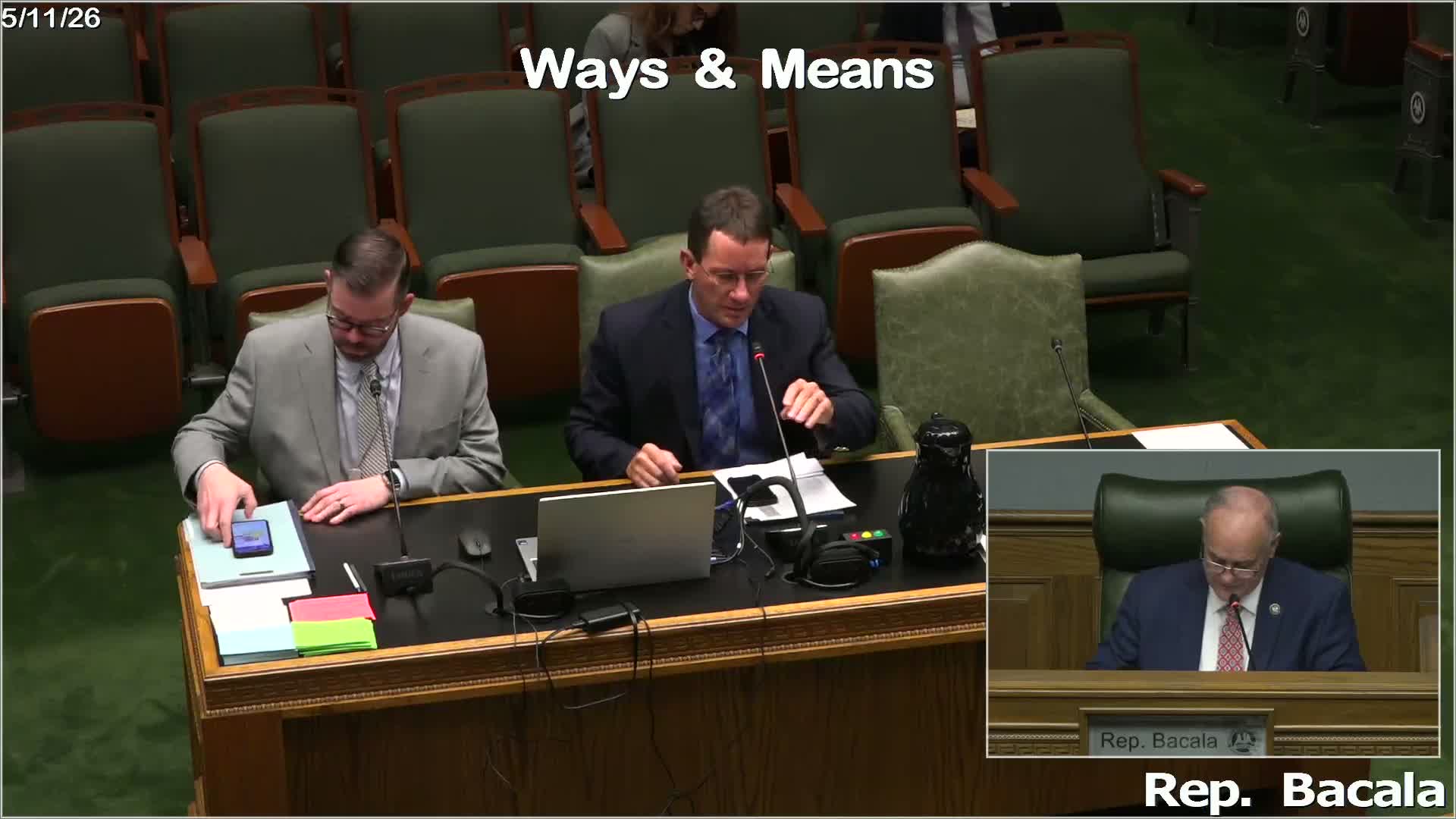
Roger Husser, assistant commissioner in the Division of Administration, told the House Ways and Means Committee on May 11 that the state has made “considerable progress” on capital outlay but still needs policy changes to move more projects from paper to construction. "It's more than doubled in 5 years," Husser said of FP&C's output, arguing that recent culture and process changes have raised delivery rates. Husser said the state has used staff augmentation and tighter cash‑flow management to speed projects and recommended additional steps to reduce delays.
Husser and Matt Baker, director of the Office of Facility Planning and Control, said the statutory cap on the priority‑1 cash line of credit — adjusted yearly for construction inflation — constrains how much work can proceed in a single fiscal year. "That number this year is $574,000,000," Husser said. He warned that the bill’s priority‑5 backlog now implies multi‑decade waits for some non‑state projects: "if we never added another non‑state project to the bill, it would take 19 years to move all of those P5 up to P1." Husser called that a false expectation for municipalities that assume a project in the bill means near‑term funding.
To address the problem, FP&C recommended a set of operational and statutory changes. Recommendations discussed with the committee included: continued purging of dormant non‑state projects; limiting scope creep and the number of new projects; time limits or reporting and performance obligations for non‑state grants; a requirement that member sponsors re‑endorse projects that have lingered in P5 for many years; consider caps on total non‑state project value per legislative district; and establishing a maximum size for non‑state projects so very large single projects do not block funding for many smaller needs.
FP&C also urged wider use of P5 commitments and project bundling. Under the commitment process, the commissioner of administration may approve a noncash P5 commitment that allows agencies to award contracts while the rest of the project’s funding remains in later years of HB2. Baker described criteria for commitments: projects must be shovel‑ready, have sufficient short‑term funding to pay invoices until the next bond cycle and meet other readiness tests. Husser said bundling — grouping multiple related line items (for example, several campus projects or DOTD multimodal projects) into one line item — is being piloted and can give agencies flexibility to move money among items that are part of the same bundle.
Several legislators pressed for concrete guardrails. Representative Wilder and others asked how to ensure members who act prudently are not disadvantaged compared with members who add many projects that never move. Husser said the division would supply more data on historical performance and that some practices can be implemented administratively, while others would require legislation.
Husser closed by urging improved transparency for HB2: show each project’s total historical funding, and record the year a project first appeared in the bill so members and local officials may better judge age and viability. The committee asked agencies to return with fiscal and staffing details to help turn recommendations into precise legislative proposals. The hearing then continued with separate agency presentations on LED, DOTD and CPRA work.
Husser and Matt Baker, director of the Office of Facility Planning and Control, said the statutory cap on the priority‑1 cash line of credit — adjusted yearly for construction inflation — constrains how much work can proceed in a single fiscal year. "That number this year is $574,000,000," Husser said. He warned that the bill’s priority‑5 backlog now implies multi‑decade waits for some non‑state projects: "if we never added another non‑state project to the bill, it would take 19 years to move all of those P5 up to P1." Husser called that a false expectation for municipalities that assume a project in the bill means near‑term funding.
To address the problem, FP&C recommended a set of operational and statutory changes. Recommendations discussed with the committee included: continued purging of dormant non‑state projects; limiting scope creep and the number of new projects; time limits or reporting and performance obligations for non‑state grants; a requirement that member sponsors re‑endorse projects that have lingered in P5 for many years; consider caps on total non‑state project value per legislative district; and establishing a maximum size for non‑state projects so very large single projects do not block funding for many smaller needs.
FP&C also urged wider use of P5 commitments and project bundling. Under the commitment process, the commissioner of administration may approve a noncash P5 commitment that allows agencies to award contracts while the rest of the project’s funding remains in later years of HB2. Baker described criteria for commitments: projects must be shovel‑ready, have sufficient short‑term funding to pay invoices until the next bond cycle and meet other readiness tests. Husser said bundling — grouping multiple related line items (for example, several campus projects or DOTD multimodal projects) into one line item — is being piloted and can give agencies flexibility to move money among items that are part of the same bundle.
Several legislators pressed for concrete guardrails. Representative Wilder and others asked how to ensure members who act prudently are not disadvantaged compared with members who add many projects that never move. Husser said the division would supply more data on historical performance and that some practices can be implemented administratively, while others would require legislation.
Husser closed by urging improved transparency for HB2: show each project’s total historical funding, and record the year a project first appeared in the bill so members and local officials may better judge age and viability. The committee asked agencies to return with fiscal and staffing details to help turn recommendations into precise legislative proposals. The hearing then continued with separate agency presentations on LED, DOTD and CPRA work.
View the Full Meeting & All Its Details
This article offers just a summary. Unlock complete video, transcripts, and insights as a Founder Member.
✓
Watch full, unedited meeting videos
✓
Search every word spoken in unlimited transcripts
✓
AI summaries & real-time alerts (all government levels)
✓
Permanent access to expanding government content
30-day money-back guarantee
