Louisiana House concedes to Senate amendments on HB 102 after heated debate over firearms, capital charges and costs
May 11, 2026 | 2026 Legislature LA, Louisiana
This article was created by AI summarizing key points discussed. AI makes mistakes, so for full details and context, please refer to the video of the full meeting. Please report any errors so we can fix them. Report an error »
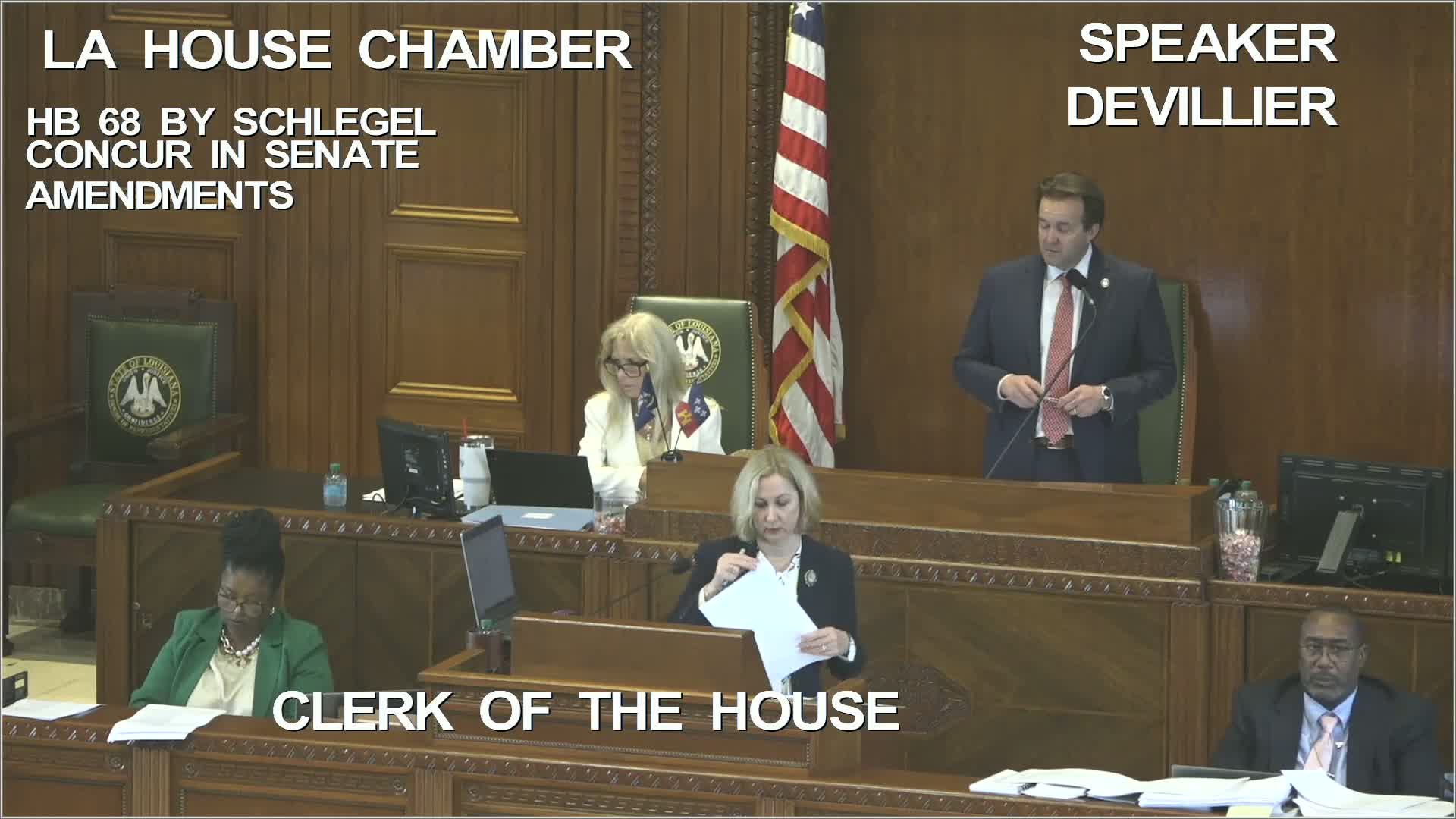
The Louisiana House on Thursday agreed to Senate amendments to House Bill 102, a criminal-code measure that supporters said strengthens protections for vulnerable groups and critics said could dramatically widen the scope of capital-related offenses and raise costs for the justice system.
Rep. Brett Wiley, who carried the legislation on the floor, told colleagues the package “began as protection for the most vulnerable” and that the amendments were intended to address “examples like the mall shooting” and other incidents in which multiple people were put at risk. Wiley said the changes make penalties stronger for offenders who use firearms to create mass risk, and he urged members to support the changes as a public-safety measure.
Opponents pressed for specifics about how the amendments would operate in practice. Rep. Kyle Green raised procedural and fiscal concerns and asked whether fiscal notes had been prepared; Green said he knew of none. “Has there been, to your knowledge, any fiscal note that's been produced on these facts?” he asked. Wiley replied he knew of none and said it would be difficult to project the impact.
Several members warned the amended language could sweep in people not intended to be capital defendants. Rep. Marcel questioned whether attempted acts that injure no one could be treated as first-degree murder under the amendment’s text. “If you point a gun and you do not hit anybody, what are you going to be charged with under this bill?” Marcel asked. Wiley responded that the amendments require a death for first-degree murder to occur, and he said prosecutors and grand juries would weigh facts and intent.
Other members flagged a potential spike in demand for capital-defense counsel and court resources. Rep. Mandy Landry said the changes could increase capital indictments tenfold in Orleans Parish alone and “the cost is huge,” arguing the public-defender system should have been consulted and the bill recommitted to appropriations. Wiley and other supporters said the amendments came through the Senate with significant bipartisan support.
After roughly an hour-and-a-half of additional questions and back-and-forth, the House concurred in the Senate amendments by voice and machine vote; the clerk recorded 79 yays and 12 nays. Members then moved the bill forward under regular legislative procedure.
Why it matters: Lawmakers debating the bill framed it as a balance between stronger penalties for attackers who create mass risk and safeguards for due process. Critics pressed for fiscal analysis and tighter drafting to limit unintended consequences for juveniles and those legitimately claiming self-defense. The matter remains politically salient because it ties criminal-justice reform and gun-policy rhetoric to real-world budget and legal-system implications.
Next steps: With concurrence recorded, HB 102 will proceed per House rules (conferenced or enrolled as appropriate). Implementation questions — including any requested fiscal notes or court-system impacts — were left to future committee or appropriations oversight.
Rep. Brett Wiley, who carried the legislation on the floor, told colleagues the package “began as protection for the most vulnerable” and that the amendments were intended to address “examples like the mall shooting” and other incidents in which multiple people were put at risk. Wiley said the changes make penalties stronger for offenders who use firearms to create mass risk, and he urged members to support the changes as a public-safety measure.
Opponents pressed for specifics about how the amendments would operate in practice. Rep. Kyle Green raised procedural and fiscal concerns and asked whether fiscal notes had been prepared; Green said he knew of none. “Has there been, to your knowledge, any fiscal note that's been produced on these facts?” he asked. Wiley replied he knew of none and said it would be difficult to project the impact.
Several members warned the amended language could sweep in people not intended to be capital defendants. Rep. Marcel questioned whether attempted acts that injure no one could be treated as first-degree murder under the amendment’s text. “If you point a gun and you do not hit anybody, what are you going to be charged with under this bill?” Marcel asked. Wiley responded that the amendments require a death for first-degree murder to occur, and he said prosecutors and grand juries would weigh facts and intent.
Other members flagged a potential spike in demand for capital-defense counsel and court resources. Rep. Mandy Landry said the changes could increase capital indictments tenfold in Orleans Parish alone and “the cost is huge,” arguing the public-defender system should have been consulted and the bill recommitted to appropriations. Wiley and other supporters said the amendments came through the Senate with significant bipartisan support.
After roughly an hour-and-a-half of additional questions and back-and-forth, the House concurred in the Senate amendments by voice and machine vote; the clerk recorded 79 yays and 12 nays. Members then moved the bill forward under regular legislative procedure.
Why it matters: Lawmakers debating the bill framed it as a balance between stronger penalties for attackers who create mass risk and safeguards for due process. Critics pressed for fiscal analysis and tighter drafting to limit unintended consequences for juveniles and those legitimately claiming self-defense. The matter remains politically salient because it ties criminal-justice reform and gun-policy rhetoric to real-world budget and legal-system implications.
Next steps: With concurrence recorded, HB 102 will proceed per House rules (conferenced or enrolled as appropriate). Implementation questions — including any requested fiscal notes or court-system impacts — were left to future committee or appropriations oversight.
Don't Miss a Word: See the Full Meeting!
Go beyond summaries. Unlock every video, transcript, and key insight with a Founder Membership.
✓
Get instant access to full meeting videos
✓
Search and clip any phrase from complete transcripts
✓
Receive AI-powered summaries & custom alerts
✓
Enjoy lifetime, unrestricted access to government data
30-day money-back guarantee
