West Chicago mayor pitches futsal courts; council asks staff for parking, maintenance study
May 11, 2026 | West Chicago, DuPage County, Illinois
This article was created by AI summarizing key points discussed. AI makes mistakes, so for full details and context, please refer to the video of the full meeting. Please report any errors so we can fix them. Report an error »
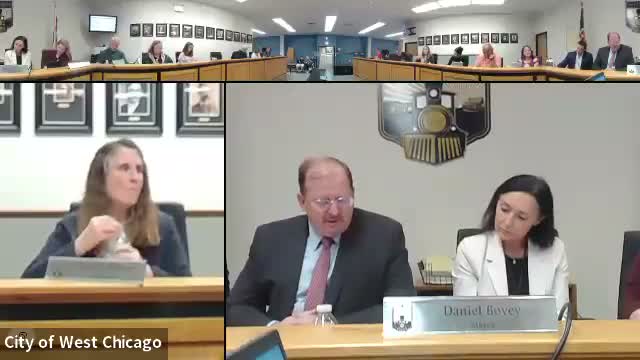
Mayor Daniel Bovee presented a conceptual plan for the southwest portion of 157 West Washington Street on May 4, proposing two futsal courts, pickleball courts, a small plaza and micro‑shops as an early step in a larger downtown revitalization effort. He emphasized the proposal was for discussion and that no formal land‑use decision would be made that night.
Bovee said two private sponsors — Street Soccer USA and Missionary Athletes International (MAI) — had each committed $150,000 toward an estimated $450,000 cost. "Street Soccer USA has committed to providing a $150,000, a third of the cost," he said, and staff identified $50,000 in existing funds; Bovee proposed the local soccer community raise the remaining $100,000.
The mayor framed the project as a modest, catalytic step: a compact, publicly accessible facility intended to bring foot traffic to nearby shops and begin the incremental activation of a larger 15‑acre redevelopment area. "This puts us in motion," he said, arguing futsal courts would be used for both community programming and club training and would complement — not replace — larger soccer‑field needs being pursued at a planned community park.
Council members pressed staff on operational and site questions. "One of the big concerns I have is gonna be the parking situation; in our downtown area, parking is already an issue," said an alderman at the meeting, urging that the city quantify on‑site and nearby parking capacity before committing to a location. Other members raised maintenance, scheduling and security: who would maintain the artificial turf; who would schedule and supervise programming; and whether permanent restrooms were feasible. The mayor and staff said the immediate restroom plan would likely rely on porta‑potties and that a longer‑term market building — part of a $3.2 million grant application mentioned by the mayor — could include restrooms if funded.
Several aldermen suggested exploring alternate placements for the courts, closer to existing parking or in corners of the site that would better integrate with future development. Others cautioned that the proposal was not a panacea for broader downtown development goals but could provide momentum if sited and managed well.
Council members asked staff to return with specific feasibility analyses: parking counts and possible new parking configurations; estimated operations and maintenance costs for artificial turf and lighting; options for restroom and water access; governance and scheduling approaches; and potential revenue models, including sponsorship and modest rental fees. The mayor also proposed structured community outreach, either a public hearing or a dedicated forum, after staff compiles options.
The council did not vote on the land‑use concept. Staff was directed to gather the requested data and return with options and cost estimates that would allow the council to consider next steps and, if desired, a public engagement plan.
Bovee said two private sponsors — Street Soccer USA and Missionary Athletes International (MAI) — had each committed $150,000 toward an estimated $450,000 cost. "Street Soccer USA has committed to providing a $150,000, a third of the cost," he said, and staff identified $50,000 in existing funds; Bovee proposed the local soccer community raise the remaining $100,000.
The mayor framed the project as a modest, catalytic step: a compact, publicly accessible facility intended to bring foot traffic to nearby shops and begin the incremental activation of a larger 15‑acre redevelopment area. "This puts us in motion," he said, arguing futsal courts would be used for both community programming and club training and would complement — not replace — larger soccer‑field needs being pursued at a planned community park.
Council members pressed staff on operational and site questions. "One of the big concerns I have is gonna be the parking situation; in our downtown area, parking is already an issue," said an alderman at the meeting, urging that the city quantify on‑site and nearby parking capacity before committing to a location. Other members raised maintenance, scheduling and security: who would maintain the artificial turf; who would schedule and supervise programming; and whether permanent restrooms were feasible. The mayor and staff said the immediate restroom plan would likely rely on porta‑potties and that a longer‑term market building — part of a $3.2 million grant application mentioned by the mayor — could include restrooms if funded.
Several aldermen suggested exploring alternate placements for the courts, closer to existing parking or in corners of the site that would better integrate with future development. Others cautioned that the proposal was not a panacea for broader downtown development goals but could provide momentum if sited and managed well.
Council members asked staff to return with specific feasibility analyses: parking counts and possible new parking configurations; estimated operations and maintenance costs for artificial turf and lighting; options for restroom and water access; governance and scheduling approaches; and potential revenue models, including sponsorship and modest rental fees. The mayor also proposed structured community outreach, either a public hearing or a dedicated forum, after staff compiles options.
The council did not vote on the land‑use concept. Staff was directed to gather the requested data and return with options and cost estimates that would allow the council to consider next steps and, if desired, a public engagement plan.
View the Full Meeting & All Its Details
This article offers just a summary. Unlock complete video, transcripts, and insights as a Founder Member.
✓
Watch full, unedited meeting videos
✓
Search every word spoken in unlimited transcripts
✓
AI summaries & real-time alerts (all government levels)
✓
Permanent access to expanding government content
30-day money-back guarantee
