Will County panel warns of tick and mosquito season; Powassan surveillance cited as reason for expanded testing
May 11, 2026 | Will County, Illinois
This article was created by AI summarizing key points discussed. AI makes mistakes, so for full details and context, please refer to the video of the full meeting. Please report any errors so we can fix them. Report an error »
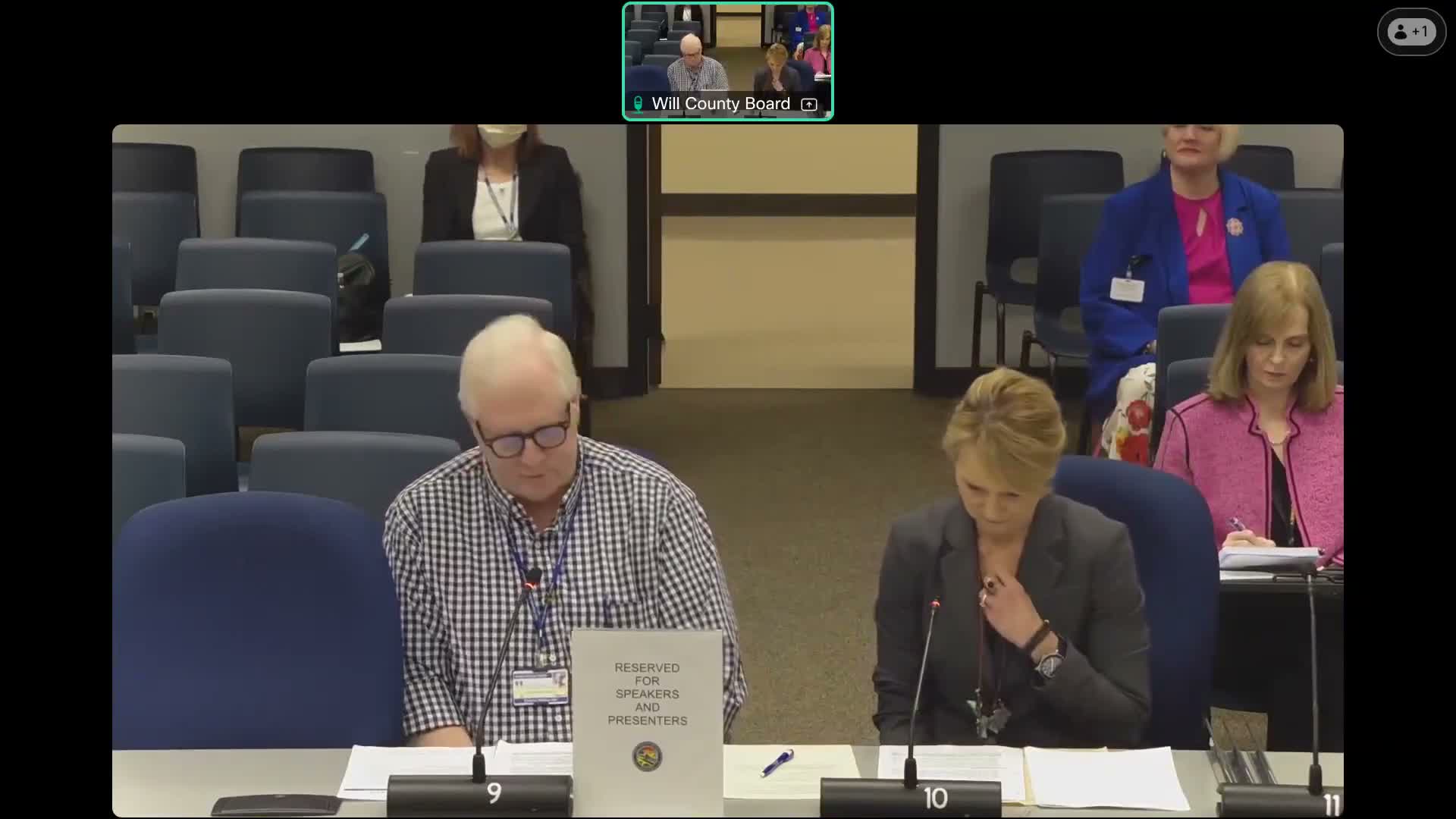
Sean Connors, introduced by the department for the committee’s update, told members that Will County is entering West Nile and tick season and that the department has run a larvicide seminar for participating municipalities.
"Through our grant program, we purchased larvicide, and we distribute it to the municipalities that are interested in it," Connors said, explaining that trained municipal staff hold certificates allowing them to apply larvicide in stagnant water and catch basins.
Connors described the county’s tick surveillance program: crews perform six tick drags a year timed to seasonality, collect specimens on white cloth, place ticks into vials with ethanol and send samples to state labs and to the CDC lab network for species and pathogen testing. He said Powassan virus was first detected in Illinois last year (in northern counties), and that state grant programs and the new tick‑tracking portal have helped speed detection.
The department also reported that emergency‑room visits for tick‑related incidents have already doubled this year compared with last, increasing clinician awareness and prompting an alert from the Illinois Department of Public Health that county staff said is shared with local physicians.
In question‑and‑answer exchanges, officials clarified testing and reporting limits: a single disposed tick cannot be tested unless it was collected and submitted under program rules; the department cannot test arbitrary specimens outside the grant’s scope; and hospitals report lab‑identified pathogens to local health departments per existing surveillance rules. Staff said they will email committee members a link to the IDPH tick portal that shows county detections on a map.
Committee members urged public messaging on prevention — long sleeves, tick checks and proper removal — and asked staff to check whether lone star ticks have been found locally. Connors said the county will follow up and provide details via email and the portal.
The committee did not take formal action on vector control funding in this session; members asked staff to share more detailed surveillance results at a future meeting.
"Through our grant program, we purchased larvicide, and we distribute it to the municipalities that are interested in it," Connors said, explaining that trained municipal staff hold certificates allowing them to apply larvicide in stagnant water and catch basins.
Connors described the county’s tick surveillance program: crews perform six tick drags a year timed to seasonality, collect specimens on white cloth, place ticks into vials with ethanol and send samples to state labs and to the CDC lab network for species and pathogen testing. He said Powassan virus was first detected in Illinois last year (in northern counties), and that state grant programs and the new tick‑tracking portal have helped speed detection.
The department also reported that emergency‑room visits for tick‑related incidents have already doubled this year compared with last, increasing clinician awareness and prompting an alert from the Illinois Department of Public Health that county staff said is shared with local physicians.
In question‑and‑answer exchanges, officials clarified testing and reporting limits: a single disposed tick cannot be tested unless it was collected and submitted under program rules; the department cannot test arbitrary specimens outside the grant’s scope; and hospitals report lab‑identified pathogens to local health departments per existing surveillance rules. Staff said they will email committee members a link to the IDPH tick portal that shows county detections on a map.
Committee members urged public messaging on prevention — long sleeves, tick checks and proper removal — and asked staff to check whether lone star ticks have been found locally. Connors said the county will follow up and provide details via email and the portal.
The committee did not take formal action on vector control funding in this session; members asked staff to share more detailed surveillance results at a future meeting.
View the Full Meeting & All Its Details
This article offers just a summary. Unlock complete video, transcripts, and insights as a Founder Member.
✓
Watch full, unedited meeting videos
✓
Search every word spoken in unlimited transcripts
✓
AI summaries & real-time alerts (all government levels)
✓
Permanent access to expanding government content
30-day money-back guarantee
