Franklin commission backs sending two-year smaller‑lot housing pilot to planning board
May 11, 2026 | Franklin, Simpson County, Kentucky
This article was created by AI summarizing key points discussed. AI makes mistakes, so for full details and context, please refer to the video of the full meeting. Please report any errors so we can fix them. Report an error »
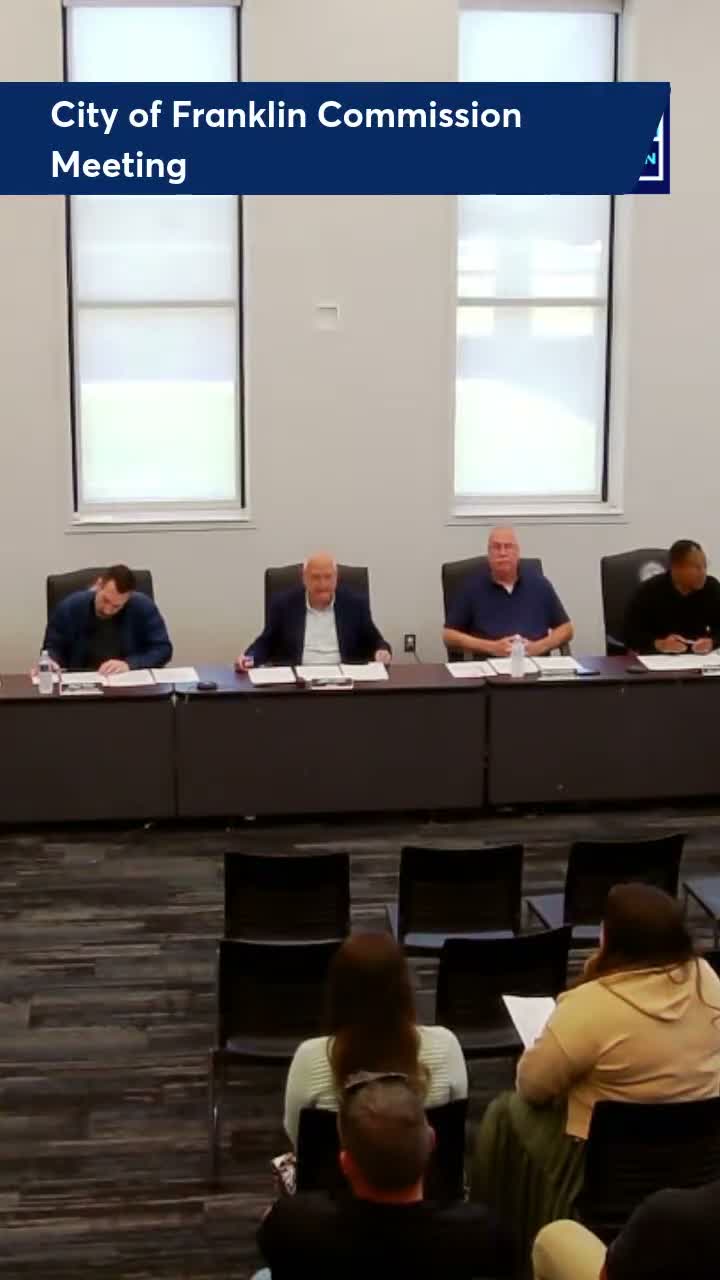
The Franklin City Commission voted to send text amendments for a two‑year pilot program for smaller‑lot residential development to the planning and zoning board for a public hearing. The pilot, presented by Scott Crabtree and an advisory group, would authorize a conditional planned residential development for an initial project on North Street to test whether smaller lots can produce more affordable starter homes.
The pilot, described by advisory group members as a limited experiment, would let a private developer build under the amended rules for two years; if the project proves viable the city could expand the approach. "We've put together a pilot program ordinance that will create this type of development one time for this particular development only for a period of two years," said Scott Crabtree. He asked the commission to send the text amendments to planning and zoning for a public hearing rather than adopt a permanent zoning change immediately.
Why it matters: Commissioners and presenters said Franklin faces a shortage of affordable starter homes and that smaller lots could lower per‑lot infrastructure costs. "As Habitat, we do not have the funding to be able to do developments this large on our own," said Dana Hester, executive director of Habitat for Humanity, urging partnership on the project. Adrian McNew, assistant director of the Franklin housing authority, said the county faces a widening affordable‑housing gap and supported testing new lot‑size rules to retain workers and young families.
Developers and advisory members presented design safeguards intended to limit future misuse of the amendment: caps on impervious coverage, minimum and maximum square footage limits for certain housing types, off‑road parking, and homeowners‑association covenants that would allow city enforcement if the HOA is not active. "We've met with the planning and zoning board…we spent a lot of time trying to bulletproof this amendment so it can't be manipulated in a way that all developers in the future would take this amendment and…put every size home on this small lot," developer Josh Jones said.
The commission discussed location and site design. Commissioners were told the initial site is on the south side of North Street, backing up to the community cemetery, and that the developers plan to use existing utility corridors and off‑road parking to reduce on‑street parking pressure. The presenters emphasized the plan is a pilot and that developers would assume financial risk if the prototype is unsuccessful.
The motion approved by the commission was limited to forwarding the proposed text amendments to planning and zoning for a public hearing; planning and zoning would review public comments and return a recommendation to the commission, which would consider any ordinance later. The motion to refer passed by voice vote.
Next steps: The planning and zoning board will schedule a public hearing on the proposed text amendments; if it recommends approval the commission will consider an ordinance at a future meeting.
The pilot, described by advisory group members as a limited experiment, would let a private developer build under the amended rules for two years; if the project proves viable the city could expand the approach. "We've put together a pilot program ordinance that will create this type of development one time for this particular development only for a period of two years," said Scott Crabtree. He asked the commission to send the text amendments to planning and zoning for a public hearing rather than adopt a permanent zoning change immediately.
Why it matters: Commissioners and presenters said Franklin faces a shortage of affordable starter homes and that smaller lots could lower per‑lot infrastructure costs. "As Habitat, we do not have the funding to be able to do developments this large on our own," said Dana Hester, executive director of Habitat for Humanity, urging partnership on the project. Adrian McNew, assistant director of the Franklin housing authority, said the county faces a widening affordable‑housing gap and supported testing new lot‑size rules to retain workers and young families.
Developers and advisory members presented design safeguards intended to limit future misuse of the amendment: caps on impervious coverage, minimum and maximum square footage limits for certain housing types, off‑road parking, and homeowners‑association covenants that would allow city enforcement if the HOA is not active. "We've met with the planning and zoning board…we spent a lot of time trying to bulletproof this amendment so it can't be manipulated in a way that all developers in the future would take this amendment and…put every size home on this small lot," developer Josh Jones said.
The commission discussed location and site design. Commissioners were told the initial site is on the south side of North Street, backing up to the community cemetery, and that the developers plan to use existing utility corridors and off‑road parking to reduce on‑street parking pressure. The presenters emphasized the plan is a pilot and that developers would assume financial risk if the prototype is unsuccessful.
The motion approved by the commission was limited to forwarding the proposed text amendments to planning and zoning for a public hearing; planning and zoning would review public comments and return a recommendation to the commission, which would consider any ordinance later. The motion to refer passed by voice vote.
Next steps: The planning and zoning board will schedule a public hearing on the proposed text amendments; if it recommends approval the commission will consider an ordinance at a future meeting.
View the Full Meeting & All Its Details
This article offers just a summary. Unlock complete video, transcripts, and insights as a Founder Member.
✓
Watch full, unedited meeting videos
✓
Search every word spoken in unlimited transcripts
✓
AI summaries & real-time alerts (all government levels)
✓
Permanent access to expanding government content
30-day money-back guarantee
