Howard County Council adopts FY2021 budget after hours of amendment votes
May 11, 2026 | Howard County, Maryland
This article was created by AI summarizing key points discussed. AI makes mistakes, so for full details and context, please refer to the video of the full meeting. Please report any errors so we can fix them. Report an error »
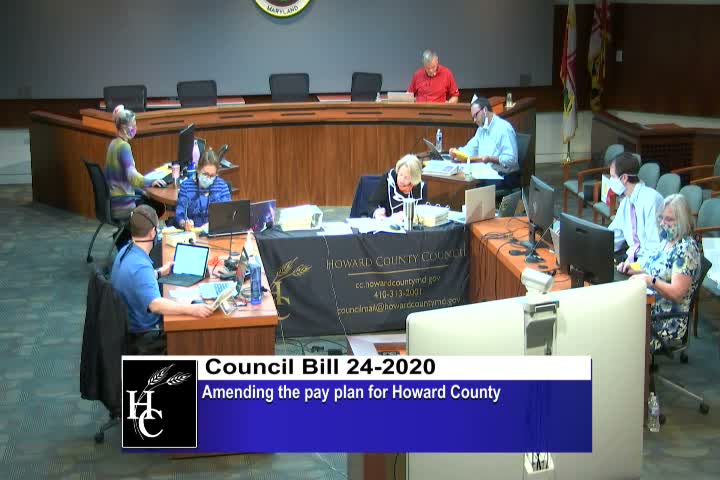
The Howard County Council on May 27 approved the county's fiscal year 2021 budget after an extended virtual legislative session that centered on dozens of operating- and capital-budget amendments.
The session began with the council administrator reading emergency appropriations tied to CARES Act funding and the chair placing the FY2021 annual budget (Council Bill 25) on the floor for final consideration. Council members debated multiple technical and substantive amendments for hours before voting the measure through as amended.
Why it matters: the adopted budget funds core services while reflecting reductions and restorations negotiated by council members. Supporters said the package balanced fiscal caution during the COVID-19 public-health emergency with targeted restorations to avoid service disruptions; critics said the plan deferred significant capital work in low-income and underserved areas.
Key votes and outcomes included the passage of multiple collective-bargaining implementing bills early in the session and, later, a heavily amended Council Bill 25 that the council ultimately approved. Among the largest items discussed were a proposed $21 million package of operating cuts and a series of capital restorations and cuts that together reshaped the county's capital program.
During debate, some council members pushed to move roughly $4 million of housing-fee resources into operating contingency to ensure more public transparency around how affordable-housing funds are spent; that motion passed. Another extended exchange focused on a proposed slate of $90.8 million capital cuts and whether particular cuts to a systemic facilities project (C0317) would force layoffs of 11 Department of Public Works staff. Auditors and administration staff told the council that prior-year appropriations and other tools could be used to avoid immediate layoffs, and the council restored roughly $947,000 tied to those positions.
The council also negotiated a path forward for a major downtown cultural center project: supporters and opponents agreed to restore the project authorization but place the $61.65 million funding line in a contingency account pending a more detailed plan and future council approval.
On the revenue side, the council amended and approved a modest increase to the county's transfer tax and approved a phased, progressive recordation-tax structure in amended form; those measures were debated intensely because they reallocate how new revenues would be dedicated among schools, parks and other capital needs.
What's next: the budget and the accompanying bond-authorizing measures and resolutions were recorded as adopted; staff and auditors will finalize amended appendices and funding schedules. Several council members urged continuing discussions with the county's state delegates about structural changes to how transfer and recordation revenues are distributed.
Quotes from the meeting reflect the tone of the debate: "It's about $4,000,000 collected by a combination of fees in lieu and other moderate-income housing unit fees," one council member said of the housing pot, urging a public process. The auditor summarized the capital reductions as "$90,800,000 in proposed cuts, almost $4,000,000 coming back," emphasizing the scale of the changes.
The council closed the session by thanking staff and auditors for the long, largely remote process and stressing the unusual fiscal context created by the pandemic.
The session began with the council administrator reading emergency appropriations tied to CARES Act funding and the chair placing the FY2021 annual budget (Council Bill 25) on the floor for final consideration. Council members debated multiple technical and substantive amendments for hours before voting the measure through as amended.
Why it matters: the adopted budget funds core services while reflecting reductions and restorations negotiated by council members. Supporters said the package balanced fiscal caution during the COVID-19 public-health emergency with targeted restorations to avoid service disruptions; critics said the plan deferred significant capital work in low-income and underserved areas.
Key votes and outcomes included the passage of multiple collective-bargaining implementing bills early in the session and, later, a heavily amended Council Bill 25 that the council ultimately approved. Among the largest items discussed were a proposed $21 million package of operating cuts and a series of capital restorations and cuts that together reshaped the county's capital program.
During debate, some council members pushed to move roughly $4 million of housing-fee resources into operating contingency to ensure more public transparency around how affordable-housing funds are spent; that motion passed. Another extended exchange focused on a proposed slate of $90.8 million capital cuts and whether particular cuts to a systemic facilities project (C0317) would force layoffs of 11 Department of Public Works staff. Auditors and administration staff told the council that prior-year appropriations and other tools could be used to avoid immediate layoffs, and the council restored roughly $947,000 tied to those positions.
The council also negotiated a path forward for a major downtown cultural center project: supporters and opponents agreed to restore the project authorization but place the $61.65 million funding line in a contingency account pending a more detailed plan and future council approval.
On the revenue side, the council amended and approved a modest increase to the county's transfer tax and approved a phased, progressive recordation-tax structure in amended form; those measures were debated intensely because they reallocate how new revenues would be dedicated among schools, parks and other capital needs.
What's next: the budget and the accompanying bond-authorizing measures and resolutions were recorded as adopted; staff and auditors will finalize amended appendices and funding schedules. Several council members urged continuing discussions with the county's state delegates about structural changes to how transfer and recordation revenues are distributed.
Quotes from the meeting reflect the tone of the debate: "It's about $4,000,000 collected by a combination of fees in lieu and other moderate-income housing unit fees," one council member said of the housing pot, urging a public process. The auditor summarized the capital reductions as "$90,800,000 in proposed cuts, almost $4,000,000 coming back," emphasizing the scale of the changes.
The council closed the session by thanking staff and auditors for the long, largely remote process and stressing the unusual fiscal context created by the pandemic.
View the Full Meeting & All Its Details
This article offers just a summary. Unlock complete video, transcripts, and insights as a Founder Member.
✓
Watch full, unedited meeting videos
✓
Search every word spoken in unlimited transcripts
✓
AI summaries & real-time alerts (all government levels)
✓
Permanent access to expanding government content
30-day money-back guarantee
