San Diego council adopts amended 'Trust' surveillance ordinance after weeks of debate and heavy public comment
May 11, 2026 | San Diego City, San Diego County, California
This article was created by AI summarizing key points discussed. AI makes mistakes, so for full details and context, please refer to the video of the full meeting. Please report any errors so we can fix them. Report an error »
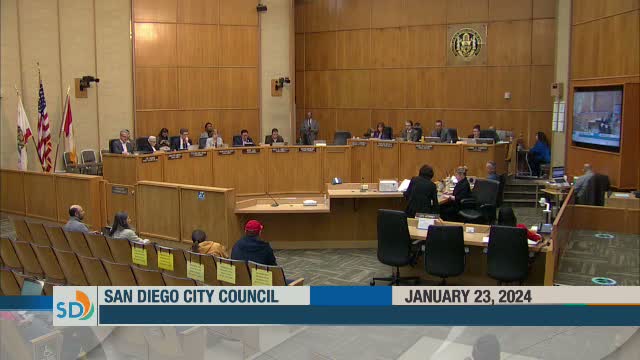
San Diego City Council on Jan. 23 approved a revised package of amendments to the city's Transparent and Responsible Use of Surveillance Technology ordinance, commonly called the "Trust" ordinance, after extended public comment and floor changes. The motion, made by Councilmember Chris Von Wilpert and seconded by Pro Tem LaCava, passed 6 to 2 with Council President Elo Rivera and Councilmember Vivian Moreno voting no; Council District 4 remained vacant.
The adopted package keeps intact the ordinance's core requirement that the council review and adopt surveillance-use policies but narrows, clarifies and adds operational language city staff said was needed for implementation. Chloe Madison, the mayor's senior policy adviser on public safety, said the amendments were intended to preserve transparency while avoiding unintended operational consequences for city departments and public-safety grants. "These revisions are not intended to change the purpose and intent of the ordinance," Madison told the council, and she described changes distinguishing "existing" from "new" technologies, and exemptions for certain routine systems and enterprise databases already governed by other laws.
Privacy advocates and members of the city's Privacy Advisory Board (PAB) warned the council against broad exemptions. "We want to make sure that the 90-day review period stays as is," Ike Onyenetu, chair of the PAB, told council members during public comment. Advocacy groups and dozens of residents urged the council not to exempt systems such as ARGIS or other law-enforcement databases that community members said can enable mass surveillance when used together.
Councilmembers negotiated amendments on the floor. Von Wilpert's motion as adopted retained a 90-day review period for the PAB, added an explicit, limited exemption to permit certain hazardous-materials detection tools for fire-HazMat use, and included a new requirement that the city have 30 days to attempt to "cure" an alleged material violation before a claimant may file a lawsuit seeking monetary damages. City attorneys and the mayor's staff confirmed they would work with clerks and labor representatives to iron out drafting and to notify recognized employee organizations about any potential bargaining issues.
Supporters of the amended package said the changes strike a balance between privacy oversight and practical city operations. "Transparency and efficient government can coexist," Pro Tem LaCava said in supporting the motion. Opponents said some exemptions remained too broad and that the council was moving a significant rewrite without full time for community review and while one council district lacked representation.
The ordinance changes will take effect according to the city's usual ordinance-adoption schedule, and councilmembers indicated they expect further refinements. Councilmembers asked staff to return to the Public Safety Committee with more-targeted language on how the ordinance treats non-city partners and specific agency databases (an item the council asked to continue considering in committee). The council also directed city staff to post explanatory materials and to make the PAB's recommendations and the adopted use policies publicly available.
What happens next: staff will publish the amended ordinance text and updated guidance on implementation, the city attorney will coordinate required notifications to recognized employee organizations, and councilmembers said they expect additional follow-up in committee to refine definitions and narrow any exemptions that generate community concern.
The adopted package keeps intact the ordinance's core requirement that the council review and adopt surveillance-use policies but narrows, clarifies and adds operational language city staff said was needed for implementation. Chloe Madison, the mayor's senior policy adviser on public safety, said the amendments were intended to preserve transparency while avoiding unintended operational consequences for city departments and public-safety grants. "These revisions are not intended to change the purpose and intent of the ordinance," Madison told the council, and she described changes distinguishing "existing" from "new" technologies, and exemptions for certain routine systems and enterprise databases already governed by other laws.
Privacy advocates and members of the city's Privacy Advisory Board (PAB) warned the council against broad exemptions. "We want to make sure that the 90-day review period stays as is," Ike Onyenetu, chair of the PAB, told council members during public comment. Advocacy groups and dozens of residents urged the council not to exempt systems such as ARGIS or other law-enforcement databases that community members said can enable mass surveillance when used together.
Councilmembers negotiated amendments on the floor. Von Wilpert's motion as adopted retained a 90-day review period for the PAB, added an explicit, limited exemption to permit certain hazardous-materials detection tools for fire-HazMat use, and included a new requirement that the city have 30 days to attempt to "cure" an alleged material violation before a claimant may file a lawsuit seeking monetary damages. City attorneys and the mayor's staff confirmed they would work with clerks and labor representatives to iron out drafting and to notify recognized employee organizations about any potential bargaining issues.
Supporters of the amended package said the changes strike a balance between privacy oversight and practical city operations. "Transparency and efficient government can coexist," Pro Tem LaCava said in supporting the motion. Opponents said some exemptions remained too broad and that the council was moving a significant rewrite without full time for community review and while one council district lacked representation.
The ordinance changes will take effect according to the city's usual ordinance-adoption schedule, and councilmembers indicated they expect further refinements. Councilmembers asked staff to return to the Public Safety Committee with more-targeted language on how the ordinance treats non-city partners and specific agency databases (an item the council asked to continue considering in committee). The council also directed city staff to post explanatory materials and to make the PAB's recommendations and the adopted use policies publicly available.
What happens next: staff will publish the amended ordinance text and updated guidance on implementation, the city attorney will coordinate required notifications to recognized employee organizations, and councilmembers said they expect additional follow-up in committee to refine definitions and narrow any exemptions that generate community concern.
View the Full Meeting & All Its Details
This article offers just a summary. Unlock complete video, transcripts, and insights as a Founder Member.
✓
Watch full, unedited meeting videos
✓
Search every word spoken in unlimited transcripts
✓
AI summaries & real-time alerts (all government levels)
✓
Permanent access to expanding government content
30-day money-back guarantee
