Senate Finance Committee advances broad human-services "program integrity" bill after tense debate
May 09, 2026 | 2026 Legislature MN, Minnesota
This article was created by AI summarizing key points discussed. AI makes mistakes, so for full details and context, please refer to the video of the full meeting. Please report any errors so we can fix them. Report an error »
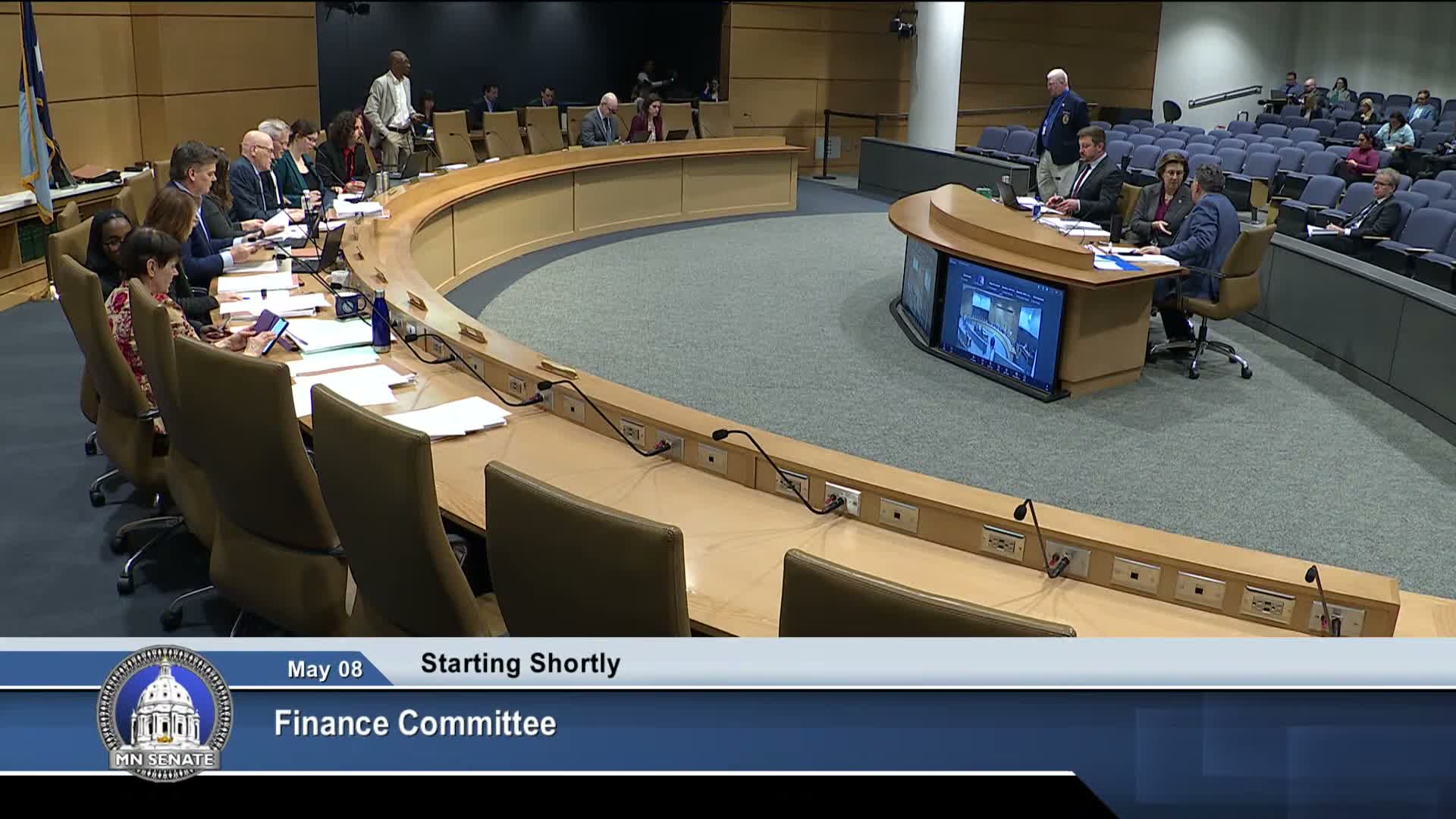
The Minnesota Senate Finance Committee voted May 7 to recommend passage of House File 3379, a sprawling program-integrity package that authors and staff say is meant to strengthen prepayment and postpayment review, tighten provider enrollment and oversight, and reduce improper Medicaid payments.
Authors Sen. Hoffman and Sen. Wicklund presented the bill and emphasized bipartisan, iterative drafting with nonpartisan staff and stakeholders. "We are listening and we're taking feedback from members and the public," Sen. Hoffman said, adding that the provision to eliminate remote supports had been removed and that senators had negotiated changes to nursing-home-rate language with colleagues.
Fiscal staff walked the committee through the bill's spreadsheet. Kyle Raymond, fiscal staff to the Human Services Committee, said the Senate position in the amendment shows a net fiscal effect of roughly a $109 million reduction in the 2026–27 biennium for human-services agencies, with a general-fund reduction of about $110.2 million in 2026–27 and an estimated $96.2 million increase in later years. Raymond described a large component of those numbers as driven by expanded prepayment review and a one-time timing shift in payments that produces a carry-forward reduction in the forecasted biennium.
Sen. Pratt pressed staff on whether the savings in the $156 million line reflect recoveries from fraud or merely the timing of payments. "Is there a presumed amount of fraud that's going to be caught?" Pratt asked. Raymond and nonpartisan staff replied that the $156 million figure is largely a result of a two-week payment delay in implementation and that there is no specific assumed fraud recovery included in that line. Nonpartisan staff added the proposal does not explicitly assume additional recoveries tied to fraud in that calculation.
Supporters described prepayment review as a program-integrity tool being phased in with greater notice and safeguards. "The prepayment review is a program-integrity process," Sen. Goodwin said, adding it is part of the federal corrective-action work that requires more assessment before payments are made. Sponsors and staff also pointed to new bill language requiring a 60-day notice before prepayment review begins to reduce the risk that providers are caught off guard.
Committee members repeatedly cautioned about implementation risks. Sen. Hoffman referenced a judicial order and said continuity of care for vulnerable Minnesotans is a primary concern: "There are 6 people who died because it didn't go so well," he said, urging caution in how changes are implemented. Sponsors said some items will be phased in and accompanied by expanded notice requirements.
Several contested provisions were amended during the hearing. Sen. Mohammed offered an amendment (A7) that removes a requirement for separate individual provider enrollment IDs and instead directs the Department of Human Services to integrate electronic visit verification (EVV) data with Medicaid billing so EVV can be used to validate claims. Elise Bailey, DHS budget director, told the committee that collecting tax-identification information currently occurs at enrollment for entities, and that the EVV-based approach achieves worker-level accountability without requiring thousands of individual enrollments at DHS.
On nursing-facility costs, members pressed whether a per-employee cap on reimbursed health-insurance costs would keep pace with rising premiums. Bailey said the proposal would set a cap roughly comparable to the state employee plan and that the cap would be indexed over time; authors indicated an amendment was forthcoming to revise or remove that section.
The committee adopted a series of amendments by voice vote, including A4 (the working draft), A7 (EVV integration in lieu of mass individual enrollments), A9 (a funding mechanism for the "early and often" program), and A5 (targeted utilization or prior-authorization language aimed at high-risk provider categories). Sponsors and staff said some provisions will be revisited on the floor and that Judiciary will review parts of the bill next week that touch due-process and criminal statutes.
Sen. Wicklund moved that House File 3379 as amended be recommended passed; the committee approved the motion by voice vote and instructed staff to make technical and conforming changes. Sponsors said they will continue negotiating language on the floor and with Judiciary to address outstanding concerns about notice, continuity of care and implementation timelines.
The committee recessed briefly for author consultations and then adjourned. The authors said Judiciary will convene next week to review items that committee staff have flagged as needing further legal review; the bill was referred to the floor with those caveats.
Authors Sen. Hoffman and Sen. Wicklund presented the bill and emphasized bipartisan, iterative drafting with nonpartisan staff and stakeholders. "We are listening and we're taking feedback from members and the public," Sen. Hoffman said, adding that the provision to eliminate remote supports had been removed and that senators had negotiated changes to nursing-home-rate language with colleagues.
Fiscal staff walked the committee through the bill's spreadsheet. Kyle Raymond, fiscal staff to the Human Services Committee, said the Senate position in the amendment shows a net fiscal effect of roughly a $109 million reduction in the 2026–27 biennium for human-services agencies, with a general-fund reduction of about $110.2 million in 2026–27 and an estimated $96.2 million increase in later years. Raymond described a large component of those numbers as driven by expanded prepayment review and a one-time timing shift in payments that produces a carry-forward reduction in the forecasted biennium.
Sen. Pratt pressed staff on whether the savings in the $156 million line reflect recoveries from fraud or merely the timing of payments. "Is there a presumed amount of fraud that's going to be caught?" Pratt asked. Raymond and nonpartisan staff replied that the $156 million figure is largely a result of a two-week payment delay in implementation and that there is no specific assumed fraud recovery included in that line. Nonpartisan staff added the proposal does not explicitly assume additional recoveries tied to fraud in that calculation.
Supporters described prepayment review as a program-integrity tool being phased in with greater notice and safeguards. "The prepayment review is a program-integrity process," Sen. Goodwin said, adding it is part of the federal corrective-action work that requires more assessment before payments are made. Sponsors and staff also pointed to new bill language requiring a 60-day notice before prepayment review begins to reduce the risk that providers are caught off guard.
Committee members repeatedly cautioned about implementation risks. Sen. Hoffman referenced a judicial order and said continuity of care for vulnerable Minnesotans is a primary concern: "There are 6 people who died because it didn't go so well," he said, urging caution in how changes are implemented. Sponsors said some items will be phased in and accompanied by expanded notice requirements.
Several contested provisions were amended during the hearing. Sen. Mohammed offered an amendment (A7) that removes a requirement for separate individual provider enrollment IDs and instead directs the Department of Human Services to integrate electronic visit verification (EVV) data with Medicaid billing so EVV can be used to validate claims. Elise Bailey, DHS budget director, told the committee that collecting tax-identification information currently occurs at enrollment for entities, and that the EVV-based approach achieves worker-level accountability without requiring thousands of individual enrollments at DHS.
On nursing-facility costs, members pressed whether a per-employee cap on reimbursed health-insurance costs would keep pace with rising premiums. Bailey said the proposal would set a cap roughly comparable to the state employee plan and that the cap would be indexed over time; authors indicated an amendment was forthcoming to revise or remove that section.
The committee adopted a series of amendments by voice vote, including A4 (the working draft), A7 (EVV integration in lieu of mass individual enrollments), A9 (a funding mechanism for the "early and often" program), and A5 (targeted utilization or prior-authorization language aimed at high-risk provider categories). Sponsors and staff said some provisions will be revisited on the floor and that Judiciary will review parts of the bill next week that touch due-process and criminal statutes.
Sen. Wicklund moved that House File 3379 as amended be recommended passed; the committee approved the motion by voice vote and instructed staff to make technical and conforming changes. Sponsors said they will continue negotiating language on the floor and with Judiciary to address outstanding concerns about notice, continuity of care and implementation timelines.
The committee recessed briefly for author consultations and then adjourned. The authors said Judiciary will convene next week to review items that committee staff have flagged as needing further legal review; the bill was referred to the floor with those caveats.
Don't Miss a Word: See the Full Meeting!
Go beyond summaries. Unlock every video, transcript, and key insight with a Founder Membership.
✓
Get instant access to full meeting videos
✓
Search and clip any phrase from complete transcripts
✓
Receive AI-powered summaries & custom alerts
✓
Enjoy lifetime, unrestricted access to government data
30-day money-back guarantee
