Planning board unanimously approves Lynn University 342‑bed dorm and easement abandonment
May 10, 2026 | Boca Raton, Palm Beach County, Florida
This article was created by AI summarizing key points discussed. AI makes mistakes, so for full details and context, please refer to the video of the full meeting. Please report any errors so we can fix them. Report an error »
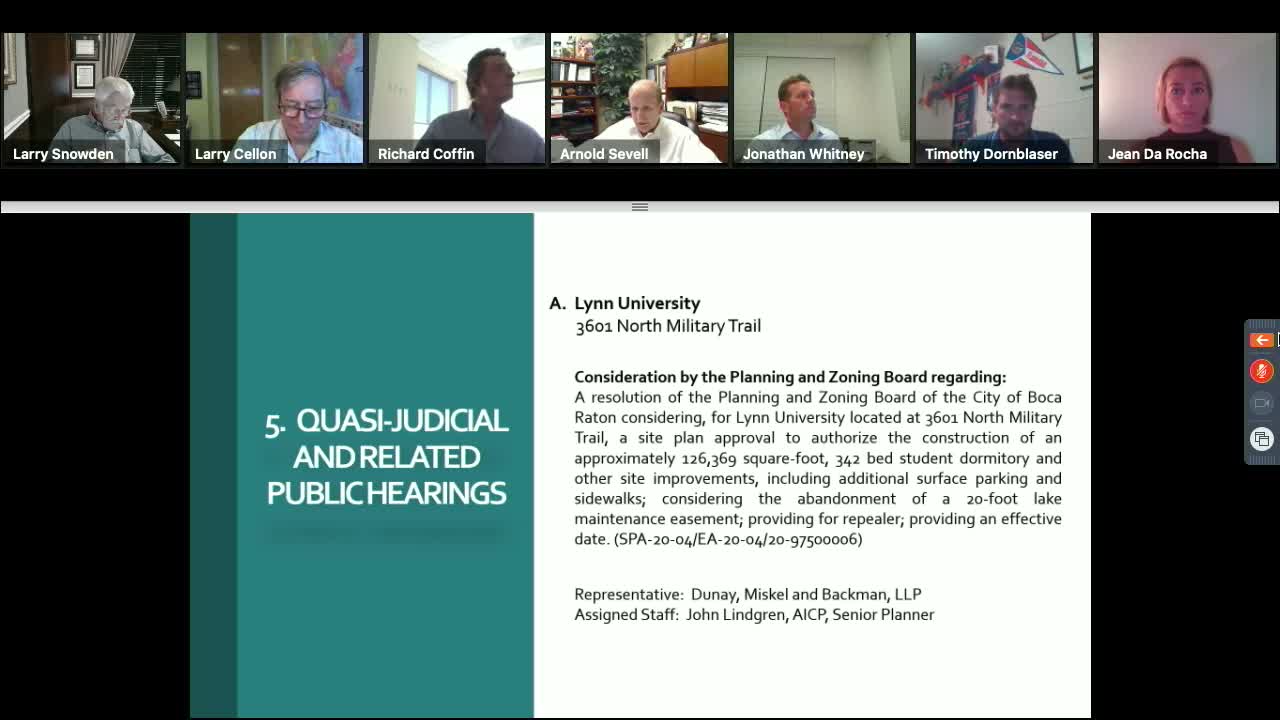
The Boca Raton Planning & Zoning Board voted unanimously Wednesday to approve a site plan for a new student housing building at Lynn University and to abandon a deeded 20‑foot lake‑maintenance easement on the campus.
Senior planner John Lundgren told the board the application is for “an approximately 112,369 square foot, 342 bed student dormitory,” and apologized that a figure of 126,369 square feet had mistakenly been printed in the board packet; staff corrected the record and recommended approval subject to conditions. Lundgren said the new building would not increase the campus enrollment cap of 3,000 students established in the approved master plan.
Bonnie Misskel, representing Lynn University, described the three‑story building as consistent with campus architecture, with interior courtyard space, two drop‑off areas, and 144 surface parking spaces. She said the project would add pedestrian connections and landscaping, including “22 street trees” along Potomac Road, and 75 bicycle parking spaces.
Misskel read two minor edits to conditions of approval clarifying that the applicant must submit landscaping plans and obtain an engineering right‑of‑way permit prior to issuance of a main‑use building permit and must secure that permit prior to certificate of occupancy for the street‑tree installation. She told the board the university had reviewed the documents and consented to the tree and landscaping plan.
Board members asked about the size and spacing of the live oaks; Carol Perez, on the project team, confirmed trees would be 10–12 feet tall and spaced 35 feet on center. Members also asked whether the dorm would add students; Misskel reiterated the building would house existing and admitted students but would not raise the master‑plan enrollment cap.
There were no public speakers. Staff moved to approve the site plan with the corrected square footage and the amended conditions; the board voted 7–0 in favor.
The approval includes the abandonment of the 20‑foot lake maintenance easement, which staff said is no longer necessary because the area will be a dry retention area rather than the originally planned lake. The project next proceeds to any required permitting and permitting inspections under the conditions approved by the board.
Senior planner John Lundgren told the board the application is for “an approximately 112,369 square foot, 342 bed student dormitory,” and apologized that a figure of 126,369 square feet had mistakenly been printed in the board packet; staff corrected the record and recommended approval subject to conditions. Lundgren said the new building would not increase the campus enrollment cap of 3,000 students established in the approved master plan.
Bonnie Misskel, representing Lynn University, described the three‑story building as consistent with campus architecture, with interior courtyard space, two drop‑off areas, and 144 surface parking spaces. She said the project would add pedestrian connections and landscaping, including “22 street trees” along Potomac Road, and 75 bicycle parking spaces.
Misskel read two minor edits to conditions of approval clarifying that the applicant must submit landscaping plans and obtain an engineering right‑of‑way permit prior to issuance of a main‑use building permit and must secure that permit prior to certificate of occupancy for the street‑tree installation. She told the board the university had reviewed the documents and consented to the tree and landscaping plan.
Board members asked about the size and spacing of the live oaks; Carol Perez, on the project team, confirmed trees would be 10–12 feet tall and spaced 35 feet on center. Members also asked whether the dorm would add students; Misskel reiterated the building would house existing and admitted students but would not raise the master‑plan enrollment cap.
There were no public speakers. Staff moved to approve the site plan with the corrected square footage and the amended conditions; the board voted 7–0 in favor.
The approval includes the abandonment of the 20‑foot lake maintenance easement, which staff said is no longer necessary because the area will be a dry retention area rather than the originally planned lake. The project next proceeds to any required permitting and permitting inspections under the conditions approved by the board.
View the Full Meeting & All Its Details
This article offers just a summary. Unlock complete video, transcripts, and insights as a Founder Member.
✓
Watch full, unedited meeting videos
✓
Search every word spoken in unlimited transcripts
✓
AI summaries & real-time alerts (all government levels)
✓
Permanent access to expanding government content
30-day money-back guarantee
