Assembly passes chapter amendment to restrict PFAS in apparel, sets phased deadlines and penalties
May 10, 2026 | 2026 Legislature NY, New York
This article was created by AI summarizing key points discussed. AI makes mistakes, so for full details and context, please refer to the video of the full meeting. Please report any errors so we can fix them. Report an error »
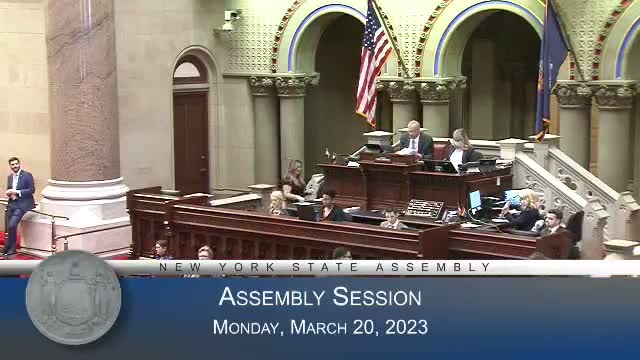
The New York State Assembly on the floor adopted a chapter amendment aimed at removing intentionally added PFAS from clothing and apparel, with phased compliance dates and civil penalties for violations.
Sponsor Miss Fahey, explaining Rules Report 93, said the measure updates last year's law to "prohibit PFAS in clothing," extends some effective dates to Jan. 1, 2025, brings outdoor apparel into compliance by 2028, and directs the Department of Environmental Conservation to develop parts‑per‑million numerical limits by 2028. "This chapter amendment is ... to prohibit PFAS in clothing," Fahey said in her explanation of the bill.
The bill defines "outdoor apparel" to include clothing intended primarily for hiking, skiing, camping, climbing, bicycling and fishing and establishes an "intentionally added" standard so that PFAS deliberately added to a product are banned regardless of any threshold the DEC later adopts. In floor exchanges, Fahey said the language reads "at or above a level that department shall establish in regulation or as intentionally added," which she described as an "either/or" formulation that makes intentionally added PFAS impermissible even if a regulatory PPM threshold were later set.
Opponents pressed the sponsor on enforcement and economic impact. One member warned that the civil penalty — "not to exceed $1,000 for each day during which such violation continues" — could impose crushing costs on small retailers that fail to move inventory before the effective dates. In a sharply worded floor remark, an opponent said: "If you have a pair of Gore‑Tex ski pants on the shelf and you don't get rid of it by the effective day ... you're facing up to a $180,000 fine," and said the bill could ban widely used products without EPA thresholds for clothing.
Miss Fahey and supporters countered that the industry is already pivoting away from PFAS and that prevention of these "forever chemicals" at the source reduces wastewater treatment burdens. "We are seeing dozens of manufacturers move away from any PFAS," Fahey said, and supporters pointed to studies finding PFAS in children's waterproof or stain‑resistant clothing as rationale for prevention.
The Assembly recorded a party vote on the measure; members on both sides explained their positions before the clerk recorded the result: "Ayes 107, Noes 40." The clerk announced the bill passed.
The bill assigns DEC responsibility to develop technical regulatory limits and leaves several implementation details to rulemaking, including clarifications about resale shops and the mechanics of civil‑penalty assessment. Sponsors noted phased implementation to allow businesses time to turn over inventory; opponents asked for clearer statutory language limiting per‑item versus per‑violator exposure to fines.
The Assembly moved to the next calendar items after recording the result. The chapter amendment will now proceed to whatever remaining procedural steps are required for enactment.
Sponsor Miss Fahey, explaining Rules Report 93, said the measure updates last year's law to "prohibit PFAS in clothing," extends some effective dates to Jan. 1, 2025, brings outdoor apparel into compliance by 2028, and directs the Department of Environmental Conservation to develop parts‑per‑million numerical limits by 2028. "This chapter amendment is ... to prohibit PFAS in clothing," Fahey said in her explanation of the bill.
The bill defines "outdoor apparel" to include clothing intended primarily for hiking, skiing, camping, climbing, bicycling and fishing and establishes an "intentionally added" standard so that PFAS deliberately added to a product are banned regardless of any threshold the DEC later adopts. In floor exchanges, Fahey said the language reads "at or above a level that department shall establish in regulation or as intentionally added," which she described as an "either/or" formulation that makes intentionally added PFAS impermissible even if a regulatory PPM threshold were later set.
Opponents pressed the sponsor on enforcement and economic impact. One member warned that the civil penalty — "not to exceed $1,000 for each day during which such violation continues" — could impose crushing costs on small retailers that fail to move inventory before the effective dates. In a sharply worded floor remark, an opponent said: "If you have a pair of Gore‑Tex ski pants on the shelf and you don't get rid of it by the effective day ... you're facing up to a $180,000 fine," and said the bill could ban widely used products without EPA thresholds for clothing.
Miss Fahey and supporters countered that the industry is already pivoting away from PFAS and that prevention of these "forever chemicals" at the source reduces wastewater treatment burdens. "We are seeing dozens of manufacturers move away from any PFAS," Fahey said, and supporters pointed to studies finding PFAS in children's waterproof or stain‑resistant clothing as rationale for prevention.
The Assembly recorded a party vote on the measure; members on both sides explained their positions before the clerk recorded the result: "Ayes 107, Noes 40." The clerk announced the bill passed.
The bill assigns DEC responsibility to develop technical regulatory limits and leaves several implementation details to rulemaking, including clarifications about resale shops and the mechanics of civil‑penalty assessment. Sponsors noted phased implementation to allow businesses time to turn over inventory; opponents asked for clearer statutory language limiting per‑item versus per‑violator exposure to fines.
The Assembly moved to the next calendar items after recording the result. The chapter amendment will now proceed to whatever remaining procedural steps are required for enactment.
View the Full Meeting & All Its Details
This article offers just a summary. Unlock complete video, transcripts, and insights as a Founder Member.
✓
Watch full, unedited meeting videos
✓
Search every word spoken in unlimited transcripts
✓
AI summaries & real-time alerts (all government levels)
✓
Permanent access to expanding government content
30-day money-back guarantee
