Residents and unions clash over proposed South Ontario Logistics Center EIR and rezoning
May 10, 2026 | Ontario, San Bernardino County, California
This article was created by AI summarizing key points discussed. AI makes mistakes, so for full details and context, please refer to the video of the full meeting. Please report any errors so we can fix them. Report an error »
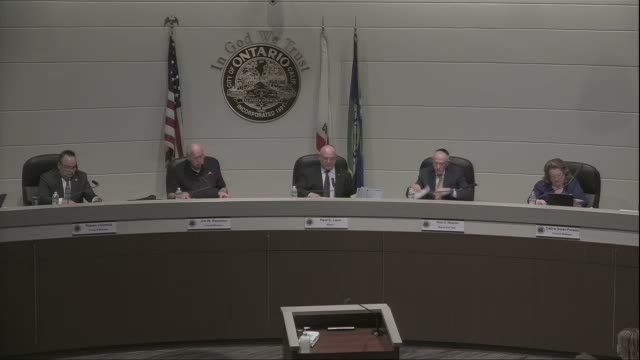
The council held a lengthy public hearing on the South Ontario Logistics Center, a proposal to redesignate about 219.39 acres for business-park and industrial uses and allow up to 5,333,518 square feet of industrial and business-park development. Planning staff summarized the EIR, identified several "significant and unavoidable" impacts (loss of agricultural land, air quality, cultural resources, greenhouse-gas emissions and traffic) and recommended certification of the EIR with a mitigation-monitoring program and a statement of overriding considerations.
Mr. Murphy, the planning presenter, described the site's history as former dairies in an agricultural preserve and said: "As part of the specific plan creation and the general plan amendments, an environmental impact report was prepared for this project...we're identifying these as significant and unavoidable," noting that mitigation and design standards would still apply.
Public comment was sharply divided. Several residents, environmental-justice and local-food advocates urged the council to preserve the city's remaining prime farmland, to consider agrivoltaics and to reject additional warehouse development that they said already harms air quality. Anna Gonzalez, interim executive director of the Center for Community Action and Environmental Justice, told the council the region is "poisoning the families of Ontario" and called the area a "diesel death zone," urging the council to put "people over profits." Multiple speakers raised air-quality, traffic and public-health concerns and pointed to thousands of emailed comments on the item.
Labor and construction representatives, and the project applicant, urged approval. Jeff Johnston, representing Euclid Land Venture (the applicant), said the project will fund infrastructure improvements and argued the development will unlock housing on adjacent land by building roads, water and sewer: "Our project will contribute about $144,000,000 towards the infrastructure that will help serve the housing that's on the North Side of Eucalyptus," he said. Union speakers asked for local-hire and skilled-workforce requirements; they argued the project will create construction jobs and apprenticeships and pledged to press for living wages on projects where unions are engaged.
City staff reminded the council that private property rights, prior purchases and soil conditions factor into feasibility; several councilmembers said the city cannot force property owners to keep land in agriculture and that remediation costs and market pressures affect reuse. The council set a two-minute limit for public commenters to accommodate roughly 27 speakers; the transcript ends after council deliberations where a motion was made, but the provided excerpt does not contain a clear roll-call vote result for Item 12.
The public record for Item 12 will include the EIR, associated mitigation measures, and the many emailed and written comments cited by staff; the council must decide whether to certify the EIR and approve the general-plan and zoning amendments that would allow development under the specific plan.
Mr. Murphy, the planning presenter, described the site's history as former dairies in an agricultural preserve and said: "As part of the specific plan creation and the general plan amendments, an environmental impact report was prepared for this project...we're identifying these as significant and unavoidable," noting that mitigation and design standards would still apply.
Public comment was sharply divided. Several residents, environmental-justice and local-food advocates urged the council to preserve the city's remaining prime farmland, to consider agrivoltaics and to reject additional warehouse development that they said already harms air quality. Anna Gonzalez, interim executive director of the Center for Community Action and Environmental Justice, told the council the region is "poisoning the families of Ontario" and called the area a "diesel death zone," urging the council to put "people over profits." Multiple speakers raised air-quality, traffic and public-health concerns and pointed to thousands of emailed comments on the item.
Labor and construction representatives, and the project applicant, urged approval. Jeff Johnston, representing Euclid Land Venture (the applicant), said the project will fund infrastructure improvements and argued the development will unlock housing on adjacent land by building roads, water and sewer: "Our project will contribute about $144,000,000 towards the infrastructure that will help serve the housing that's on the North Side of Eucalyptus," he said. Union speakers asked for local-hire and skilled-workforce requirements; they argued the project will create construction jobs and apprenticeships and pledged to press for living wages on projects where unions are engaged.
City staff reminded the council that private property rights, prior purchases and soil conditions factor into feasibility; several councilmembers said the city cannot force property owners to keep land in agriculture and that remediation costs and market pressures affect reuse. The council set a two-minute limit for public commenters to accommodate roughly 27 speakers; the transcript ends after council deliberations where a motion was made, but the provided excerpt does not contain a clear roll-call vote result for Item 12.
The public record for Item 12 will include the EIR, associated mitigation measures, and the many emailed and written comments cited by staff; the council must decide whether to certify the EIR and approve the general-plan and zoning amendments that would allow development under the specific plan.
View the Full Meeting & All Its Details
This article offers just a summary. Unlock complete video, transcripts, and insights as a Founder Member.
✓
Watch full, unedited meeting videos
✓
Search every word spoken in unlimited transcripts
✓
AI summaries & real-time alerts (all government levels)
✓
Permanent access to expanding government content
30-day money-back guarantee
