Board denies appeal of Saddleback Meadows setbacks after residents raise wildfire and water concerns
May 10, 2026 | Orange County, California
This article was created by AI summarizing key points discussed. AI makes mistakes, so for full details and context, please refer to the video of the full meeting. Please report any errors so we can fix them. Report an error »
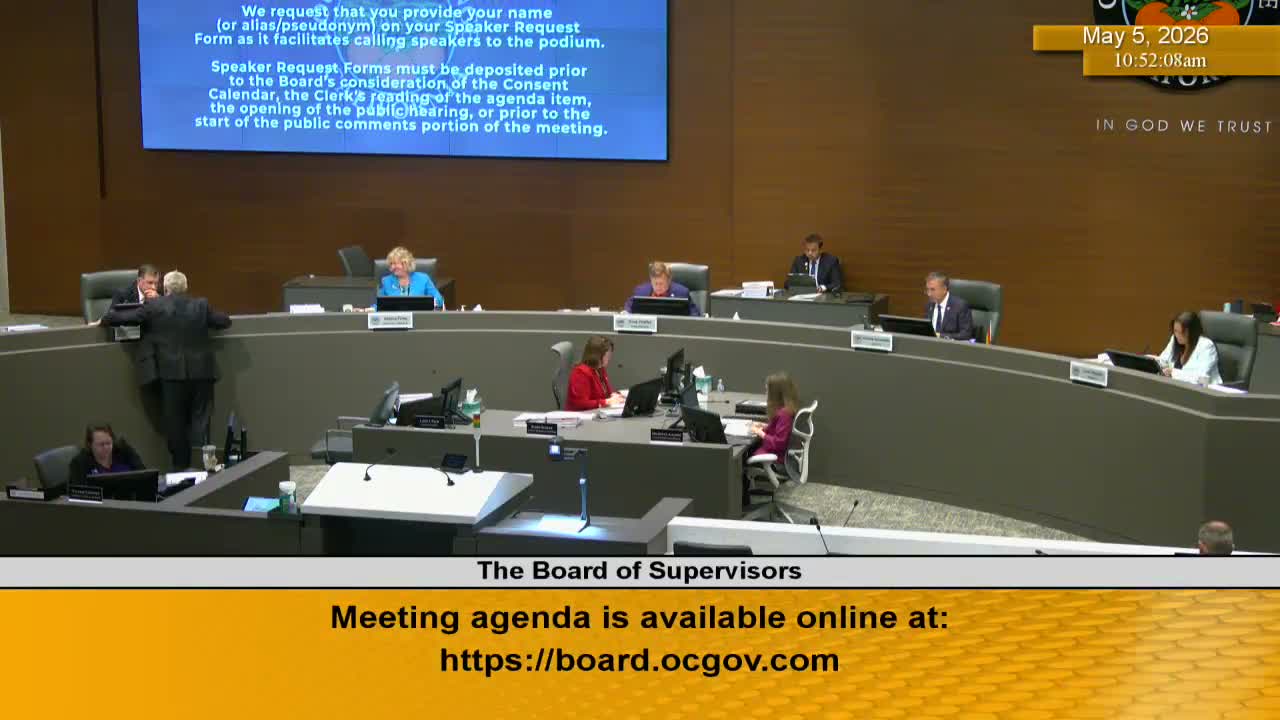
The Orange County Board of Supervisors on May 5 denied an appeal of a planning‑commission approval for the Saddleback Meadows development’s site‑development standards (a use permit for setbacks), concluding the board lacked legal grounds on the narrow issue before it despite extensive public objections about wildfire risk, water supply and environmental review.
The public hearing drew residents and environmental groups who urged the board to pause approvals and require updated studies. Diane Reed, a Hidden Ridge resident, said evacuation capacity was insufficient and cited Assembly Bill 2911 in arguing that projects creating shared egress must demonstrate safe evacuation routes. "Until evacuation capacity and fire protection are demonstrated to be adequate for both Saddleback Meadows and Hidden Ridge, approval is inconsistent with both statute and prudent risk management," she told the board.
Multiple speakers raised related points: Cindy Goss said OCFA’s master fire plan and fuel‑modification details had not been publicly disclosed and that the project’s documents focus on internal spread rather than community evacuation. Gloria Sefton for the Saddleback Canyons Conservancy asserted there is no secure water supply for the project and that the developer faces a conditional will‑serve letter and may need a proposed 1,000,000‑gallon water tank—issues, she said, that require further environmental study and a mandatory CEQA finding if threatened species are present.
The applicant’s representative, Mike Recupero, told the board residents’ comments reflected long‑running opposition and historical concerns rather than new legal arguments related to the narrow setback use permit. "Passion is not a land use strategy," he said, asking board members to rely on the administrative record, staff analysis and the environmental documents in the file.
County counsel and planning staff framed the board’s role more narrowly. Senior Assistant County Counsel Nicole Walsh told supervisors the question before them was limited to a use permit for setbacks and site standards; she noted the project has a long litigation and settlement history and that two EIR addenda have been completed since certification of the original EIR. Walsh said the 2022 addendum addressed changes in the project footprint and that staff judged an addendum to be the correct environmental document given the reduced development footprint.
OCFA’s fire marshal, Felicia Bryant, told the board that OCFA reviewed the project under the California Fire Code and local ordinances and concluded the submittal met applicable requirements. "Submittal met the requirements as required by the state and the local ordinance," she said, and added OCFA re‑checked the materials "as late as yesterday morning" and stood by the decision.
Board action and rationale: Supervisor Wagner (who represents the district where the project lies) opened the board discussion by emphasizing the legal narrowness of the appeal; he moved to deny the appeal, noting the board must rely on the county’s experts and the administrative record. The motion to deny the appeal carried 4–0 with one abstention recorded; the clerk announced the vote as four in favor, one abstention. By denying the residents’ appeal on the setbacks question, the board effectively sustained the planning commission’s approval of the use permit for site‑development standards.
Why it matters: Neighbors argued the Saddleback Meadows project, even in its reduced form, raises communitywide wildfire and evacuation concerns on already narrow canyon roads and that environmental documents from 2002 plus addenda do not address newer development and cumulative impacts. County staff, OCFA and the applicant said the environmental review and code compliance were adequate for the narrow issue before the board. The ruling resolves the immediate legal question about setbacks but leaves broader policy and planning disputes — water infrastructure, evacuation modeling and cumulative CEQA issues — as matters of continuing debate and potential future proceedings.
Next steps: The board closed the public portion of the hearing and directed that, where necessary, staff and the applicant may be asked for follow‑up information. Several residents and organizations signaled intent to pursue additional administrative or legal avenues if they continue to believe environmental and public‑safety gaps remain.
The public hearing drew residents and environmental groups who urged the board to pause approvals and require updated studies. Diane Reed, a Hidden Ridge resident, said evacuation capacity was insufficient and cited Assembly Bill 2911 in arguing that projects creating shared egress must demonstrate safe evacuation routes. "Until evacuation capacity and fire protection are demonstrated to be adequate for both Saddleback Meadows and Hidden Ridge, approval is inconsistent with both statute and prudent risk management," she told the board.
Multiple speakers raised related points: Cindy Goss said OCFA’s master fire plan and fuel‑modification details had not been publicly disclosed and that the project’s documents focus on internal spread rather than community evacuation. Gloria Sefton for the Saddleback Canyons Conservancy asserted there is no secure water supply for the project and that the developer faces a conditional will‑serve letter and may need a proposed 1,000,000‑gallon water tank—issues, she said, that require further environmental study and a mandatory CEQA finding if threatened species are present.
The applicant’s representative, Mike Recupero, told the board residents’ comments reflected long‑running opposition and historical concerns rather than new legal arguments related to the narrow setback use permit. "Passion is not a land use strategy," he said, asking board members to rely on the administrative record, staff analysis and the environmental documents in the file.
County counsel and planning staff framed the board’s role more narrowly. Senior Assistant County Counsel Nicole Walsh told supervisors the question before them was limited to a use permit for setbacks and site standards; she noted the project has a long litigation and settlement history and that two EIR addenda have been completed since certification of the original EIR. Walsh said the 2022 addendum addressed changes in the project footprint and that staff judged an addendum to be the correct environmental document given the reduced development footprint.
OCFA’s fire marshal, Felicia Bryant, told the board that OCFA reviewed the project under the California Fire Code and local ordinances and concluded the submittal met applicable requirements. "Submittal met the requirements as required by the state and the local ordinance," she said, and added OCFA re‑checked the materials "as late as yesterday morning" and stood by the decision.
Board action and rationale: Supervisor Wagner (who represents the district where the project lies) opened the board discussion by emphasizing the legal narrowness of the appeal; he moved to deny the appeal, noting the board must rely on the county’s experts and the administrative record. The motion to deny the appeal carried 4–0 with one abstention recorded; the clerk announced the vote as four in favor, one abstention. By denying the residents’ appeal on the setbacks question, the board effectively sustained the planning commission’s approval of the use permit for site‑development standards.
Why it matters: Neighbors argued the Saddleback Meadows project, even in its reduced form, raises communitywide wildfire and evacuation concerns on already narrow canyon roads and that environmental documents from 2002 plus addenda do not address newer development and cumulative impacts. County staff, OCFA and the applicant said the environmental review and code compliance were adequate for the narrow issue before the board. The ruling resolves the immediate legal question about setbacks but leaves broader policy and planning disputes — water infrastructure, evacuation modeling and cumulative CEQA issues — as matters of continuing debate and potential future proceedings.
Next steps: The board closed the public portion of the hearing and directed that, where necessary, staff and the applicant may be asked for follow‑up information. Several residents and organizations signaled intent to pursue additional administrative or legal avenues if they continue to believe environmental and public‑safety gaps remain.
Don't Miss a Word: See the Full Meeting!
Go beyond summaries. Unlock every video, transcript, and key insight with a Founder Membership.
✓
Get instant access to full meeting videos
✓
Search and clip any phrase from complete transcripts
✓
Receive AI-powered summaries & custom alerts
✓
Enjoy lifetime, unrestricted access to government data
30-day money-back guarantee
