Commission asks staff to develop Housing First policy and pursue pocket‑neighborhoods, redevelopment incentives and mixed housing types
May 09, 2026 | Alachua County, Florida
This article was created by AI summarizing key points discussed. AI makes mistakes, so for full details and context, please refer to the video of the full meeting. Please report any errors so we can fix them. Report an error »
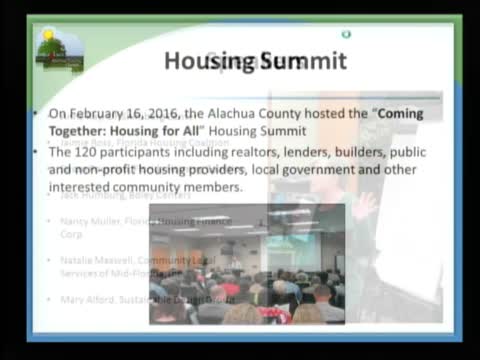
Growth Management presented findings from a February housing summit and proposed eleven policy options to address housing affordability, ranging from 'Housing First' supportive‑housing models to tiny‑house villages, community land trusts and inclusionary zoning.
Staff emphasized that implementation will require changes to land‑use rules, funding priorities and coordination with city and nonprofit partners. Growth Management Director Steve Lochnick noted the effect of GASB and funding limits on local programs and urged a long‑term approach: "We're planning for the next decade — the policy choices we make now will shape housing supply, choice and affordability for years to come," he told the board.
After discussion, the commission voted to refer a focused set of items back to staff for development with stakeholders: 1) draft a Housing First policy and continue work on a county fair‑housing assessment; 2) research 'pocket neighborhoods' and smaller‑home strategies; 3) develop incentives for redevelopment of activity centers; and 4) analyze options to encourage mixed housing types in infill and transit‑oriented areas. The board asked staff to work with municipal governments, the housing authorities, the Chamber and builders to prepare specific implementation recommendations and cost estimates.
Commissioners and staff noted complexity: some options require code changes, others need amendments to the Local Housing Assistance Plan or coordination with state funding programs. Staff will return with more detailed proposals, fiscal implications and draft code tools for the board to consider.
Staff emphasized that implementation will require changes to land‑use rules, funding priorities and coordination with city and nonprofit partners. Growth Management Director Steve Lochnick noted the effect of GASB and funding limits on local programs and urged a long‑term approach: "We're planning for the next decade — the policy choices we make now will shape housing supply, choice and affordability for years to come," he told the board.
After discussion, the commission voted to refer a focused set of items back to staff for development with stakeholders: 1) draft a Housing First policy and continue work on a county fair‑housing assessment; 2) research 'pocket neighborhoods' and smaller‑home strategies; 3) develop incentives for redevelopment of activity centers; and 4) analyze options to encourage mixed housing types in infill and transit‑oriented areas. The board asked staff to work with municipal governments, the housing authorities, the Chamber and builders to prepare specific implementation recommendations and cost estimates.
Commissioners and staff noted complexity: some options require code changes, others need amendments to the Local Housing Assistance Plan or coordination with state funding programs. Staff will return with more detailed proposals, fiscal implications and draft code tools for the board to consider.
Don't Miss a Word: See the Full Meeting!
Go beyond summaries. Unlock every video, transcript, and key insight with a Founder Membership.
✓
Get instant access to full meeting videos
✓
Search and clip any phrase from complete transcripts
✓
Receive AI-powered summaries & custom alerts
✓
Enjoy lifetime, unrestricted access to government data
30-day money-back guarantee
