Boca Raton planning board approves Chick‑fil‑A site plan with new operational conditions after heated debate
May 09, 2026 | Boca Raton, Palm Beach County, Florida
This article was created by AI summarizing key points discussed. AI makes mistakes, so for full details and context, please refer to the video of the full meeting. Please report any errors so we can fix them. Report an error »
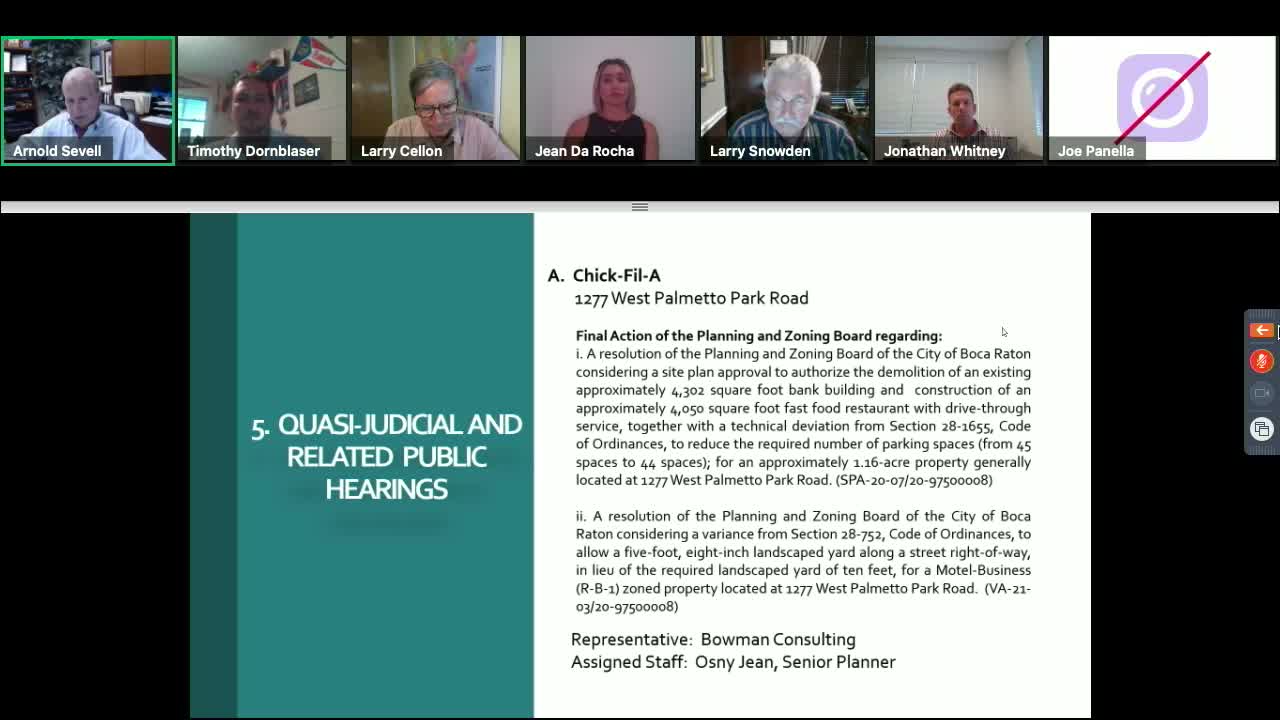
The Boca Raton Planning and Zoning Board voted 6–1 on June 3 to approve a site plan and variance for a Chick‑fil‑A restaurant at 1277 West Palmetto Park Road, but attached several operational and monitoring conditions after staff warned a tightly constrained site could create queuing and neighborhood impacts.
Senior planner Azen Jean told the board the project would demolish an existing ~4,302‑square‑foot bank building and replace it with an approximately 4,050‑square‑foot fast‑food restaurant with a dual‑lane ordering configuration and a bypass lane. Jean said the plan provides 20 on‑site stacking spaces (the city engineering standard requires 10), and that the applicant is requesting a technical deviation to provide 44 parking spaces where code requires 45 and a variance to reduce the required 10‑foot landscape yard along the street to 5 feet 8 inches.
The city’s traffic analysis, presented by traffic engineer Johaira Moledo, found no immediate level‑of‑service degradation at the nearby intersection under current traffic volumes; she said staff would follow up with the precise level‑of‑service figures if requested. Staff also recommended several conditions — including approved tree species lists coordinated with Palm Beach County and FPL, dynamic signage to limit on‑site stacking overflow, staged topographic surveys during construction to verify approved grades, and enforcement language allowing the city to suspend drive‑through operations for code violations — to reduce the possibility of queue spillover and protect adjacent properties.
The applicant pushed back strongly. Ellie Zacharitis, who said she represents the petitioner and had been sworn to testify, characterized several proposed conditions as unprecedented and discriminatory and said some were not in code. “In my entire professional experience, I’ve never seen such government overreach and discrimination against one particular end user,” Zacharitis said, urging the board to remove conditions she said could effectively revoke the approval without proper process. She also said the applicant had redesigned access at staff’s request and was providing substantially more stacking than the engineering minimum.
Board members expressed sharp disagreement over the character and timing of the conditions. Several members called the late arrival of the new conditions — some distributed the morning of the hearing — troubling. Board member [Mr.] Snowden, who moved approval, and others said they were sympathetic to the applicant’s concerns but supported conditions that would prevent a drive‑through queue from obstructing parking or spilling into the public right‑of‑way. “We’re trying to solve problems that we’ve learned occur as we do our jobs,” Development Services Director Brandon Chaddigan said, adding that the conditions are intended to ensure the operation does not detrimentally affect neighboring properties.
As a compromise, the applicant agreed to an operational condition that requires an employee on site during peak hours to assist with the bypass lane and customer flow. The board had not set a fixed definition for “peak hours” at the hearing; staff and the applicant discussed either defining specific time windows or allowing the operator to designate peak periods based on their experience.
After debate, the board voted to approve the site plan resolution and variance, including the applicant’s requested plan changes and the added operational language; the roll call yielded six yes votes and one no (Mr. Rocha). The motion was recorded as approval of the application "inclusive of all of the requested changes and revisions requested by the applicant," with the added requirement that the applicant provide on‑site personnel during peak hours to manage queueing and bypass lane use.
What happens next: The development order will be finalized to reflect the approved conditions and the applicant must satisfy the conditions and any required agency approvals (Palm Beach County and FPL coordination was noted for tree species) before building permits are fully cleared. Staff and the applicant also agreed to refine the notice and enforcement language that specifies steps the city will take before suspending operations for violations.
Votes and board action: Motion to approve — moved by Mr. Snowden; seconded by Mr. Dorenblazer. Vote: Panella (yes), Sloane (yes), Rocha (no), Dorenblazer (yes), Snowden (yes), Whitney (yes), Chair Sebel (yes). Outcome: approved, 6–1.
Key technical details and clarifications: the approved plan anticipates a net increase in daily vehicular trips compared with the current bank use, staff supported a one‑space parking reduction to preserve an oak tree, the applicant requested bollards in lieu of wheel stops for 10 parking spaces (a staff‑approved variation to the engineering manual), and staff added conditions requiring specific tree species coordination, dynamic signage to prevent queue overflow, staged topographic verification during construction, and operational controls for drive‑through management.
Board members and staff said the language on enforcement will be clarified to include written notice steps and an opportunity for the operator to request a prompt hearing; the board approved language and asked staff to refine it in the final development order.
Reporting note: Quotes and attributions are drawn from the public hearing record. Where the transcript contained typographical variants for names and terms (for example, Palmetto Park Road was rendered in one slide as a misspelling), this report uses standard place and business spellings (e.g., Chick‑fil‑A, Palmetto Park Road, Boca Raton) and the spellings the speakers used when they self‑identified.
Senior planner Azen Jean told the board the project would demolish an existing ~4,302‑square‑foot bank building and replace it with an approximately 4,050‑square‑foot fast‑food restaurant with a dual‑lane ordering configuration and a bypass lane. Jean said the plan provides 20 on‑site stacking spaces (the city engineering standard requires 10), and that the applicant is requesting a technical deviation to provide 44 parking spaces where code requires 45 and a variance to reduce the required 10‑foot landscape yard along the street to 5 feet 8 inches.
The city’s traffic analysis, presented by traffic engineer Johaira Moledo, found no immediate level‑of‑service degradation at the nearby intersection under current traffic volumes; she said staff would follow up with the precise level‑of‑service figures if requested. Staff also recommended several conditions — including approved tree species lists coordinated with Palm Beach County and FPL, dynamic signage to limit on‑site stacking overflow, staged topographic surveys during construction to verify approved grades, and enforcement language allowing the city to suspend drive‑through operations for code violations — to reduce the possibility of queue spillover and protect adjacent properties.
The applicant pushed back strongly. Ellie Zacharitis, who said she represents the petitioner and had been sworn to testify, characterized several proposed conditions as unprecedented and discriminatory and said some were not in code. “In my entire professional experience, I’ve never seen such government overreach and discrimination against one particular end user,” Zacharitis said, urging the board to remove conditions she said could effectively revoke the approval without proper process. She also said the applicant had redesigned access at staff’s request and was providing substantially more stacking than the engineering minimum.
Board members expressed sharp disagreement over the character and timing of the conditions. Several members called the late arrival of the new conditions — some distributed the morning of the hearing — troubling. Board member [Mr.] Snowden, who moved approval, and others said they were sympathetic to the applicant’s concerns but supported conditions that would prevent a drive‑through queue from obstructing parking or spilling into the public right‑of‑way. “We’re trying to solve problems that we’ve learned occur as we do our jobs,” Development Services Director Brandon Chaddigan said, adding that the conditions are intended to ensure the operation does not detrimentally affect neighboring properties.
As a compromise, the applicant agreed to an operational condition that requires an employee on site during peak hours to assist with the bypass lane and customer flow. The board had not set a fixed definition for “peak hours” at the hearing; staff and the applicant discussed either defining specific time windows or allowing the operator to designate peak periods based on their experience.
After debate, the board voted to approve the site plan resolution and variance, including the applicant’s requested plan changes and the added operational language; the roll call yielded six yes votes and one no (Mr. Rocha). The motion was recorded as approval of the application "inclusive of all of the requested changes and revisions requested by the applicant," with the added requirement that the applicant provide on‑site personnel during peak hours to manage queueing and bypass lane use.
What happens next: The development order will be finalized to reflect the approved conditions and the applicant must satisfy the conditions and any required agency approvals (Palm Beach County and FPL coordination was noted for tree species) before building permits are fully cleared. Staff and the applicant also agreed to refine the notice and enforcement language that specifies steps the city will take before suspending operations for violations.
Votes and board action: Motion to approve — moved by Mr. Snowden; seconded by Mr. Dorenblazer. Vote: Panella (yes), Sloane (yes), Rocha (no), Dorenblazer (yes), Snowden (yes), Whitney (yes), Chair Sebel (yes). Outcome: approved, 6–1.
Key technical details and clarifications: the approved plan anticipates a net increase in daily vehicular trips compared with the current bank use, staff supported a one‑space parking reduction to preserve an oak tree, the applicant requested bollards in lieu of wheel stops for 10 parking spaces (a staff‑approved variation to the engineering manual), and staff added conditions requiring specific tree species coordination, dynamic signage to prevent queue overflow, staged topographic verification during construction, and operational controls for drive‑through management.
Board members and staff said the language on enforcement will be clarified to include written notice steps and an opportunity for the operator to request a prompt hearing; the board approved language and asked staff to refine it in the final development order.
Reporting note: Quotes and attributions are drawn from the public hearing record. Where the transcript contained typographical variants for names and terms (for example, Palmetto Park Road was rendered in one slide as a misspelling), this report uses standard place and business spellings (e.g., Chick‑fil‑A, Palmetto Park Road, Boca Raton) and the spellings the speakers used when they self‑identified.
View the Full Meeting & All Its Details
This article offers just a summary. Unlock complete video, transcripts, and insights as a Founder Member.
✓
Watch full, unedited meeting videos
✓
Search every word spoken in unlimited transcripts
✓
AI summaries & real-time alerts (all government levels)
✓
Permanent access to expanding government content
30-day money-back guarantee
