Ontario council upholds approval of nine–building airport-area industrial project over environmental appeal
May 09, 2026 | Ontario, San Bernardino County, California
This article was created by AI summarizing key points discussed. AI makes mistakes, so for full details and context, please refer to the video of the full meeting. Please report any errors so we can fix them. Report an error »
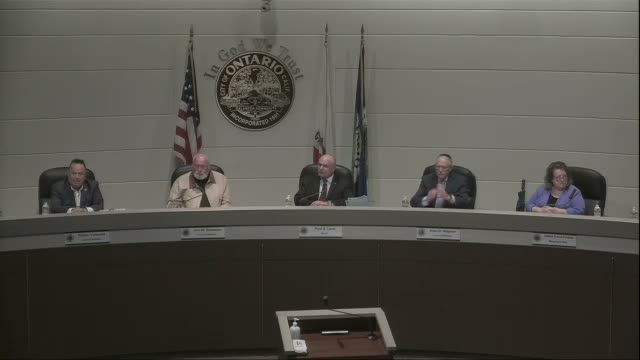
Ontario’s City Council voted 5-0 to reject an appeal of a planning commission approval for a nine–building industrial development east of Ontario International Airport, upholding staff recommendations and the use of an addendum to the Ontario Plan 2050 supplemental environmental impact report (File PDEV2047). The project would construct 4,263,454 square feet of industrial space on about 216.36 gross acres.
Mr. Murphy, the city’s executive director of community development, told the council the Planning Commission had reviewed an addendum to the city’s Plan 2050 EIR and approved the project by a 4–0 vote. Murphy said the appellate groups — Pomona Valley Audubon Society, the Center for Biological Diversity, Endangered Habitats League and Los Angeles Audubon Society — based their appeal on three main claims: procedural concerns about public-comment time at the Planning Commission, alleged misstatements about burrowing owl presence on the site and claims that the addendum did not adequately address cumulative greenhouse-gas and air-quality impacts.
Opponents pressed the council on biological and procedural grounds. Carol Coy, a biologist who said she reviewed federal wildlife-strike data, told the council she had examined FAA wildlife-strike entries and found many records documented partial remains or carcasses, and that the burrowing owl typically scores low on FAA hazard charts. "I've reviewed all 411 entries on the federal wildlife strike database from 1992 to 2022," Coy said, arguing the consultant’s characterization of risk was overstated. Other speakers, including members of Inland Valley Advocates for the Environment and the Center for Biological Diversity, said the site once supported larger numbers of owls (they referenced counts of 11 active nesting burrows in 2017) and that relocation risks, coding errors and the adequacy of the environmental analysis deserve greater scrutiny.
The applicant, represented by owner Bruce McDonald of Can Am, defended the project and the addendum. McDonald said surveys following state protocols found two pairs of burrowing owls on the property and that the applicant has proposed a translocation plan and five potential conservation sites. "We do have two pairs of burrowing owls," McDonald said, and his team said the proposed translocation plan has been submitted to state wildlife regulators and would need California Department of Fish and Wildlife approval as mitigation.
Technical witnesses presented opposing views on hazard and mitigation. Travis McGill, a wildlife biologist for the applicant, described surveys and said relocation to larger conserved areas could improve genetic diversity and survival. Lisa Harmon, an aviation consultant with Mead & Hunt, said burrowing owls appear in strike records frequently enough to raise concern and noted FAA guidance recommending conservation set back from aircraft movement areas; she said conservation adjacent to active movement areas is typically incompatible with federal grant assurances.
During deliberations council members cited the decline in local owl pairs and said they were persuaded by staff and the applicant’s mitigation commitments. The council took a motion "to reject the appeal," moved by Councilmember Jim Bowman and seconded by "Miss Bridal." City Attorney Bair clarified that a "yes" vote on the motion would be a vote in favor of the applicant and against the appellant. The motion passed by electronic vote 5–0.
The decision leaves the Planning Commission’s approval in place; staff and the applicant indicated that the project’s mitigation, including a translocation plan, will require agency approvals (California Department of Fish and Wildlife) and follow-up implementation steps. The council closed the public hearing and proceeded to the next agenda items.
The record for this hearing includes the project file PDEV2047, the Ontario Plan 2050 supplemental EIR addendum and 41 written communications lodged with the city.
Mr. Murphy, the city’s executive director of community development, told the council the Planning Commission had reviewed an addendum to the city’s Plan 2050 EIR and approved the project by a 4–0 vote. Murphy said the appellate groups — Pomona Valley Audubon Society, the Center for Biological Diversity, Endangered Habitats League and Los Angeles Audubon Society — based their appeal on three main claims: procedural concerns about public-comment time at the Planning Commission, alleged misstatements about burrowing owl presence on the site and claims that the addendum did not adequately address cumulative greenhouse-gas and air-quality impacts.
Opponents pressed the council on biological and procedural grounds. Carol Coy, a biologist who said she reviewed federal wildlife-strike data, told the council she had examined FAA wildlife-strike entries and found many records documented partial remains or carcasses, and that the burrowing owl typically scores low on FAA hazard charts. "I've reviewed all 411 entries on the federal wildlife strike database from 1992 to 2022," Coy said, arguing the consultant’s characterization of risk was overstated. Other speakers, including members of Inland Valley Advocates for the Environment and the Center for Biological Diversity, said the site once supported larger numbers of owls (they referenced counts of 11 active nesting burrows in 2017) and that relocation risks, coding errors and the adequacy of the environmental analysis deserve greater scrutiny.
The applicant, represented by owner Bruce McDonald of Can Am, defended the project and the addendum. McDonald said surveys following state protocols found two pairs of burrowing owls on the property and that the applicant has proposed a translocation plan and five potential conservation sites. "We do have two pairs of burrowing owls," McDonald said, and his team said the proposed translocation plan has been submitted to state wildlife regulators and would need California Department of Fish and Wildlife approval as mitigation.
Technical witnesses presented opposing views on hazard and mitigation. Travis McGill, a wildlife biologist for the applicant, described surveys and said relocation to larger conserved areas could improve genetic diversity and survival. Lisa Harmon, an aviation consultant with Mead & Hunt, said burrowing owls appear in strike records frequently enough to raise concern and noted FAA guidance recommending conservation set back from aircraft movement areas; she said conservation adjacent to active movement areas is typically incompatible with federal grant assurances.
During deliberations council members cited the decline in local owl pairs and said they were persuaded by staff and the applicant’s mitigation commitments. The council took a motion "to reject the appeal," moved by Councilmember Jim Bowman and seconded by "Miss Bridal." City Attorney Bair clarified that a "yes" vote on the motion would be a vote in favor of the applicant and against the appellant. The motion passed by electronic vote 5–0.
The decision leaves the Planning Commission’s approval in place; staff and the applicant indicated that the project’s mitigation, including a translocation plan, will require agency approvals (California Department of Fish and Wildlife) and follow-up implementation steps. The council closed the public hearing and proceeded to the next agenda items.
The record for this hearing includes the project file PDEV2047, the Ontario Plan 2050 supplemental EIR addendum and 41 written communications lodged with the city.
Don't Miss a Word: See the Full Meeting!
Go beyond summaries. Unlock every video, transcript, and key insight with a Founder Membership.
✓
Get instant access to full meeting videos
✓
Search and clip any phrase from complete transcripts
✓
Receive AI-powered summaries & custom alerts
✓
Enjoy lifetime, unrestricted access to government data
30-day money-back guarantee
