Committee reviews raising hospital outpatient drug cap to 130% of average sales price; hospitals and insurer flag fiscal trade-offs
May 09, 2026 | Health Care, HOUSE OF REPRESENTATIVES, Committees, Legislative , Vermont
This article was created by AI summarizing key points discussed. AI makes mistakes, so for full details and context, please refer to the video of the full meeting. Please report any errors so we can fix them. Report an error »
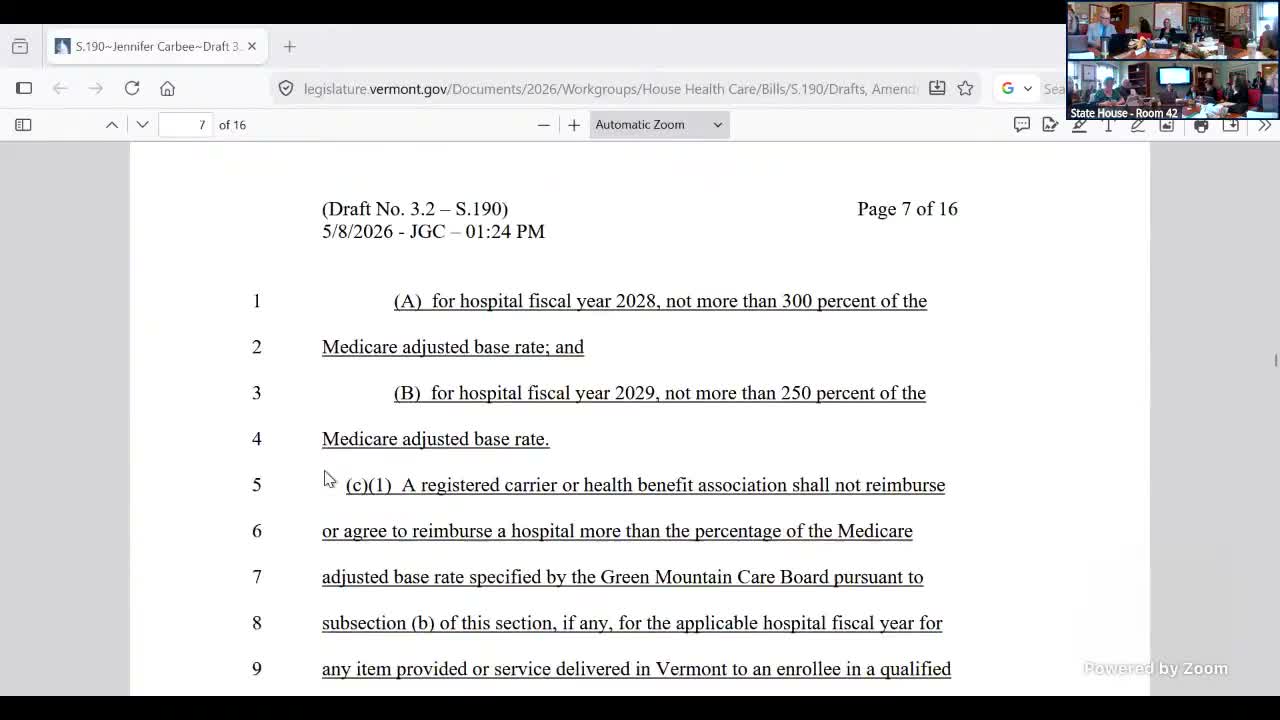
Legislative counsel Jennifer Carby told the committee the draft adds a provision amending Act 55’s cap on hospitals’ outpatient prescription drug reimbursement, which currently bars claims that exceed 120% of the average sales price (ASP) in effect as of 04/01/2025. "This would increase all of the 1 twenties to 1 thirties," Carby said, describing the technical change from 1.20 to 1.30.
Carby said the provision would apply to hospital outpatient and office settings where hospitals charge more than the ASP limit and that members had proposed staging the effective date. The draft as discussed tied the ASP adjustment to a mid‑year effective date (initially July 1, 2026) but members explored moving it to October 1 or January to ease implementation timing.
Committee members flagged a related fiscal trade‑off: the committee has a standing 3.5% commitment tied to net commercial patient revenue that stakeholders estimate translates to roughly $6,000,000. Chair Black said one approach would be to keep the 3.5% mechanism intact and use the ASP increase to “net back approximately that amount” so the overall budgetary effect would be neutral.
Representing hospitals, Devin Green of the Vermont Association of Hospitals and Health Systems said the 3.5% figure was in the $54–56 million range and that critical access hospitals’ net patient service revenue concerns were smaller (on the order of $3,000,000). "We do appreciate the acknowledgment of inflation in the Act 55 prescription drug cap," he said, while urging continued consultation with the Green Mountain Care Board on the critical access hospital language.
Courtney Harness of Blue Cross and Blue Shield of Vermont told the committee the change "will have a material worsening of the financial position of your domestic nonprofit insurer." Harness recalled prior ASP‑driven savings the insurer saw pass entirely through to premiums — citing an $87,000,000 ASP cost reduction — and said she did not expect those earlier reductions to have produced insurer gains. She said she had no immediate estimate for the fiscal impact of the 130% cap and would need to run the numbers for the committee.
Members pressed for clarity on timing and the magnitude of impacts: the committee discussed a six‑month window of transitional effects and how market shares (one member cited a 60% market share for the insurer) would affect dollar impacts (the committee colloquially calculated a half‑year impact of about $1.8 million for a 60% share of a $6 million estimate). No formal vote was taken; Chair Black said she would "hold off on a vote" to allow members and affected parties to consult and return with more precise figures.
The draft also includes provisions directed at critical access hospitals: Carby described intent language to inform Vermont seniors and Medicare beneficiaries about federal rules governing 20% cost sharing for outpatient services at critical access hospitals, require hospitals to identify outpatient services billed at high multiples of Medicare‑allowed amounts, post disclosures prominently on hospital websites and outpatient departments, and file proposed disclosure materials with the Green Mountain Care Board for approval.
The committee did not approve final language during the session and postponed voting to allow insurers, hospitals and the Green Mountain Care Board to provide clearer fiscal estimates and to discuss effective dates and implementation timing.
Carby said the provision would apply to hospital outpatient and office settings where hospitals charge more than the ASP limit and that members had proposed staging the effective date. The draft as discussed tied the ASP adjustment to a mid‑year effective date (initially July 1, 2026) but members explored moving it to October 1 or January to ease implementation timing.
Committee members flagged a related fiscal trade‑off: the committee has a standing 3.5% commitment tied to net commercial patient revenue that stakeholders estimate translates to roughly $6,000,000. Chair Black said one approach would be to keep the 3.5% mechanism intact and use the ASP increase to “net back approximately that amount” so the overall budgetary effect would be neutral.
Representing hospitals, Devin Green of the Vermont Association of Hospitals and Health Systems said the 3.5% figure was in the $54–56 million range and that critical access hospitals’ net patient service revenue concerns were smaller (on the order of $3,000,000). "We do appreciate the acknowledgment of inflation in the Act 55 prescription drug cap," he said, while urging continued consultation with the Green Mountain Care Board on the critical access hospital language.
Courtney Harness of Blue Cross and Blue Shield of Vermont told the committee the change "will have a material worsening of the financial position of your domestic nonprofit insurer." Harness recalled prior ASP‑driven savings the insurer saw pass entirely through to premiums — citing an $87,000,000 ASP cost reduction — and said she did not expect those earlier reductions to have produced insurer gains. She said she had no immediate estimate for the fiscal impact of the 130% cap and would need to run the numbers for the committee.
Members pressed for clarity on timing and the magnitude of impacts: the committee discussed a six‑month window of transitional effects and how market shares (one member cited a 60% market share for the insurer) would affect dollar impacts (the committee colloquially calculated a half‑year impact of about $1.8 million for a 60% share of a $6 million estimate). No formal vote was taken; Chair Black said she would "hold off on a vote" to allow members and affected parties to consult and return with more precise figures.
The draft also includes provisions directed at critical access hospitals: Carby described intent language to inform Vermont seniors and Medicare beneficiaries about federal rules governing 20% cost sharing for outpatient services at critical access hospitals, require hospitals to identify outpatient services billed at high multiples of Medicare‑allowed amounts, post disclosures prominently on hospital websites and outpatient departments, and file proposed disclosure materials with the Green Mountain Care Board for approval.
The committee did not approve final language during the session and postponed voting to allow insurers, hospitals and the Green Mountain Care Board to provide clearer fiscal estimates and to discuss effective dates and implementation timing.
View the Full Meeting & All Its Details
This article offers just a summary. Unlock complete video, transcripts, and insights as a Founder Member.
✓
Watch full, unedited meeting videos
✓
Search every word spoken in unlimited transcripts
✓
AI summaries & real-time alerts (all government levels)
✓
Permanent access to expanding government content
30-day money-back guarantee
