Staff tells Chapel Hill‑Carrboro school board the study supports considering at most one elementary‑school closure
May 09, 2026 | Chapel Hill-Carrboro City Schools, School Districts, North Carolina
This article was created by AI summarizing key points discussed. AI makes mistakes, so for full details and context, please refer to the video of the full meeting. Please report any errors so we can fix them. Report an error »
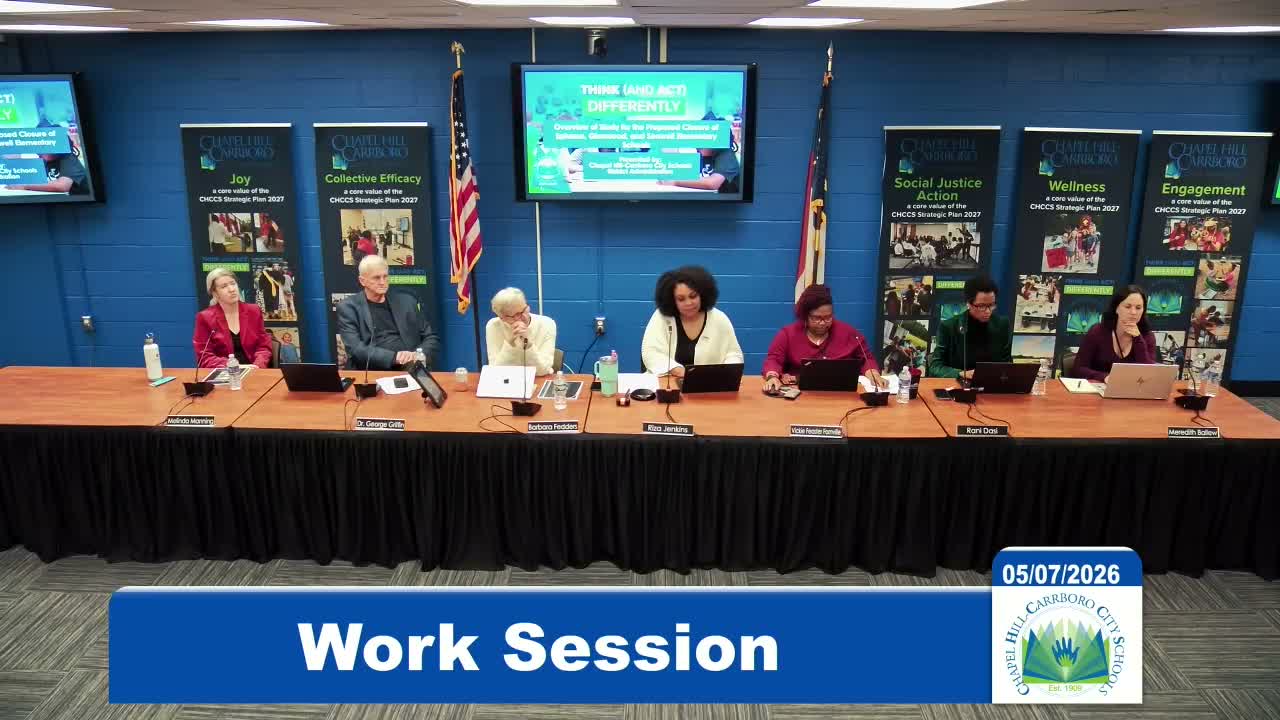
District staff presented a study of three elementary schools under consideration for closure and recommended the board consider at most one school for closure, saying new housing analysis and program‑capacity work make multiple closures unnecessary at this time.
Mr. Ciarochi, who presented the report, summarized the study's scope and data sources — including Carolina Demography, NC State program‑capacity inventories and prior Wolpert facility work — and emphasized the distinction between statutorily required criteria and board‑requested analyses. He said Carolina Demography's housing work reduced the projected elementary decline to about 111 students over a 10‑year period and urged the board to focus on five‑year trends.
The presentation highlighted mandated criteria such as geographic conditions and inconvenience to affected pupils, then reviewed capital and operating cost estimates. Staff reported recent expenditures of roughly $678,000 at Ephesus, $770,000 at Glenwood and $2.6 million at Sewell (2020–2025) and noted long‑range facility estimates differ by methodology. Staff also said the district currently receives about $4.2 million annually for maintenance and that projected needs substantially exceed that amount.
On utilization, NC State's program‑capacity inventory produced a lower, program‑aware capacity metric than older SSAFA legacy numbers. Using program capacity, staff said district utilization was about 81% and could be raised into the mid‑80s by redistricting; closing one school would push utilization higher but closing two could exceed the practical program‑capacity range and strain school flexibility.
Staff also reviewed transportation and routing implications and estimated additional transport costs of roughly $112,000–$117,000 for some closure scenarios, while noting program schools like Glenwood might not add net transportation cost because of existing travel patterns.
After the presentation, board members asked detailed questions about utilization targets, the confidence of housing projections, how redistricting scenarios would be developed, and whether the May 21 public hearing would consider all three schools or a narrowed set of options. Mr. Ciarochi said the hearing could be for all three schools if the board did not narrow options first; staff did not make an explicit closure motion at the meeting.
Mr. Ciarochi said staff's assessment, based on the combined criteria and the new program‑capacity data, would support considering no schools or one school for closure rather than two. The board set a public hearing for May 21 and discussed a possible decision date of June 4 and a post‑decision redistricting process that could extend into the following school year.
The meeting closed with committee reports and instructions to direct the public to a project website for materials and a moderated feedback form.
Mr. Ciarochi, who presented the report, summarized the study's scope and data sources — including Carolina Demography, NC State program‑capacity inventories and prior Wolpert facility work — and emphasized the distinction between statutorily required criteria and board‑requested analyses. He said Carolina Demography's housing work reduced the projected elementary decline to about 111 students over a 10‑year period and urged the board to focus on five‑year trends.
The presentation highlighted mandated criteria such as geographic conditions and inconvenience to affected pupils, then reviewed capital and operating cost estimates. Staff reported recent expenditures of roughly $678,000 at Ephesus, $770,000 at Glenwood and $2.6 million at Sewell (2020–2025) and noted long‑range facility estimates differ by methodology. Staff also said the district currently receives about $4.2 million annually for maintenance and that projected needs substantially exceed that amount.
On utilization, NC State's program‑capacity inventory produced a lower, program‑aware capacity metric than older SSAFA legacy numbers. Using program capacity, staff said district utilization was about 81% and could be raised into the mid‑80s by redistricting; closing one school would push utilization higher but closing two could exceed the practical program‑capacity range and strain school flexibility.
Staff also reviewed transportation and routing implications and estimated additional transport costs of roughly $112,000–$117,000 for some closure scenarios, while noting program schools like Glenwood might not add net transportation cost because of existing travel patterns.
After the presentation, board members asked detailed questions about utilization targets, the confidence of housing projections, how redistricting scenarios would be developed, and whether the May 21 public hearing would consider all three schools or a narrowed set of options. Mr. Ciarochi said the hearing could be for all three schools if the board did not narrow options first; staff did not make an explicit closure motion at the meeting.
Mr. Ciarochi said staff's assessment, based on the combined criteria and the new program‑capacity data, would support considering no schools or one school for closure rather than two. The board set a public hearing for May 21 and discussed a possible decision date of June 4 and a post‑decision redistricting process that could extend into the following school year.
The meeting closed with committee reports and instructions to direct the public to a project website for materials and a moderated feedback form.
View the Full Meeting & All Its Details
This article offers just a summary. Unlock complete video, transcripts, and insights as a Founder Member.
✓
Watch full, unedited meeting videos
✓
Search every word spoken in unlimited transcripts
✓
AI summaries & real-time alerts (all government levels)
✓
Permanent access to expanding government content
30-day money-back guarantee
