Committee reviews House strike‑all on S.227, debates superintendent duties and warrant limits
May 09, 2026 | Education, SENATE, Committees, Legislative , Vermont
This article was created by AI summarizing key points discussed. AI makes mistakes, so for full details and context, please refer to the video of the full meeting. Please report any errors so we can fix them. Report an error »
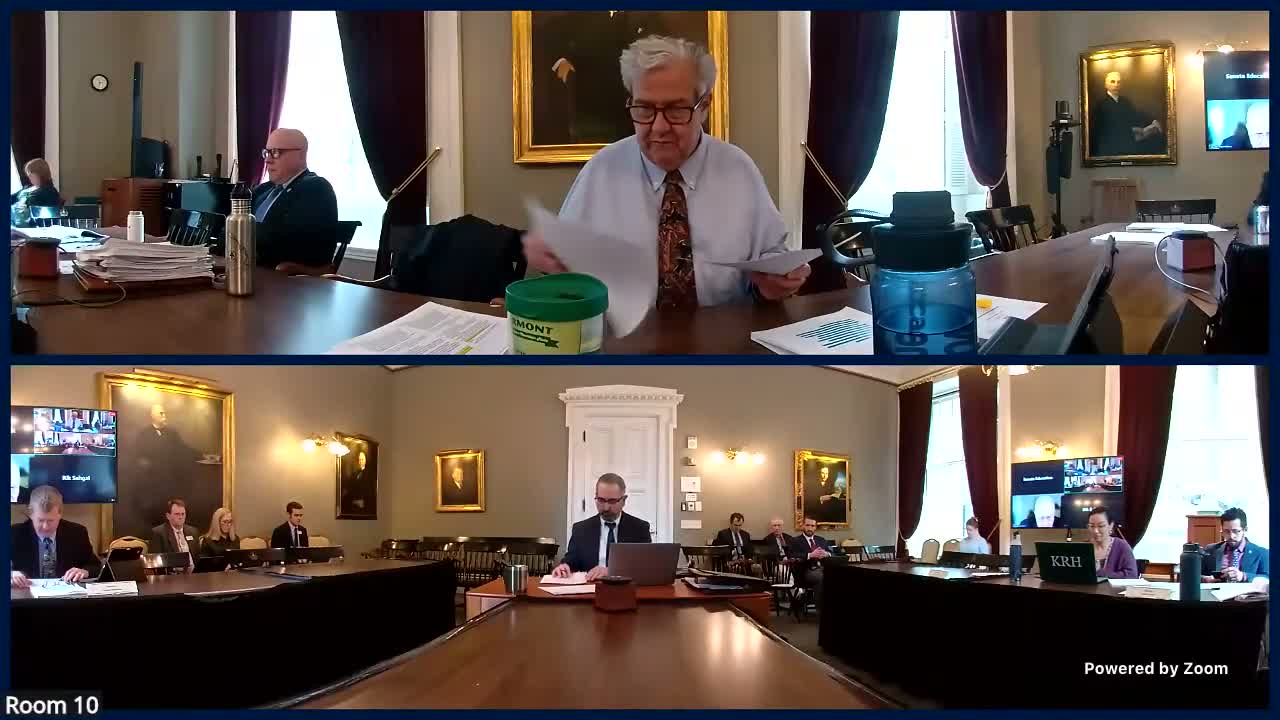
The Senate education committee on S.227 reviewed a House 'strike‑all' amendment that alters how schools must respond in immigration‑related incidents, with particular attention to who can declare nonpublic areas, how student information is shared and what a judicial warrant must authorize for law‑enforcement entry.
Rick Sable of the office of legislative counsel opened the session with a web‑posted side‑by‑side of the Senate and House texts, saying he had "highlighted the pertinent changes" so lawmakers could see where the House narrowed or restructured language. He noted the House repeatedly added the phrase "head of school or designee" to indicate that some duties extend to approved independent schools as well as public districts.
Committee members pressed for precision on the bill's definitions. Counsel said the House removed language that had treated employees and contractors as part of the definition of "school," and the committee discussed whether the bill should explicitly apply only to "approved independent schools" under Title 16 §166. Several members said independent schools that are not approved by the state likely fall outside the bill's reach, and counsel agreed to draft clarifying language.
A central point of debate was how warrants should be handled when law enforcement seeks to enter school property. The House text narrows the warrant requirement so a judicial warrant must "authorize entrance into a specific area of the school" and name a specific individual located within the school. Some members argued that narrowing the text could help limit disruption to children; others warned it could make it difficult for officers to execute warrants and could endanger officers and officials if a targeted individual moves to a different wing.
One committee member described the feared consequences of broad enforcement actions in schools, saying local reports showed unmarked vehicles and armed agents during an incident that "terrorized" people nearby; a different member responded that the bill's objective is to prevent precisely that kind of intrusion unless a warrant expressly says so. Counsel recommended amending language to say "specific areas" and to ensure the statute aligns with how superintendents will read warrants in practice.
On student privacy and information sharing, counsel said the House reworded the section to focus on "student information privacy" and broadened the entities covered to "school districts and independent schools," clarifying which bodies are prohibited from using policies that would exclude students or disclose protected information except as required by law. The committee also discussed whether a superintendent's duty to "connect the student and the student's family" to immigration advocates should instead be limited to contacting a parent or legal guardian or focused on the student only; several members urged narrowing that requirement to avoid imposing unfamiliar responsibilities on school leaders.
Committee members asked about timing and implementation. Counsel said parts of the immigration resource guide will be placed in session law with a one‑time delivery deadline, while other guidance and model procedures would be developed by the Attorney General and distributed through the Agency of Education; dates discussed included an August distribution window and a model‑procedure deadline tied to 01/01/2027. Counsel said he would prepare amendments to clarify whether references should read "approved independent schools" and to adjust the warrant language as discussed.
The committee did not take a final vote on S.227 during this session; counsel posted draft 2.1 of the bill language to the committee webpage and the panel shifted to other business.
Rick Sable of the office of legislative counsel opened the session with a web‑posted side‑by‑side of the Senate and House texts, saying he had "highlighted the pertinent changes" so lawmakers could see where the House narrowed or restructured language. He noted the House repeatedly added the phrase "head of school or designee" to indicate that some duties extend to approved independent schools as well as public districts.
Committee members pressed for precision on the bill's definitions. Counsel said the House removed language that had treated employees and contractors as part of the definition of "school," and the committee discussed whether the bill should explicitly apply only to "approved independent schools" under Title 16 §166. Several members said independent schools that are not approved by the state likely fall outside the bill's reach, and counsel agreed to draft clarifying language.
A central point of debate was how warrants should be handled when law enforcement seeks to enter school property. The House text narrows the warrant requirement so a judicial warrant must "authorize entrance into a specific area of the school" and name a specific individual located within the school. Some members argued that narrowing the text could help limit disruption to children; others warned it could make it difficult for officers to execute warrants and could endanger officers and officials if a targeted individual moves to a different wing.
One committee member described the feared consequences of broad enforcement actions in schools, saying local reports showed unmarked vehicles and armed agents during an incident that "terrorized" people nearby; a different member responded that the bill's objective is to prevent precisely that kind of intrusion unless a warrant expressly says so. Counsel recommended amending language to say "specific areas" and to ensure the statute aligns with how superintendents will read warrants in practice.
On student privacy and information sharing, counsel said the House reworded the section to focus on "student information privacy" and broadened the entities covered to "school districts and independent schools," clarifying which bodies are prohibited from using policies that would exclude students or disclose protected information except as required by law. The committee also discussed whether a superintendent's duty to "connect the student and the student's family" to immigration advocates should instead be limited to contacting a parent or legal guardian or focused on the student only; several members urged narrowing that requirement to avoid imposing unfamiliar responsibilities on school leaders.
Committee members asked about timing and implementation. Counsel said parts of the immigration resource guide will be placed in session law with a one‑time delivery deadline, while other guidance and model procedures would be developed by the Attorney General and distributed through the Agency of Education; dates discussed included an August distribution window and a model‑procedure deadline tied to 01/01/2027. Counsel said he would prepare amendments to clarify whether references should read "approved independent schools" and to adjust the warrant language as discussed.
The committee did not take a final vote on S.227 during this session; counsel posted draft 2.1 of the bill language to the committee webpage and the panel shifted to other business.
Don't Miss a Word: See the Full Meeting!
Go beyond summaries. Unlock every video, transcript, and key insight with a Founder Membership.
✓
Get instant access to full meeting videos
✓
Search and clip any phrase from complete transcripts
✓
Receive AI-powered summaries & custom alerts
✓
Enjoy lifetime, unrestricted access to government data
30-day money-back guarantee
