Panel weighs faster ejectments, shorter landlord duty to store belongings and wider no‑trespass powers
May 09, 2026 | Economic Development, Housing & General Affairs, SENATE, Committees, Legislative , Vermont
This article was created by AI summarizing key points discussed. AI makes mistakes, so for full details and context, please refer to the video of the full meeting. Please report any errors so we can fix them. Report an error »
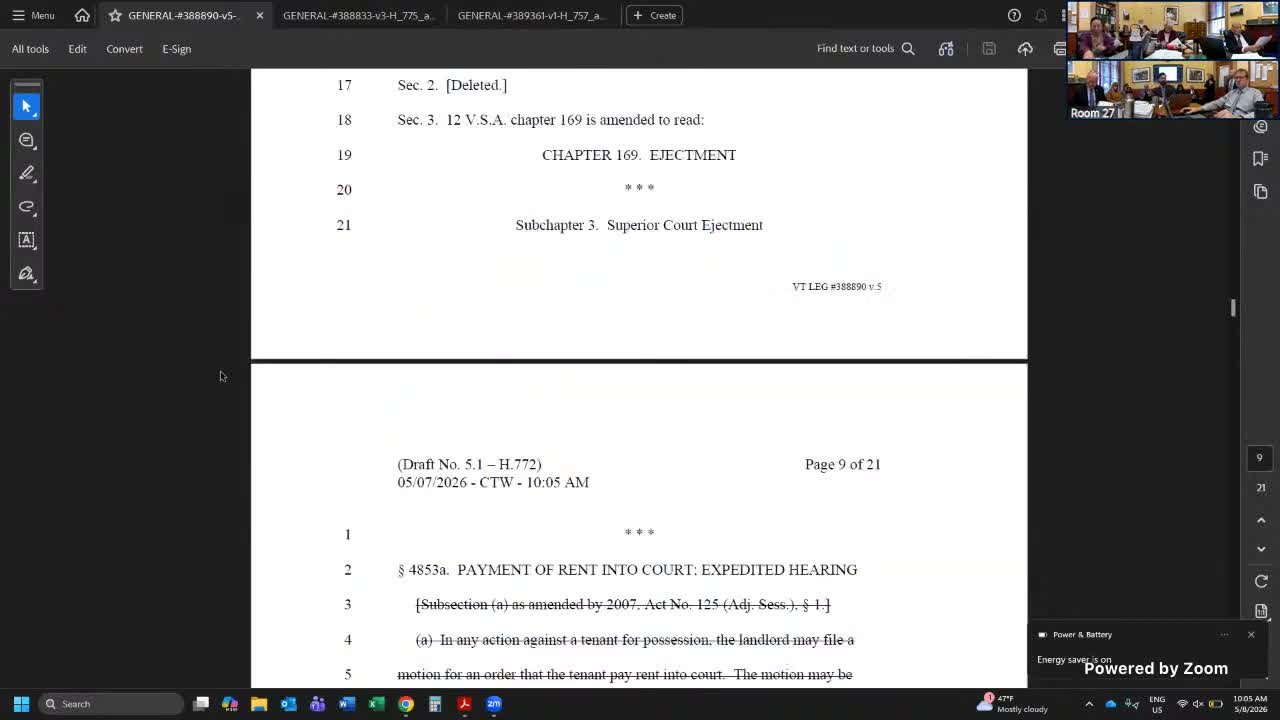
Committee discussion on May 8 focused closely on ejectment procedure and consequences for tenants’ personal property. Cameron Wood explained how the judiciary‑recommended changes would alter current practice: under existing law landlords must hold tenant property for 15 days after service of a writ; the draft would let landlords dispose of property upon being restored to possession in instances where writ timelines are short (5 or 7 days in some circumstances).
Legal advocates and several committee members raised immediate concerns. A representative of Legal Services Vermont noted that a 7‑day writ can be issued in rent‑in‑court cases and that shortening a landlord’s duty to store belongings could leave tenants without a chance to recover possessions even where they later can pay or successfully seek relief: "If the tenant can get legal help, we can go say to the court, please turn that around... But 7 days is super short," the advocate said.
The committee also debated changes to no‑trespass authority. The judiciary added language allowing a landlord to issue an individualized no‑trespass order (enforceable for one year, renewable) when a guest has been previously ejected for criminal or violent conduct or when a guest violates lease terms while on the property. Members pressed to limit the expansion to ejections that resulted from criminal activity or violent acts and discussed whether single‑family homes could be unintentionally swept in.
A motion was proposed to strike the proposed storage changes and return to current law (maintaining the 15‑day obligation); committee leaders asked for revised language and a straw poll on the storage section. The committee did not complete a final vote on the ejectment or no‑trespass amendments and asked staff to produce drafting options and to consult with sheriffs and court staff about feasibility and implementation costs.
What happens next: Staff and counsel were asked to return with clarified language (including possible limits tied to repeated harmful conduct, definitions of "lawful" vs. "unlawful" occupants and the relationship between writ issuance and storage obligations) before members vote on statutory changes.
Legal advocates and several committee members raised immediate concerns. A representative of Legal Services Vermont noted that a 7‑day writ can be issued in rent‑in‑court cases and that shortening a landlord’s duty to store belongings could leave tenants without a chance to recover possessions even where they later can pay or successfully seek relief: "If the tenant can get legal help, we can go say to the court, please turn that around... But 7 days is super short," the advocate said.
The committee also debated changes to no‑trespass authority. The judiciary added language allowing a landlord to issue an individualized no‑trespass order (enforceable for one year, renewable) when a guest has been previously ejected for criminal or violent conduct or when a guest violates lease terms while on the property. Members pressed to limit the expansion to ejections that resulted from criminal activity or violent acts and discussed whether single‑family homes could be unintentionally swept in.
A motion was proposed to strike the proposed storage changes and return to current law (maintaining the 15‑day obligation); committee leaders asked for revised language and a straw poll on the storage section. The committee did not complete a final vote on the ejectment or no‑trespass amendments and asked staff to produce drafting options and to consult with sheriffs and court staff about feasibility and implementation costs.
What happens next: Staff and counsel were asked to return with clarified language (including possible limits tied to repeated harmful conduct, definitions of "lawful" vs. "unlawful" occupants and the relationship between writ issuance and storage obligations) before members vote on statutory changes.
View the Full Meeting & All Its Details
This article offers just a summary. Unlock complete video, transcripts, and insights as a Founder Member.
✓
Watch full, unedited meeting videos
✓
Search every word spoken in unlimited transcripts
✓
AI summaries & real-time alerts (all government levels)
✓
Permanent access to expanding government content
30-day money-back guarantee
