Senate Education Committee reviews draft of school district consolidation bill and delays class-size enforcement until foundation formula
May 09, 2026 | Education, SENATE, Committees, Legislative , Vermont
This article was created by AI summarizing key points discussed. AI makes mistakes, so for full details and context, please refer to the video of the full meeting. Please report any errors so we can fix them. Report an error »
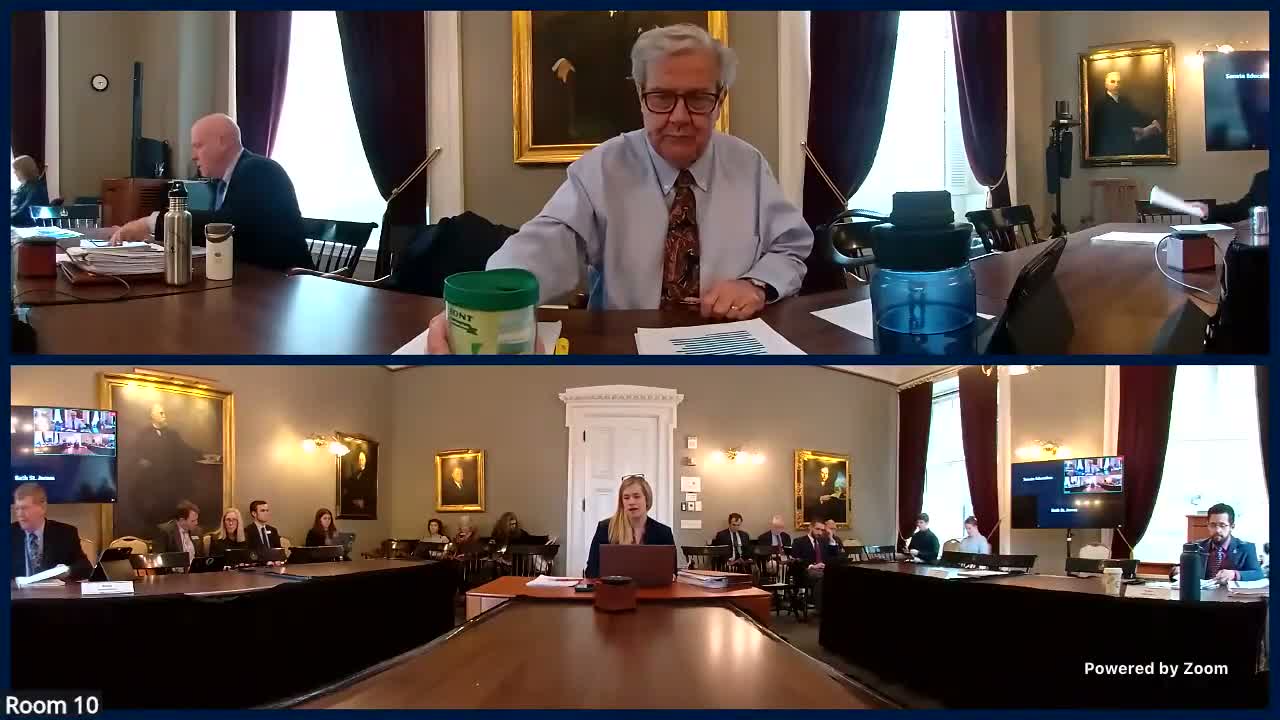
Beth St. James of the Office of Legislative Council presented changes to draft 5.2 of a bill concerning school district consolidation and school accountability, opening with newly added findings that describe administrative efficiencies from consolidation while warning of potential harms from closing small elementary schools in rural areas.
The counsel said the draft’s findings state that consolidation "resulted in the creation of larger supervisory districts and unified union school districts, which have achieved measurable administrative efficiencies, including reductions in per pupil central office costs and the elimination of duplicative governance structures," while acknowledging research showing closures "may negatively affect student outcomes and family engagement, particularly in rural areas." She also read national context language noting median and average district sizes and that "approximately 40 percent of Vermont high school graduates enroll in a 2 or 4 year degree program."
Counsel described revised reporting requirements for study committees (page 36): reports must list affected school districts, assess strengths and challenges of current structures, make concrete recommendations, and analyze how recommendations would enable study-committee districts to "maximize operational efficiencies, promote transparency and accountability, and encourage and support local decisions" under the foundation formula.
On class-size minimums (pages 74–75), counsel said the statute’s effective date is 07/01/2026 but the rules to implement those minimums are not yet finalized. To avoid prematurely triggering accountability timelines, draft 5.2 delays the "clock" that would count consecutive years of noncompliance—the trigger for potential state action—until the foundation formula is in effect and relevant contingencies and implementing rules are met. Counsel explained independent schools are treated differently in the draft because their accountability process is expected to be developed by rule under existing law (16 BSA 8 28), so the bill ties continuing eligibility for public tuition to compliance until those rules are established.
Several senators raised concerns during a temperature check. One member said they had "no remaining significant concerns" about the education-policy parts but expressed deep concerns about property-classification and taxation provisions in the bill and said they are coordinating with the Senate Finance Committee on those items. A senator who identified themself as having an "opt out" perspective said they would vote no. Another member said they planned to vote yes but flagged methodological concerns about an underlying guidance map used for district planning. A member addressed as "Hoeppner" urged removing wording that might discourage local decisions to close small elementary schools, saying the bill lacks teeth to achieve targeted outcomes. One senator said they are preparing an amendment on special education to bring next week to ensure special-education governance is not an afterthought.
Committee members debated whether to proceed with a formal vote or pause to allow the Finance Committee to complete work on the bill’s tax components. Counsel confirmed the updated draft (referenced as 5.2) was posted and said staff would circulate a new copy with the agreed edits. The committee recessed to wait for additional staff before taking further action; no motion or formal vote was recorded at this meeting.
Next steps: staff will post a clean draft reflecting the agreed edits, the Senate Finance Committee is reviewing tax provisions, and at least one senator plans to file a special-education amendment next week. The committee did not vote and will reconvene after related committee work progresses.
The counsel said the draft’s findings state that consolidation "resulted in the creation of larger supervisory districts and unified union school districts, which have achieved measurable administrative efficiencies, including reductions in per pupil central office costs and the elimination of duplicative governance structures," while acknowledging research showing closures "may negatively affect student outcomes and family engagement, particularly in rural areas." She also read national context language noting median and average district sizes and that "approximately 40 percent of Vermont high school graduates enroll in a 2 or 4 year degree program."
Counsel described revised reporting requirements for study committees (page 36): reports must list affected school districts, assess strengths and challenges of current structures, make concrete recommendations, and analyze how recommendations would enable study-committee districts to "maximize operational efficiencies, promote transparency and accountability, and encourage and support local decisions" under the foundation formula.
On class-size minimums (pages 74–75), counsel said the statute’s effective date is 07/01/2026 but the rules to implement those minimums are not yet finalized. To avoid prematurely triggering accountability timelines, draft 5.2 delays the "clock" that would count consecutive years of noncompliance—the trigger for potential state action—until the foundation formula is in effect and relevant contingencies and implementing rules are met. Counsel explained independent schools are treated differently in the draft because their accountability process is expected to be developed by rule under existing law (16 BSA 8 28), so the bill ties continuing eligibility for public tuition to compliance until those rules are established.
Several senators raised concerns during a temperature check. One member said they had "no remaining significant concerns" about the education-policy parts but expressed deep concerns about property-classification and taxation provisions in the bill and said they are coordinating with the Senate Finance Committee on those items. A senator who identified themself as having an "opt out" perspective said they would vote no. Another member said they planned to vote yes but flagged methodological concerns about an underlying guidance map used for district planning. A member addressed as "Hoeppner" urged removing wording that might discourage local decisions to close small elementary schools, saying the bill lacks teeth to achieve targeted outcomes. One senator said they are preparing an amendment on special education to bring next week to ensure special-education governance is not an afterthought.
Committee members debated whether to proceed with a formal vote or pause to allow the Finance Committee to complete work on the bill’s tax components. Counsel confirmed the updated draft (referenced as 5.2) was posted and said staff would circulate a new copy with the agreed edits. The committee recessed to wait for additional staff before taking further action; no motion or formal vote was recorded at this meeting.
Next steps: staff will post a clean draft reflecting the agreed edits, the Senate Finance Committee is reviewing tax provisions, and at least one senator plans to file a special-education amendment next week. The committee did not vote and will reconvene after related committee work progresses.
View the Full Meeting & All Its Details
This article offers just a summary. Unlock complete video, transcripts, and insights as a Founder Member.
✓
Watch full, unedited meeting videos
✓
Search every word spoken in unlimited transcripts
✓
AI summaries & real-time alerts (all government levels)
✓
Permanent access to expanding government content
30-day money-back guarantee
