Utah Geological Survey board hears finance update; outside funding surges and lapsing ceiling raised
May 09, 2026 | Utah Department of Natural Resources, Utah Government Divisions, Utah Legislative Branch, Utah
This article was created by AI summarizing key points discussed. AI makes mistakes, so for full details and context, please refer to the video of the full meeting. Please report any errors so we can fix them. Report an error »
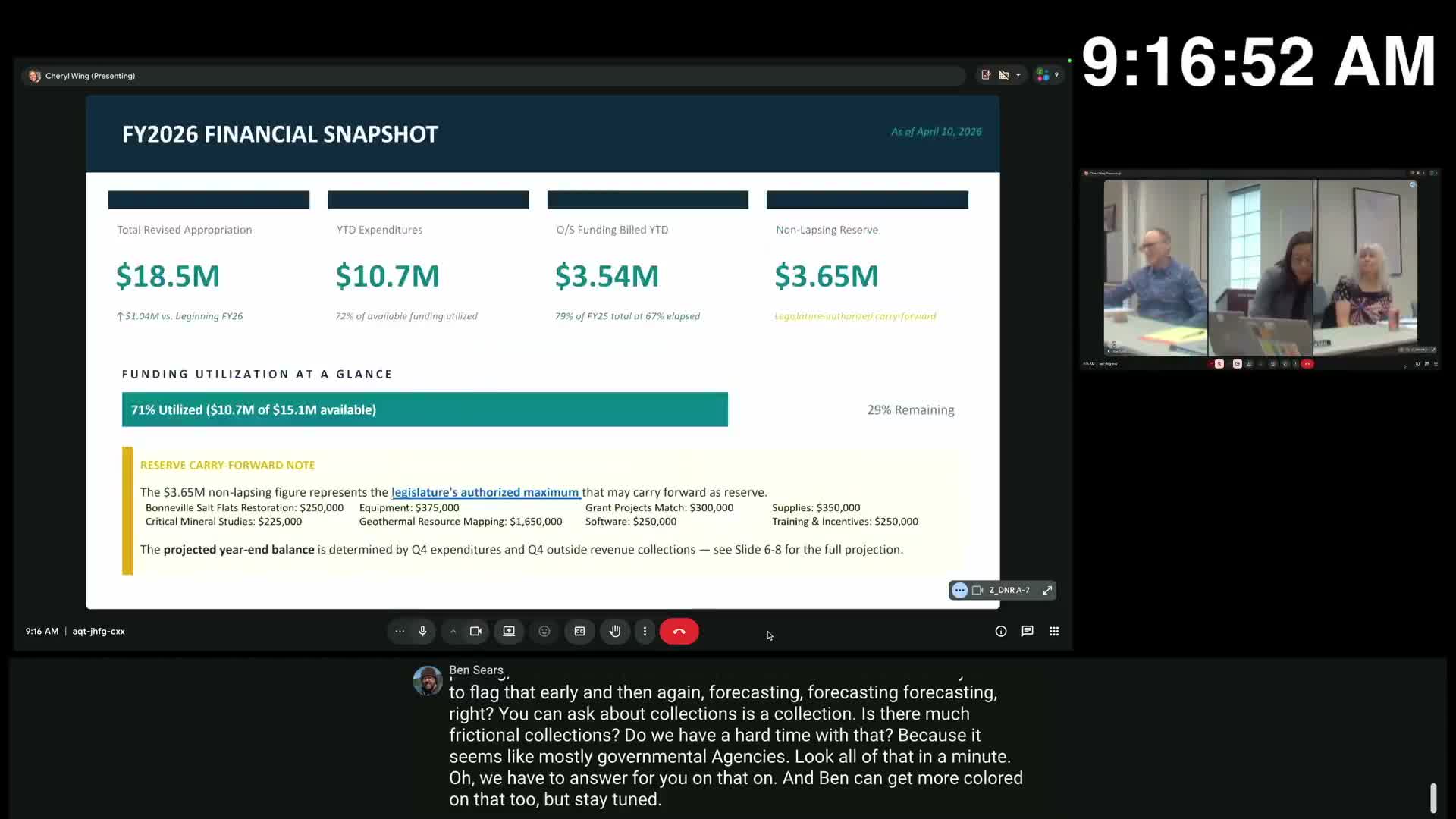
The Utah Geological Survey Board on April 15 received a detailed finance briefing showing the agencys budget stabilized after earlier revenue shortfalls and a strong year-to-date run on outside funding.
Lynn Seymour, the surveys finance manager, told board members the funding architecture for fiscal 2026 includes roughly $8.9 million in general-fund support and substantial supplementing revenue from restricted accounts and outside funding. "All of that component making up the operating budget for the survey," Seymour said, noting the surveys total operating budget combines fixed funding ($12,230,000) and outside funding ($6,270,000). She reported year-to-date expenditures of about $10.7 million as of April 10 and outside funding billed of $3.54 million, with $2.93 million collected so far.
Director (name not stated in the record) credited staff and finance work with a turnaround in collections after earlier gaps in grant charging. "Starting in February ... we were moving in the right direction," the director said, describing steps taken to ensure staff apply correct grant codes and to back-charge eligible grants to recover revenue.
Board members and staff discussed timing risks tied to the surveys restricted account (Account 1137) and the agencys lapsing-ceiling policy. Seymour said the agency successfully sought a higher lapsing ceiling so it could carry forward more building-block funds, increasing the approved carryforward authority to $3,650,000. The finance presentation projected a June 30, 2026 restricted-account balance of roughly $633,273 under current assumptions, and a year-end available balance in the range that would leave an expected positive carryforward (base case ~ $2.4 million).
Seymour outlined forecast methods used for the final quarter: a base case using recent quarters' averages, plus low/high scenarios by adjusting one standard deviation. The finance teams base forecast projected Q4 collections of roughly $1.6 million, which would bring full-year outside funding to about $4.52 million; staff said actual collections may be higher in a favorable scenario.
Board members pressed on revenue timing, noting that some state agencies and universities are slower to pay reimbursements. Seymour said collection friction existed but was manageable and that the surveys improved billing practices reduced risk of lapse or revenue loss.
The presentation also flagged workforce capacity as an implementation risk: personnel costs are the surveys largest expenditure (about 76% of total), and staff bandwidth can affect project delivery and therefore collections. The board asked staff to provide additional multi-year projections and proposals for managing restricted funds and staffing to sustain outside-funded projects.
The board took no additional formal action on finances during the meeting; the finance team will follow up with more detailed forecasts and proposed staffing plans at a future meeting.
Lynn Seymour, the surveys finance manager, told board members the funding architecture for fiscal 2026 includes roughly $8.9 million in general-fund support and substantial supplementing revenue from restricted accounts and outside funding. "All of that component making up the operating budget for the survey," Seymour said, noting the surveys total operating budget combines fixed funding ($12,230,000) and outside funding ($6,270,000). She reported year-to-date expenditures of about $10.7 million as of April 10 and outside funding billed of $3.54 million, with $2.93 million collected so far.
Director (name not stated in the record) credited staff and finance work with a turnaround in collections after earlier gaps in grant charging. "Starting in February ... we were moving in the right direction," the director said, describing steps taken to ensure staff apply correct grant codes and to back-charge eligible grants to recover revenue.
Board members and staff discussed timing risks tied to the surveys restricted account (Account 1137) and the agencys lapsing-ceiling policy. Seymour said the agency successfully sought a higher lapsing ceiling so it could carry forward more building-block funds, increasing the approved carryforward authority to $3,650,000. The finance presentation projected a June 30, 2026 restricted-account balance of roughly $633,273 under current assumptions, and a year-end available balance in the range that would leave an expected positive carryforward (base case ~ $2.4 million).
Seymour outlined forecast methods used for the final quarter: a base case using recent quarters' averages, plus low/high scenarios by adjusting one standard deviation. The finance teams base forecast projected Q4 collections of roughly $1.6 million, which would bring full-year outside funding to about $4.52 million; staff said actual collections may be higher in a favorable scenario.
Board members pressed on revenue timing, noting that some state agencies and universities are slower to pay reimbursements. Seymour said collection friction existed but was manageable and that the surveys improved billing practices reduced risk of lapse or revenue loss.
The presentation also flagged workforce capacity as an implementation risk: personnel costs are the surveys largest expenditure (about 76% of total), and staff bandwidth can affect project delivery and therefore collections. The board asked staff to provide additional multi-year projections and proposals for managing restricted funds and staffing to sustain outside-funded projects.
The board took no additional formal action on finances during the meeting; the finance team will follow up with more detailed forecasts and proposed staffing plans at a future meeting.
Don't Miss a Word: See the Full Meeting!
Go beyond summaries. Unlock every video, transcript, and key insight with a Founder Membership.
✓
Get instant access to full meeting videos
✓
Search and clip any phrase from complete transcripts
✓
Receive AI-powered summaries & custom alerts
✓
Enjoy lifetime, unrestricted access to government data
30-day money-back guarantee
