Alabama House approves SB1 after heated floor debate over redistricting and court orders
May 09, 2026 | House, Alabama Legislative Sessions, Alabama
This article was created by AI summarizing key points discussed. AI makes mistakes, so for full details and context, please refer to the video of the full meeting. Please report any errors so we can fix them. Report an error »
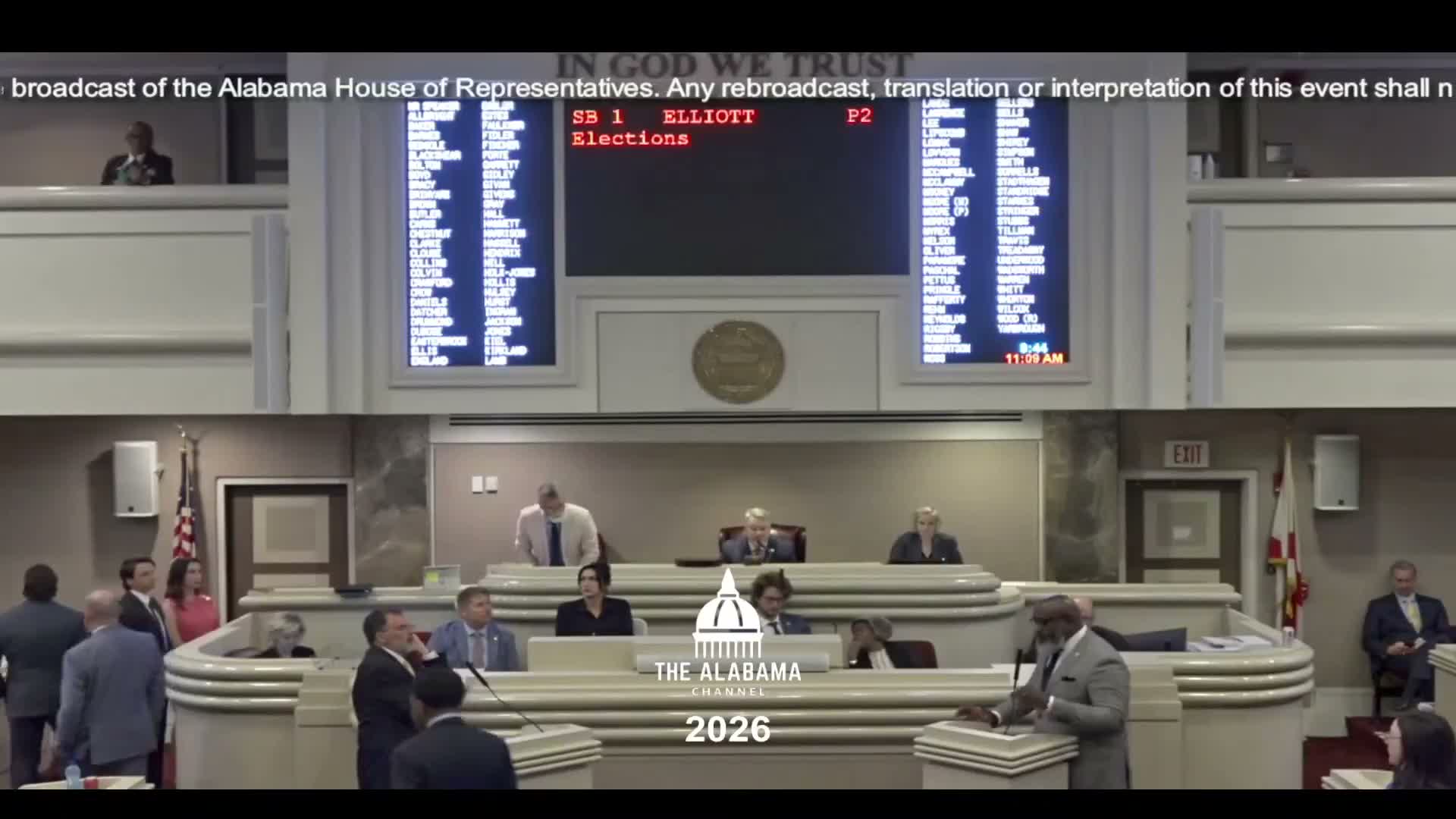
The Alabama House of Representatives voted to pass SB1 on a 75-29 recorded vote after a contentious special-session floor debate about redistricting, federal injunctions and the potential political effect on Black voters.
Supporters framed SB1 as a narrowly targeted measure tied to the status of federal litigation. At the lectern, the member defending the measure (speaker S2) said SB1 "provides a pathway for the parties to have a nomination process in the 2 state senate districts should the federal courts lift their decision against us." That description framed the bill as conditional on changes in ongoing court orders.
Opponents called the session unnecessary and charged the move would imperil representation for Black Alabamians. In a floor speech, Mr. England argued the court-ordered remedial maps "satisfied the courts and the legislature's stated principles" and cautioned that returning to earlier maps would risk diluting Black voting strength. Representative Roselyn McClammie pressed the chamber on costs and local control, saying the special session was "interfering in Montgomery County" and urging colleagues to "stop wasting our taxpayers' money, stop trying to take away our black people's voice and representation." Representative Rolanda Hollis described the week's events as rooted in racism and urged people to "be ready to mobilize" and use their vote.
The debate repeatedly turned to federal litigation that has constrained Alabama's maps. Speakers referenced cases consolidated into the broader Allen/Milligan litigation and related filings; members disagreed over whether particular state-senate matters had been separately litigated or folded into the congressional injunction. The member defending SB1 emphasized the right to appeal court rulings, saying "the constitution provides us the ability to appeal court decisions." Opponents said the state had previously defied court instructions and criticized the hiring of outside counsel.
Several numerical claims were made on the floor about costs: Representative McClammie referenced funds paid to attorneys, citing a figure of "$86,000,000," and also accused the state of spending "over $100 millions" on legal fees; Representative Hollis said the week cost approximately "$5,100,000." These figures were presented by lawmakers during debate and have not been independently verified in the chamber record.
Procedural steps accelerated the bill's consideration. Members moved the previous question to close debate; after the closure process the clerk recorded the final SB1 vote as 75 ayes and 29 nays and the chair declared the bill passed. The House then received a rules committee report on the journal and, later in the day, a member moved the House to adjourn sine die; the motion was approved.
The floor record documents the passage and the charged exchange that preceded it; the transcript contains repeated references to injunctions, special-master plans and prior litigation as the legal backdrop to SB1. The House adjourned sine die following the vote.
Supporters framed SB1 as a narrowly targeted measure tied to the status of federal litigation. At the lectern, the member defending the measure (speaker S2) said SB1 "provides a pathway for the parties to have a nomination process in the 2 state senate districts should the federal courts lift their decision against us." That description framed the bill as conditional on changes in ongoing court orders.
Opponents called the session unnecessary and charged the move would imperil representation for Black Alabamians. In a floor speech, Mr. England argued the court-ordered remedial maps "satisfied the courts and the legislature's stated principles" and cautioned that returning to earlier maps would risk diluting Black voting strength. Representative Roselyn McClammie pressed the chamber on costs and local control, saying the special session was "interfering in Montgomery County" and urging colleagues to "stop wasting our taxpayers' money, stop trying to take away our black people's voice and representation." Representative Rolanda Hollis described the week's events as rooted in racism and urged people to "be ready to mobilize" and use their vote.
The debate repeatedly turned to federal litigation that has constrained Alabama's maps. Speakers referenced cases consolidated into the broader Allen/Milligan litigation and related filings; members disagreed over whether particular state-senate matters had been separately litigated or folded into the congressional injunction. The member defending SB1 emphasized the right to appeal court rulings, saying "the constitution provides us the ability to appeal court decisions." Opponents said the state had previously defied court instructions and criticized the hiring of outside counsel.
Several numerical claims were made on the floor about costs: Representative McClammie referenced funds paid to attorneys, citing a figure of "$86,000,000," and also accused the state of spending "over $100 millions" on legal fees; Representative Hollis said the week cost approximately "$5,100,000." These figures were presented by lawmakers during debate and have not been independently verified in the chamber record.
Procedural steps accelerated the bill's consideration. Members moved the previous question to close debate; after the closure process the clerk recorded the final SB1 vote as 75 ayes and 29 nays and the chair declared the bill passed. The House then received a rules committee report on the journal and, later in the day, a member moved the House to adjourn sine die; the motion was approved.
The floor record documents the passage and the charged exchange that preceded it; the transcript contains repeated references to injunctions, special-master plans and prior litigation as the legal backdrop to SB1. The House adjourned sine die following the vote.
View the Full Meeting & All Its Details
This article offers just a summary. Unlock complete video, transcripts, and insights as a Founder Member.
✓
Watch full, unedited meeting videos
✓
Search every word spoken in unlimited transcripts
✓
AI summaries & real-time alerts (all government levels)
✓
Permanent access to expanding government content
30-day money-back guarantee
