Winchester board hears plan to trim $1 million from schools budget and weighs using reserves to keep safety officers
May 08, 2026 | Winchester Town, Litchfield County, Connecticut
This article was created by AI summarizing key points discussed. AI makes mistakes, so for full details and context, please refer to the video of the full meeting. Please report any errors so we can fix them. Report an error »
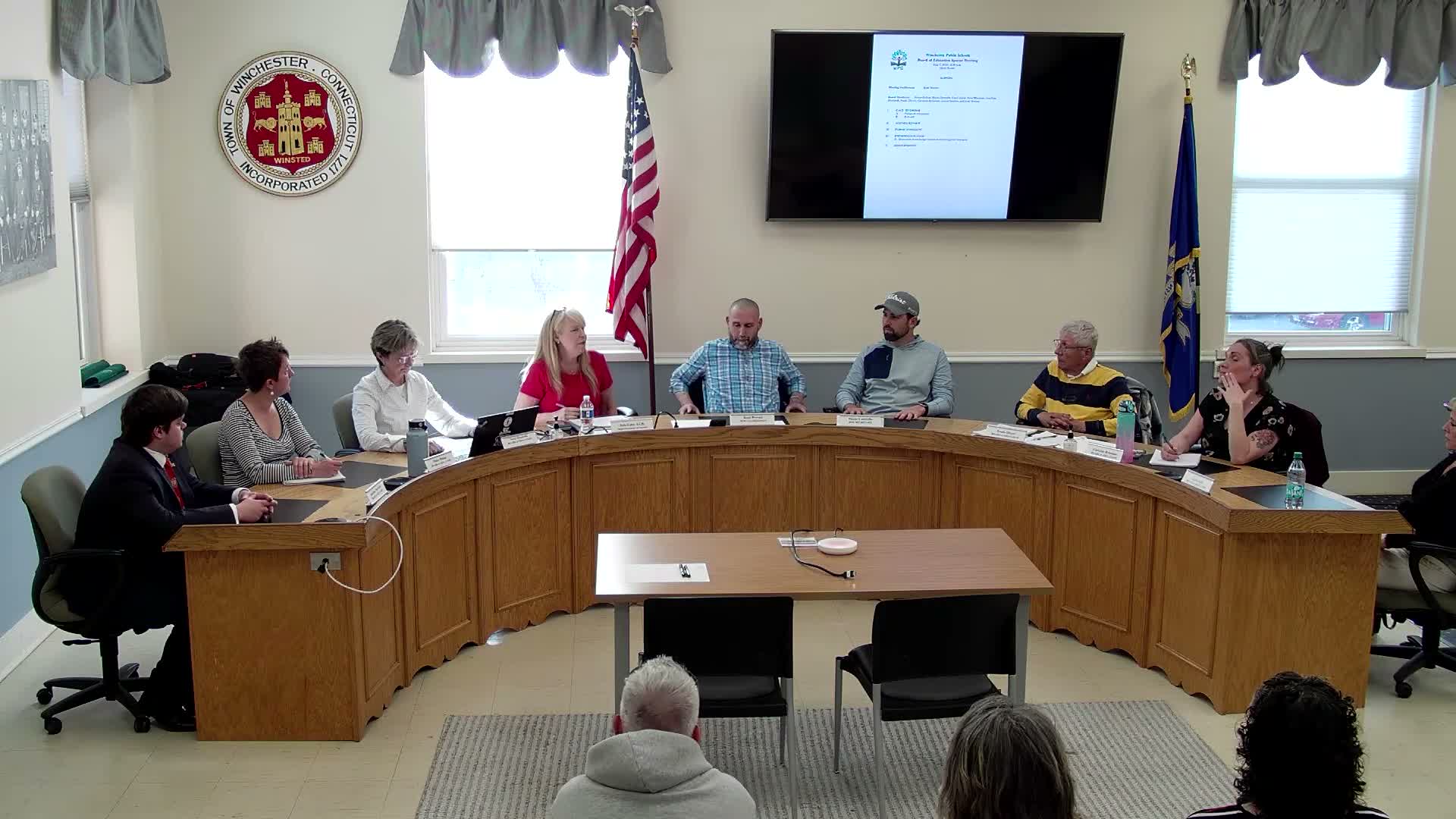
Superintendent Louvy said the Winchester public schools must reduce spending by $1,000,000 and laid out a list of proposed position and program cuts to meet the gap. "We had to reduce our budget by 1000000 dollars," the superintendent told the board, citing a $285,714 reduction in tuition from the Gilbert School and an uncertain legislative allocation of $320,998 that she treated as a one-time grant for planning purposes.
The cuts the superintendent described include eliminating nine positions overall, removing one administrator position (to be offered a teacher contract in one proposal), reducing interventionist staffing (from three to two per building), cutting one preschool classroom (and its associated paraeducator), and outsourcing data and state-reporting work currently done by a director of data. Louvy warned the list contains "nothing on here that's a good idea," and emphasized the student-service impacts of each choice.
Board members pressed for details about classroom and special-education impacts. One member asked about class size for the proposed elimination of a Grade 2 teacher; Louvy said classes are "about 19" and the contract maximum is 20. Board member Nora McCarsky warned that reducing certain special-education positions could have legal and operational consequences: "We were in receivership ... the state took us over," she said, urging the board to consider how cuts could affect the district's ability to meet students' legally required services.
The board also debated how to pay to keep two school safety officers (SSOs) the district added last year. Several members said SSOs improved parents' sense of safety after an incident that generated concern on social media; others cautioned that drawing on reserve funds would create a budget "cliff" if one-time state aid is not repeated. "We have to treat that $3.20 as a grant, as a onetime payment, as a potential cliff," the chair said, urging prudence.
Louvy described two mitigation ideas being pursued: an MOA with the teachers to increase the waiver amount for health benefits (which could create savings if enough employees accept it) and an option to allow some out-of-district families to be reimbursed at above-IRS mileage rates to drive their own children to school—a proposal she said raises legal and equity questions that lawyers are reviewing. The board discussed outsourcing PowerSchool and state-reporting work as a cost trade-off; one member cited an outsourcing cost in the neighborhood of $47,000.
No formal vote on personnel or fund transfers was taken at the special meeting. The board agreed to discuss motions and any required approvals at its regular meeting on Tuesday. A motion to adjourn was made and seconded, and the board ended the meeting by voice vote.
The board plans to revisit specific transfer or termination motions at the next regular meeting, where formal actions would be recorded and voted on.
The cuts the superintendent described include eliminating nine positions overall, removing one administrator position (to be offered a teacher contract in one proposal), reducing interventionist staffing (from three to two per building), cutting one preschool classroom (and its associated paraeducator), and outsourcing data and state-reporting work currently done by a director of data. Louvy warned the list contains "nothing on here that's a good idea," and emphasized the student-service impacts of each choice.
Board members pressed for details about classroom and special-education impacts. One member asked about class size for the proposed elimination of a Grade 2 teacher; Louvy said classes are "about 19" and the contract maximum is 20. Board member Nora McCarsky warned that reducing certain special-education positions could have legal and operational consequences: "We were in receivership ... the state took us over," she said, urging the board to consider how cuts could affect the district's ability to meet students' legally required services.
The board also debated how to pay to keep two school safety officers (SSOs) the district added last year. Several members said SSOs improved parents' sense of safety after an incident that generated concern on social media; others cautioned that drawing on reserve funds would create a budget "cliff" if one-time state aid is not repeated. "We have to treat that $3.20 as a grant, as a onetime payment, as a potential cliff," the chair said, urging prudence.
Louvy described two mitigation ideas being pursued: an MOA with the teachers to increase the waiver amount for health benefits (which could create savings if enough employees accept it) and an option to allow some out-of-district families to be reimbursed at above-IRS mileage rates to drive their own children to school—a proposal she said raises legal and equity questions that lawyers are reviewing. The board discussed outsourcing PowerSchool and state-reporting work as a cost trade-off; one member cited an outsourcing cost in the neighborhood of $47,000.
No formal vote on personnel or fund transfers was taken at the special meeting. The board agreed to discuss motions and any required approvals at its regular meeting on Tuesday. A motion to adjourn was made and seconded, and the board ended the meeting by voice vote.
The board plans to revisit specific transfer or termination motions at the next regular meeting, where formal actions would be recorded and voted on.
View the Full Meeting & All Its Details
This article offers just a summary. Unlock complete video, transcripts, and insights as a Founder Member.
✓
Watch full, unedited meeting videos
✓
Search every word spoken in unlimited transcripts
✓
AI summaries & real-time alerts (all government levels)
✓
Permanent access to expanding government content
30-day money-back guarantee
