Panel reviews S.323 to shift hemp oversight to Cannabis Control Board, add product fees and penalties
May 09, 2026 | Ways & Means, HOUSE OF REPRESENTATIVES, Committees, Legislative , Vermont
This article was created by AI summarizing key points discussed. AI makes mistakes, so for full details and context, please refer to the video of the full meeting. Please report any errors so we can fix them. Report an error »
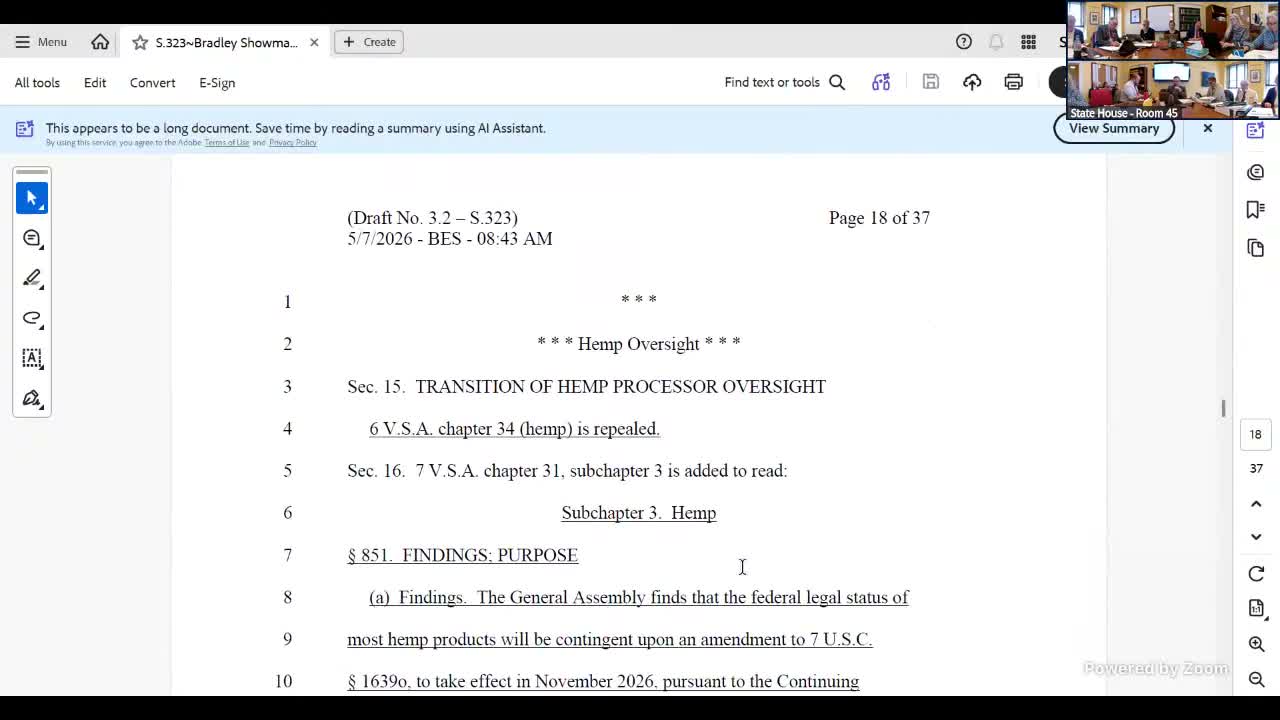
A legislative panel reviewed Senate Bill S.323 on May 8, focusing on transferring hemp oversight to the Cannabis Control Board, new product registration fees, and criminal and civil penalties for unregistered hemp and cannabis products.
Legislative counsel Bradley Showman told members the bill relocates hemp regulatory authority from the Agency of Agriculture to the Cannabis Control Board, gives that board permissive rulemaking authority to define hemp and cannabis and to exempt low-risk "craft processors," and allows the board to waive or reduce licensing fees through an "accessible policy" rather than formal rulemaking. "This law will go into effect on 11/01/2026," Showman said, describing a federal timetable that is creating regulatory uncertainty for processors.
Why it matters: supporters said the transfer would create a single regulatory home better positioned to distinguish hemp from cannabis as federal definitions change; critics on the panel pressed for legislative checks on delegating fee authority and for clearer reporting or review when agencies waive fees.
Key provisions and debate
- Oversight and rulemaking: Showman said the bill copies permissive rulemaking language from existing agriculture law and gives the Cannabis Control Board authority to set definitions, processing standards and exemptions for small "craft processors". James Pepper, chair of the Cannabis Control Board, said the flexibility is intended to help small hemp businesses and the agency handle changes that could reclassify some hemp products as cannabis.
- Product registration and fees: The bill establishes an annual $75 registration fee per product (for example, each distinct tincture or topical), with the possibility of prorated, multi‑year registrations for low‑risk, shelf‑stable products. Showman said the bill also revises how grower and processor fees are assessed, shifting away from variable acreage/volume formulas in some cases.
- Penalties and sales restrictions: Section 20 would make knowingly causing the sale of an unregistered hemp or cannabis product via mail or over a computer network a violation punishable by up to five years in prison and/or a fine of up to $5,000; the bill also authorizes a civil penalty of $5,000 per violation. Committee members discussed whether civil penalties and civil‑penalty proceeds should be deposited to the Cannabis Control Board's special fund or to the state's general fund.
- Other agricultural provisions: The bill contains multiple non‑fee and conforming changes, including seed‑law clarifications (adding wildflower seeds and bulk‑labeling requirements), consolidation of the Vermont Agricultural Credit Program within VITA, and creation of a CAFO (confined animal feeding operation) permit working group and a consultant contract for inspection standards contingent on a FY2027 appropriation.
Fiscal effects and implementation
Barnett of the Joint Fiscal Office told members anticipated fiscal impacts are relatively small if the market remains intrastate; he said if the market were interstate, product registration fees could raise an estimated ~$90,000 annually. The fiscal office does not project revenue from fines and penalties and noted contingent appropriations for the CAFO consultant.
Committee action and next steps
Members did not take a vote on S.323 at the May 8 meeting. The chair and members agreed to reconvene on Tuesday to consider amendments, particularly to clarify where penalties would be deposited and how the committee will track fee waivers. The bill's effective dates in the draft are July 1 for most sections.
Attributions: Quotes and specific technical clarifications in this story come from Bradley Showman, legislative counsel, and James Pepper, chair of the Cannabis Control Board, as recorded in committee discussion on May 8. No formal vote or final amendments were recorded during the session.
What's next: The committee will continue consideration on Tuesday and plans to return to the fee and fund‑deposit questions before advancing the bill.
Legislative counsel Bradley Showman told members the bill relocates hemp regulatory authority from the Agency of Agriculture to the Cannabis Control Board, gives that board permissive rulemaking authority to define hemp and cannabis and to exempt low-risk "craft processors," and allows the board to waive or reduce licensing fees through an "accessible policy" rather than formal rulemaking. "This law will go into effect on 11/01/2026," Showman said, describing a federal timetable that is creating regulatory uncertainty for processors.
Why it matters: supporters said the transfer would create a single regulatory home better positioned to distinguish hemp from cannabis as federal definitions change; critics on the panel pressed for legislative checks on delegating fee authority and for clearer reporting or review when agencies waive fees.
Key provisions and debate
- Oversight and rulemaking: Showman said the bill copies permissive rulemaking language from existing agriculture law and gives the Cannabis Control Board authority to set definitions, processing standards and exemptions for small "craft processors". James Pepper, chair of the Cannabis Control Board, said the flexibility is intended to help small hemp businesses and the agency handle changes that could reclassify some hemp products as cannabis.
- Product registration and fees: The bill establishes an annual $75 registration fee per product (for example, each distinct tincture or topical), with the possibility of prorated, multi‑year registrations for low‑risk, shelf‑stable products. Showman said the bill also revises how grower and processor fees are assessed, shifting away from variable acreage/volume formulas in some cases.
- Penalties and sales restrictions: Section 20 would make knowingly causing the sale of an unregistered hemp or cannabis product via mail or over a computer network a violation punishable by up to five years in prison and/or a fine of up to $5,000; the bill also authorizes a civil penalty of $5,000 per violation. Committee members discussed whether civil penalties and civil‑penalty proceeds should be deposited to the Cannabis Control Board's special fund or to the state's general fund.
- Other agricultural provisions: The bill contains multiple non‑fee and conforming changes, including seed‑law clarifications (adding wildflower seeds and bulk‑labeling requirements), consolidation of the Vermont Agricultural Credit Program within VITA, and creation of a CAFO (confined animal feeding operation) permit working group and a consultant contract for inspection standards contingent on a FY2027 appropriation.
Fiscal effects and implementation
Barnett of the Joint Fiscal Office told members anticipated fiscal impacts are relatively small if the market remains intrastate; he said if the market were interstate, product registration fees could raise an estimated ~$90,000 annually. The fiscal office does not project revenue from fines and penalties and noted contingent appropriations for the CAFO consultant.
Committee action and next steps
Members did not take a vote on S.323 at the May 8 meeting. The chair and members agreed to reconvene on Tuesday to consider amendments, particularly to clarify where penalties would be deposited and how the committee will track fee waivers. The bill's effective dates in the draft are July 1 for most sections.
Attributions: Quotes and specific technical clarifications in this story come from Bradley Showman, legislative counsel, and James Pepper, chair of the Cannabis Control Board, as recorded in committee discussion on May 8. No formal vote or final amendments were recorded during the session.
What's next: The committee will continue consideration on Tuesday and plans to return to the fee and fund‑deposit questions before advancing the bill.
View the Full Meeting & All Its Details
This article offers just a summary. Unlock complete video, transcripts, and insights as a Founder Member.
✓
Watch full, unedited meeting videos
✓
Search every word spoken in unlimited transcripts
✓
AI summaries & real-time alerts (all government levels)
✓
Permanent access to expanding government content
30-day money-back guarantee
