Conference committee signals bipartisan alignment on major housing investments
May 09, 2026 | 2026 Legislature MN, Minnesota
This article was created by AI summarizing key points discussed. AI makes mistakes, so for full details and context, please refer to the video of the full meeting. Please report any errors so we can fix them. Report an error »
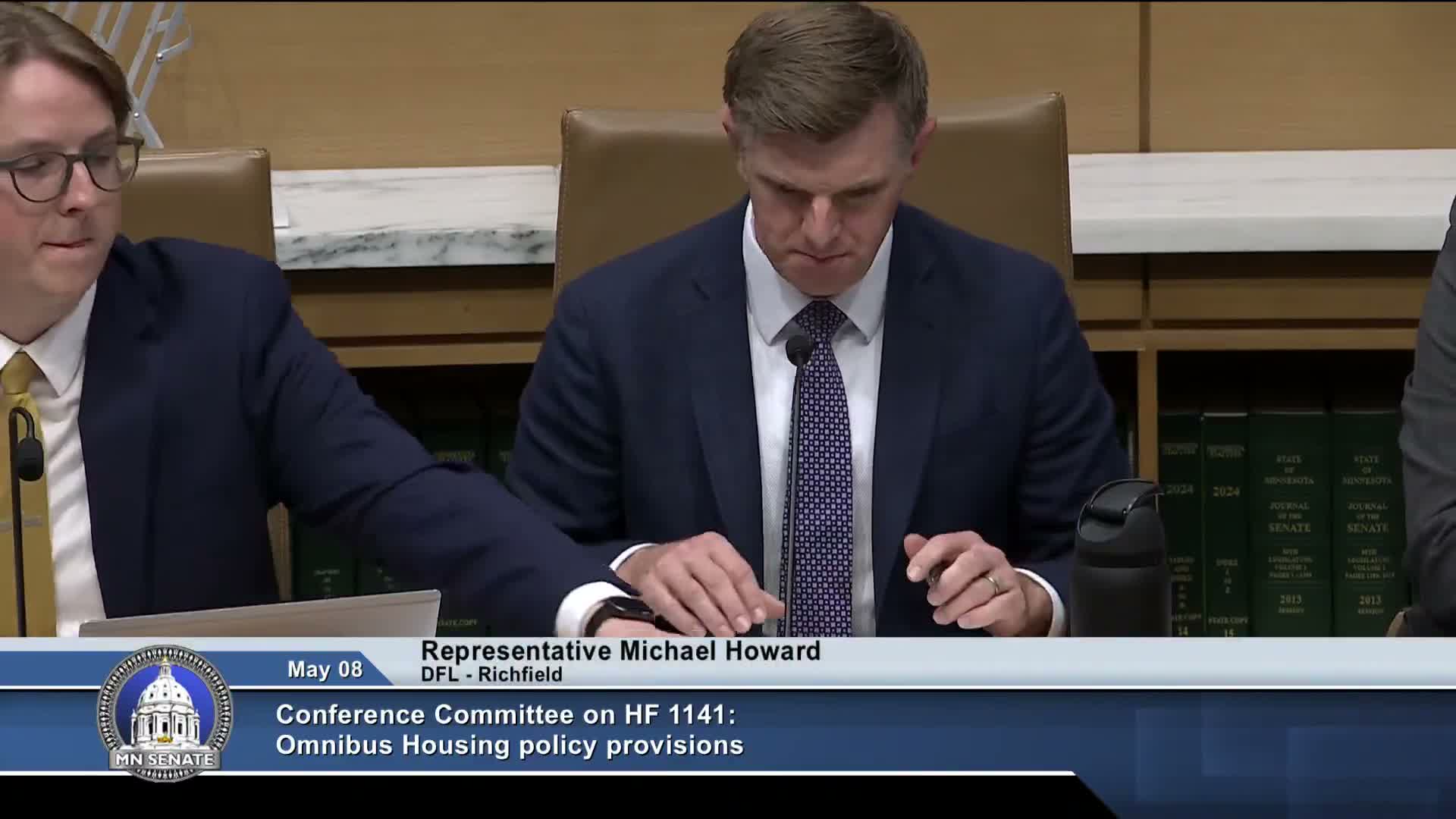
Representative Mike Howard and the conference committee’s chairs opened a joint House–Senate meeting to reconcile differences in the housing omnibus bills and to hear public testimony from advocates and residents.
Nonpartisan staff walked members through policy differences and fiscal positions. House staff noted the House bill includes a $100,000,000 authorization for housing infrastructure bonds (HIBs) and one‑time appropriations such as $20,000,000 for the workforce housing development program and $40,000,000 for the Family Homeless Prevention and Assistance Program (FHPAP). Senate fiscal staff said the Senate position authorizes $50,000,000 in HIBs and included a $5,000,000 set‑aside for home‑park improvements.
“My hope and my belief is that we choose a path that meets urgent community needs and leaves us prepared for what’s ahead,” Jennifer Ho, commissioner of Minnesota Housing, told conferees while praising areas of overlap and urging continued bipartisan cooperation. “Housing infrastructure bonds will allow us to say yes to more projects of all types throughout the state.”
Supporters urged the committee to adopt higher House funding levels. Kelly Law, senior policy and field building manager at the Minnesota Consortium of Community Developers, called a $100,000,000 HIB authorization “essential” and urged pairing development investments with funding for services. Henry Parker of CommonBond recommended adopting the House HIB level and retaining private activity bond language to leverage federal tax credits.
Advocates for emergency and preventive assistance emphasized FHPAP. Multiple testifiers, including Renee Rock (SHIP Collaborative) and Ben Helvick Anderson (Beacon Interfaith Housing Collaborative), urged adoption of $40,000,000 for FHPAP and warned that federal continuity issues are creating a funding cliff for supportive services.
Senator Lindsey Porte and other chairs said they were largely aligned on resource levels while acknowledging remaining policy questions about allocation and program design. No formal votes were taken at the session; conferees said further negotiation would follow.
What’s next: members signaled they will keep negotiating specific policy language and funding allocation in the days ahead before returning a final conference report to each chamber.
Nonpartisan staff walked members through policy differences and fiscal positions. House staff noted the House bill includes a $100,000,000 authorization for housing infrastructure bonds (HIBs) and one‑time appropriations such as $20,000,000 for the workforce housing development program and $40,000,000 for the Family Homeless Prevention and Assistance Program (FHPAP). Senate fiscal staff said the Senate position authorizes $50,000,000 in HIBs and included a $5,000,000 set‑aside for home‑park improvements.
“My hope and my belief is that we choose a path that meets urgent community needs and leaves us prepared for what’s ahead,” Jennifer Ho, commissioner of Minnesota Housing, told conferees while praising areas of overlap and urging continued bipartisan cooperation. “Housing infrastructure bonds will allow us to say yes to more projects of all types throughout the state.”
Supporters urged the committee to adopt higher House funding levels. Kelly Law, senior policy and field building manager at the Minnesota Consortium of Community Developers, called a $100,000,000 HIB authorization “essential” and urged pairing development investments with funding for services. Henry Parker of CommonBond recommended adopting the House HIB level and retaining private activity bond language to leverage federal tax credits.
Advocates for emergency and preventive assistance emphasized FHPAP. Multiple testifiers, including Renee Rock (SHIP Collaborative) and Ben Helvick Anderson (Beacon Interfaith Housing Collaborative), urged adoption of $40,000,000 for FHPAP and warned that federal continuity issues are creating a funding cliff for supportive services.
Senator Lindsey Porte and other chairs said they were largely aligned on resource levels while acknowledging remaining policy questions about allocation and program design. No formal votes were taken at the session; conferees said further negotiation would follow.
What’s next: members signaled they will keep negotiating specific policy language and funding allocation in the days ahead before returning a final conference report to each chamber.
Don't Miss a Word: See the Full Meeting!
Go beyond summaries. Unlock every video, transcript, and key insight with a Founder Membership.
✓
Get instant access to full meeting videos
✓
Search and clip any phrase from complete transcripts
✓
Receive AI-powered summaries & custom alerts
✓
Enjoy lifetime, unrestricted access to government data
30-day money-back guarantee
