Cheyenne engineer seeks modest budget increases as staff shortages, revised storm standards swell backlog
May 08, 2026 | Cheyenne, Laramie County, Wyoming
This article was created by AI summarizing key points discussed. AI makes mistakes, so for full details and context, please refer to the video of the full meeting. Please report any errors so we can fix them. Report an error »
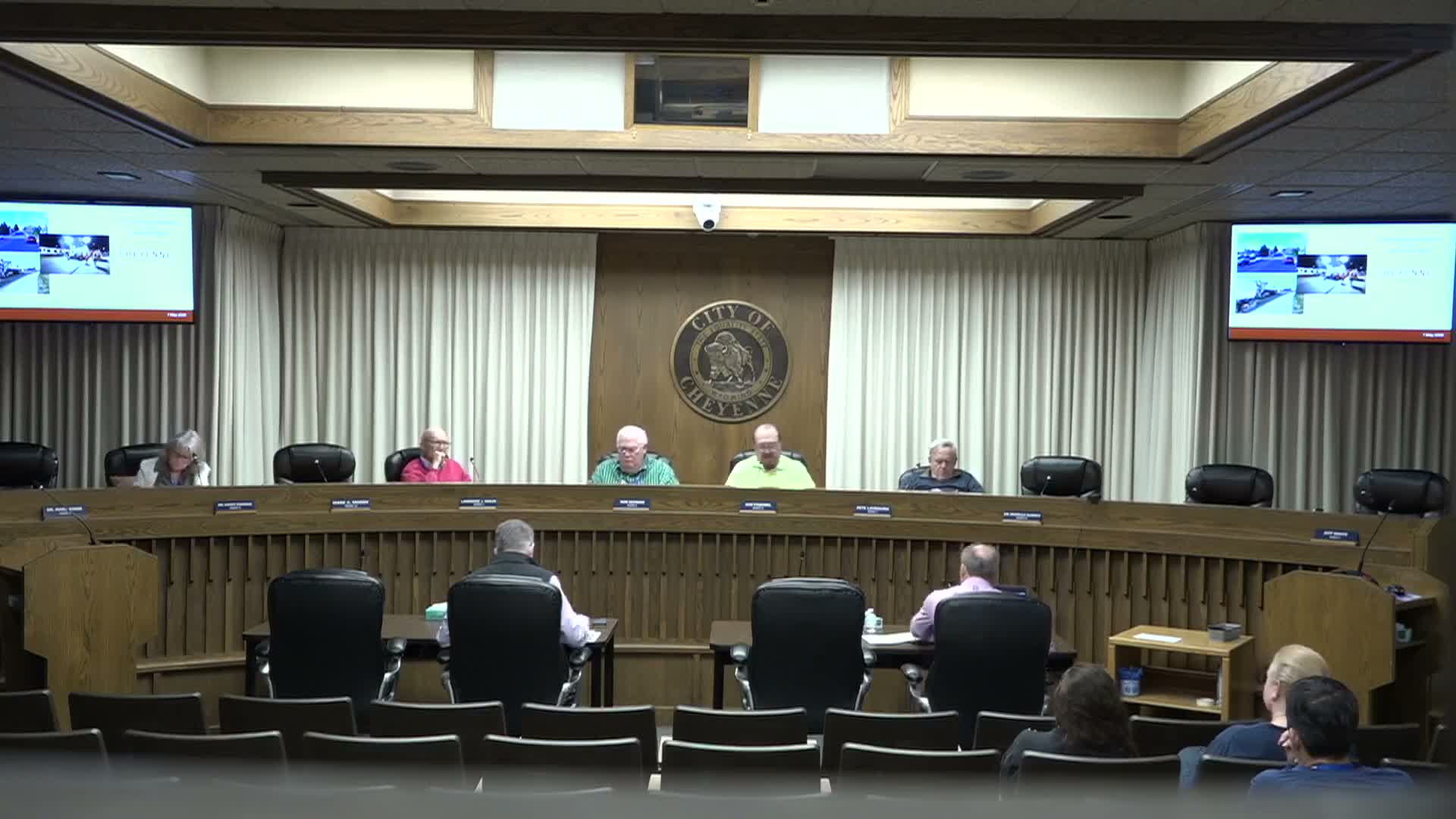
Director Cobb told the Cheyenne City Council at a work session that the engineering division needs modest budget increases for fiscal 2027 while grappling with staffing shortages, material delays and a large backlog of deferred projects. Cobb framed his presentation around safety, asset preservation and stewardship of taxpayer funds, and outlined a request that would raise the division’s general-fund budget by about $340,152 for next year.
Cobb said the department has about 18 active full‑time equivalents across its sections and is proposing an additional GIS hire; the engineering core currently lists roughly eight FTEs directly in engineering, three in GIS and several staff in related units and consultants. “We’ve got 18 active FTEs,” Cobb said, and added the city relies heavily on consultants — “over a hundred” active consulting contracts — to deliver and design projects.
A major financing and operational pressure is the city’s backlog of needed work. Cobb said a drainage backlog figure in his memo totals $142,500,000 and later described the combined roadway and drainage backlog as roughly $400,000,000. “We’re looking at almost 400 and some million dollars in backlog,” he said, and urged the council to prioritize projects that help the most people.
Cobb also highlighted a technical change that will increase future project costs: updated intensity‑duration‑frequency (IDF) rainfall curves. “Two‑, five‑, 10‑ and 25‑year storms have increased as much as 30% from what they were,” he warned, noting that a system designed last year for a 50‑year event may now be effectively a 25‑year design under the new curves, which will raise drainage‑infrastructure costs.
Another near‑term compliance change is the city’s MS4 stormwater permit. Cobb told the council that Wyoming DEQ is transitioning Cheyenne from a general MS4 permit to an individual MS4 permit (he said two individual permits will be issued in the state, for Casper and Cheyenne), a shift that will increase inspection and oversight responsibilities and likely require more in‑house inspectors and contractor oversight.
On budget specifics, Cobb sought increases in professional services (+$20,000), software and maintenance (+$84,211) to cover AutoCAD, Bluebeam and other tools, plus smaller increases for equipment and furniture. He said some software costs previously covered by American Rescue Plan funds must now be absorbed by the department.
Council members pressed Cobb on hiring and contractor availability. Cobb acknowledged a tight local market for civil engineers and construction crews, and attributed supply‑chain delays for electrical components, concrete and pipe to regionwide development activity. “Demand is high and supply is low,” he said.
The presentation closed with Cobb emphasizing that large, multi‑year projects typically take one to two years to show tangible results even when funding is available, and that the department is trying to balance near‑term maintenance needs with long‑range capital programs.
The council did not take formal action at the work session; Cobb’s budget recommendations and project priorities will return to the council in the regular budget process for further review.
Cobb said the department has about 18 active full‑time equivalents across its sections and is proposing an additional GIS hire; the engineering core currently lists roughly eight FTEs directly in engineering, three in GIS and several staff in related units and consultants. “We’ve got 18 active FTEs,” Cobb said, and added the city relies heavily on consultants — “over a hundred” active consulting contracts — to deliver and design projects.
A major financing and operational pressure is the city’s backlog of needed work. Cobb said a drainage backlog figure in his memo totals $142,500,000 and later described the combined roadway and drainage backlog as roughly $400,000,000. “We’re looking at almost 400 and some million dollars in backlog,” he said, and urged the council to prioritize projects that help the most people.
Cobb also highlighted a technical change that will increase future project costs: updated intensity‑duration‑frequency (IDF) rainfall curves. “Two‑, five‑, 10‑ and 25‑year storms have increased as much as 30% from what they were,” he warned, noting that a system designed last year for a 50‑year event may now be effectively a 25‑year design under the new curves, which will raise drainage‑infrastructure costs.
Another near‑term compliance change is the city’s MS4 stormwater permit. Cobb told the council that Wyoming DEQ is transitioning Cheyenne from a general MS4 permit to an individual MS4 permit (he said two individual permits will be issued in the state, for Casper and Cheyenne), a shift that will increase inspection and oversight responsibilities and likely require more in‑house inspectors and contractor oversight.
On budget specifics, Cobb sought increases in professional services (+$20,000), software and maintenance (+$84,211) to cover AutoCAD, Bluebeam and other tools, plus smaller increases for equipment and furniture. He said some software costs previously covered by American Rescue Plan funds must now be absorbed by the department.
Council members pressed Cobb on hiring and contractor availability. Cobb acknowledged a tight local market for civil engineers and construction crews, and attributed supply‑chain delays for electrical components, concrete and pipe to regionwide development activity. “Demand is high and supply is low,” he said.
The presentation closed with Cobb emphasizing that large, multi‑year projects typically take one to two years to show tangible results even when funding is available, and that the department is trying to balance near‑term maintenance needs with long‑range capital programs.
The council did not take formal action at the work session; Cobb’s budget recommendations and project priorities will return to the council in the regular budget process for further review.
Don't Miss a Word: See the Full Meeting!
Go beyond summaries. Unlock every video, transcript, and key insight with a Founder Membership.
✓
Get instant access to full meeting videos
✓
Search and clip any phrase from complete transcripts
✓
Receive AI-powered summaries & custom alerts
✓
Enjoy lifetime, unrestricted access to government data
30-day money-back guarantee
