House Health Care committee reviews revised reference-based pricing bill, schedules 1 p.m. vote
May 09, 2026 | Health Care, HOUSE OF REPRESENTATIVES, Committees, Legislative , Vermont
This article was created by AI summarizing key points discussed. AI makes mistakes, so for full details and context, please refer to the video of the full meeting. Please report any errors so we can fix them. Report an error »
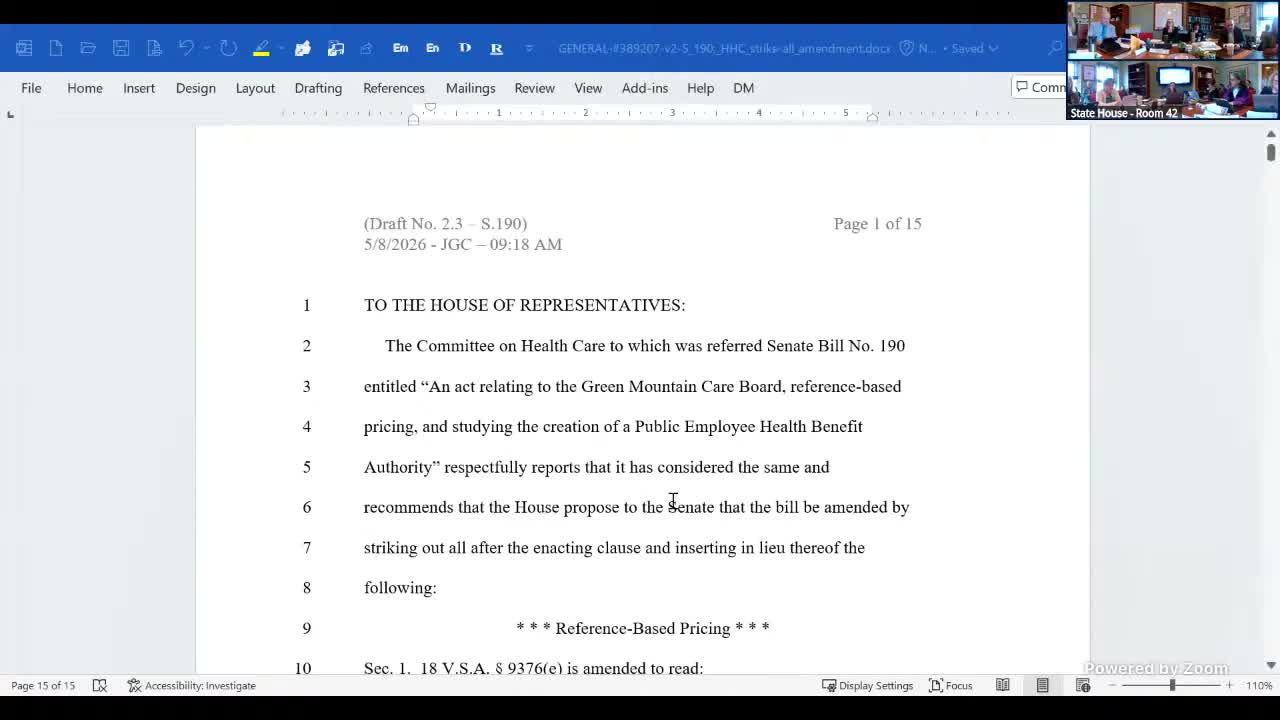
The House Health Care committee on Friday reviewed a revised draft of S.190 that would direct the Green Mountain Care Board to use reference-based pricing to lower hospital prices and set interim budget targets for fiscal years 2027–2029.
The bill’s sponsor, speaking as chair of the committee, said she removed a provision aimed specifically at teachers’ health benefits from the draft but kept the reference-based pricing language. "We
re looking to make our health care system in Vermont more affordable and sustainable and ensuring that everyone has access to high quality health care," the chair said.
Jen Harvey of the Office of Legislative Council walked members through the new draft, explaining that the bill would authorize the board to use reference-based pricing and included a transitional approach that for FY27 could direct an amount equal to 3.5% of the hospitals' combined commercial net patient revenue toward reducing commercial reimbursement rates. Harvey also described caps in the draft tying allowable hospital commercial reimbursement to percentages of a Medicare-adjusted base rate for FY28 (not more than 300%) and FY29 (not more than 250%).
The draft narrows the measure’s initial scope by excluding certain hospitals from the definition of "hospital," including critical access hospitals and hospitals participating in the federal rural community hospital demonstration program. Committee members and witnesses debated the tradeoffs of that carve-out: the Green Mountain Care Board and advocates said excluding critical access hospitals avoids technical complications tied to cost-based Medicare reimbursement, but it also means patients who receive care at CAHs may not see reductions in out-of-pocket cost even if premiums fall.
Emily Brown, executive director of the Green Mountain Care Board, told the committee the board calculated the fiscal impact without Brattleboro (a rural demonstration participant) at $54,600,000 based on approved FY26 hospital budgets. "The calculation that we have done without Brattleboro is $54,600,000," Brown said, adding that the board can perform the defined calculation if the bill passes in its current form.
Stakeholders urged caution but expressed conditional support. Mike Fisher, the state Health Care Advocate, said the draft "moves us in a good direction" while acknowledging it is imperfect and that not all Vermonters would benefit equally. Fisher urged pragmatism given end-of-session timing and said his office supports proceeding cautiously.
Hospital representatives asked for clarity and predictability. Devin Green of the Vermont Association of Hospitals and Health Systems said hospitals would prefer a fixed dollar figure for planning and suggested $50,000,000 as a defined target. "We would argue for $50,000,000," Green said, noting that a defined number can aid budgeting.
Insurers said systemwide savings in the mid‑$50 million range could translate into meaningful premium relief. A Blue Cross and Blue Shield of Vermont representative estimated that approximately $55,000,000 in savings would be roughly a 10% reduction in premiums across the qualified health plan market and cautioned about how rate filings, deductibles and local pricing effects would interact.
The draft also would require critical access hospitals to identify outpatient services billed at five times or more the Medicare allowed amount and to post prominent notices to explain Medicare beneficiary cost-sharing and options to seek care with lower out-of-pocket costs. Several committee members questioned how hospitals could operationalize per-service notices for the wide range of outpatient items and suggested more practical alternatives such as directing patients to patient financial services or board‑approved communications.
Committee debate touched on federal compliance risks: Brown noted a recent CMS memo that emphasizes charges used for Medicare must bear a reasonable relationship to the cost of furnishing services, and witnesses urged caution to avoid unintended consequences for Medicare reimbursement.
Chair closed the committee's presentation portion by saying she would work with counsel over lunch and that the panel would reconvene to vote at 1:00 p.m. The transcript records no vote during this session.
Next procedural step: the committee scheduled a 1:00 p.m. vote when it reconvened; discussion on a separate bill (H.197) was set to follow the markup session.
The bill’s sponsor, speaking as chair of the committee, said she removed a provision aimed specifically at teachers’ health benefits from the draft but kept the reference-based pricing language. "We
re looking to make our health care system in Vermont more affordable and sustainable and ensuring that everyone has access to high quality health care," the chair said.
Jen Harvey of the Office of Legislative Council walked members through the new draft, explaining that the bill would authorize the board to use reference-based pricing and included a transitional approach that for FY27 could direct an amount equal to 3.5% of the hospitals' combined commercial net patient revenue toward reducing commercial reimbursement rates. Harvey also described caps in the draft tying allowable hospital commercial reimbursement to percentages of a Medicare-adjusted base rate for FY28 (not more than 300%) and FY29 (not more than 250%).
The draft narrows the measure’s initial scope by excluding certain hospitals from the definition of "hospital," including critical access hospitals and hospitals participating in the federal rural community hospital demonstration program. Committee members and witnesses debated the tradeoffs of that carve-out: the Green Mountain Care Board and advocates said excluding critical access hospitals avoids technical complications tied to cost-based Medicare reimbursement, but it also means patients who receive care at CAHs may not see reductions in out-of-pocket cost even if premiums fall.
Emily Brown, executive director of the Green Mountain Care Board, told the committee the board calculated the fiscal impact without Brattleboro (a rural demonstration participant) at $54,600,000 based on approved FY26 hospital budgets. "The calculation that we have done without Brattleboro is $54,600,000," Brown said, adding that the board can perform the defined calculation if the bill passes in its current form.
Stakeholders urged caution but expressed conditional support. Mike Fisher, the state Health Care Advocate, said the draft "moves us in a good direction" while acknowledging it is imperfect and that not all Vermonters would benefit equally. Fisher urged pragmatism given end-of-session timing and said his office supports proceeding cautiously.
Hospital representatives asked for clarity and predictability. Devin Green of the Vermont Association of Hospitals and Health Systems said hospitals would prefer a fixed dollar figure for planning and suggested $50,000,000 as a defined target. "We would argue for $50,000,000," Green said, noting that a defined number can aid budgeting.
Insurers said systemwide savings in the mid‑$50 million range could translate into meaningful premium relief. A Blue Cross and Blue Shield of Vermont representative estimated that approximately $55,000,000 in savings would be roughly a 10% reduction in premiums across the qualified health plan market and cautioned about how rate filings, deductibles and local pricing effects would interact.
The draft also would require critical access hospitals to identify outpatient services billed at five times or more the Medicare allowed amount and to post prominent notices to explain Medicare beneficiary cost-sharing and options to seek care with lower out-of-pocket costs. Several committee members questioned how hospitals could operationalize per-service notices for the wide range of outpatient items and suggested more practical alternatives such as directing patients to patient financial services or board‑approved communications.
Committee debate touched on federal compliance risks: Brown noted a recent CMS memo that emphasizes charges used for Medicare must bear a reasonable relationship to the cost of furnishing services, and witnesses urged caution to avoid unintended consequences for Medicare reimbursement.
Chair closed the committee's presentation portion by saying she would work with counsel over lunch and that the panel would reconvene to vote at 1:00 p.m. The transcript records no vote during this session.
Next procedural step: the committee scheduled a 1:00 p.m. vote when it reconvened; discussion on a separate bill (H.197) was set to follow the markup session.
Don't Miss a Word: See the Full Meeting!
Go beyond summaries. Unlock every video, transcript, and key insight with a Founder Membership.
✓
Get instant access to full meeting videos
✓
Search and clip any phrase from complete transcripts
✓
Receive AI-powered summaries & custom alerts
✓
Enjoy lifetime, unrestricted access to government data
30-day money-back guarantee
