Urbana planning commission recommends approval for 413–419 W. Main PUD after debate over design and floodplain costs
May 08, 2026 | Urbana, Champaign County, Illinois
This article was created by AI summarizing key points discussed. AI makes mistakes, so for full details and context, please refer to the video of the full meeting. Please report any errors so we can fix them. Report an error »
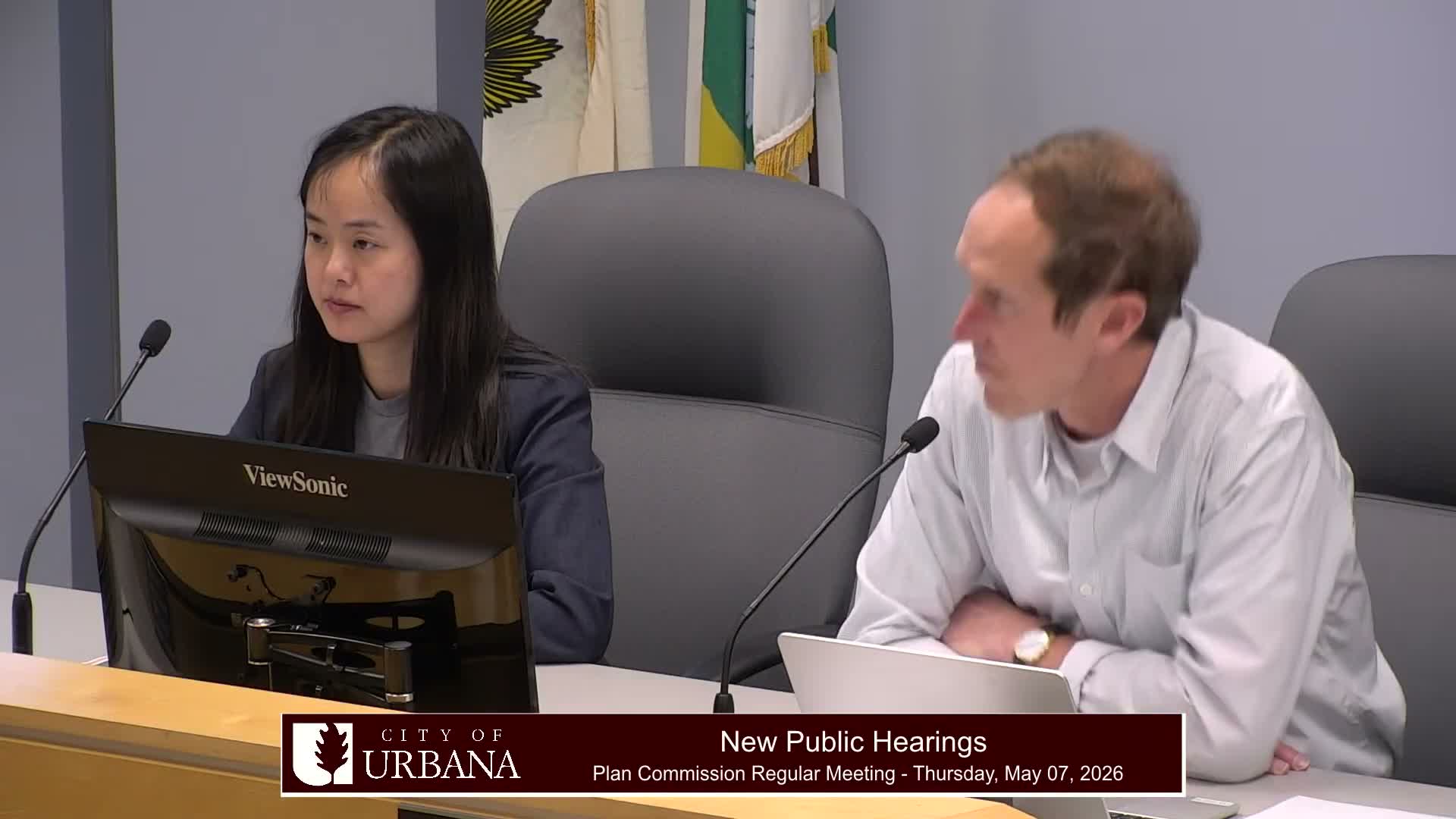
The Urbana Plan Commission voted 4–1 on May 4 to recommend approval, with conditions, of Plan Case 2519 (PUD 25), a proposed 32‑unit multifamily planned unit development at 413–419 West Main Street. The commission’s recommendation will be considered by City Council on May 18.
Staff told the commission the applicant, DMCB Properties LLC, requested that the site be developed in general conformance with R‑5 standards and granted an exception to the R‑5 floor‑area‑ratio cap (from 0.9 to 1.0) to allow a three‑story building with a mezzanine (four stories at the west end) totaling roughly 32,273 square feet and comprising 19 one‑bedroom and 13 two‑bedroom units. Staff corrected an earlier error in the circulated report: the combined lot area is 32,200 square feet, not 25,590.
Staff said the project includes a required 20‑foot dedication along the Boneyard Creek tied to a creekway permit issued April 17 and that much of the site lies in the 100‑ and 500‑year floodplain. The presentation described a flood‑mitigation approach that raises the building floor plates above base flood elevation and allows water to flow beneath the elevated structure; staff said those construction requirements add cost and were a primary reason the developer requested additional density.
Residents who spoke during public comment framed their opposition around historic character, scale and parking. Dennis Roberts, who said he lives in East Urbana, praised the developer’s creek dedication but urged the commission to consider how the façade and massing would “resonate” with Main Street’s historic buildings. “I find that this building fits really well in Daytona Beach or in Campus Town, but I don't see how it fits in,” Roberts said.
Longtime Main Street residents made similar arguments. Chris Burdie, who identified himself as a retired professor and Main Street resident, said the development is “too large and the change too dramatic” for the block and urged the developer to consider alternative sites. Phyllis Williams told the commission that older apartments in the area blend with the neighborhood and said granting R‑5 would create an island of higher density that would damage trees and front‑yard character.
The petitioner’s representatives responded that floodplain mitigation and foundation constraints make smaller buildings economically infeasible. Architect Adrienne Kim said raising the building roughly four feet above grade and designing pervious foundation systems were necessary to allow water to pass beneath the structure. Developer representative Melissa Brashear, who described herself as a local real estate broker, said the extra density provides roughly five additional units compared with the 0.9 FAR and argued increasing housing supply helps affordability over time. Kim said the design team was open to adjustments on colors and bike parking.
Commission discussion centered on the PUD approval criteria, particularly criterion 7, which asks whether a development coordinates architectural style, building form and relationships with surrounding properties. Commissioner Rose and others stressed a need for clear streetscape context to evaluate how the project would relate to adjacent buildings. Commissioner Yu moved to continue the hearing to require a streetscape illustration and a redesigned façade; that motion failed for lack of a second. Commissioner Matlock then moved to recommend approval with the conditions outlined on staff’s recommendation slide; that motion passed on a roll‑call vote (yes: Andreessen, Matlock, Rose, Allred; no: Yu).
The commission’s recommendation is advisory; City Council will review the case on May 18. The staff record notes that final development plans must generally conform to the attached site plan and that the project would be built consistent with R‑5 development regulations except for the narrow FAR exception granted through the PUD process.
Next steps: the commission’s positive recommendation and associated conditions will be forwarded to City Council for final consideration on May 18. If council approves the PUD, final engineering and building safety reviews (including city engineering sign‑off on flood mitigation) will be required before permits are issued.
Staff told the commission the applicant, DMCB Properties LLC, requested that the site be developed in general conformance with R‑5 standards and granted an exception to the R‑5 floor‑area‑ratio cap (from 0.9 to 1.0) to allow a three‑story building with a mezzanine (four stories at the west end) totaling roughly 32,273 square feet and comprising 19 one‑bedroom and 13 two‑bedroom units. Staff corrected an earlier error in the circulated report: the combined lot area is 32,200 square feet, not 25,590.
Staff said the project includes a required 20‑foot dedication along the Boneyard Creek tied to a creekway permit issued April 17 and that much of the site lies in the 100‑ and 500‑year floodplain. The presentation described a flood‑mitigation approach that raises the building floor plates above base flood elevation and allows water to flow beneath the elevated structure; staff said those construction requirements add cost and were a primary reason the developer requested additional density.
Residents who spoke during public comment framed their opposition around historic character, scale and parking. Dennis Roberts, who said he lives in East Urbana, praised the developer’s creek dedication but urged the commission to consider how the façade and massing would “resonate” with Main Street’s historic buildings. “I find that this building fits really well in Daytona Beach or in Campus Town, but I don't see how it fits in,” Roberts said.
Longtime Main Street residents made similar arguments. Chris Burdie, who identified himself as a retired professor and Main Street resident, said the development is “too large and the change too dramatic” for the block and urged the developer to consider alternative sites. Phyllis Williams told the commission that older apartments in the area blend with the neighborhood and said granting R‑5 would create an island of higher density that would damage trees and front‑yard character.
The petitioner’s representatives responded that floodplain mitigation and foundation constraints make smaller buildings economically infeasible. Architect Adrienne Kim said raising the building roughly four feet above grade and designing pervious foundation systems were necessary to allow water to pass beneath the structure. Developer representative Melissa Brashear, who described herself as a local real estate broker, said the extra density provides roughly five additional units compared with the 0.9 FAR and argued increasing housing supply helps affordability over time. Kim said the design team was open to adjustments on colors and bike parking.
Commission discussion centered on the PUD approval criteria, particularly criterion 7, which asks whether a development coordinates architectural style, building form and relationships with surrounding properties. Commissioner Rose and others stressed a need for clear streetscape context to evaluate how the project would relate to adjacent buildings. Commissioner Yu moved to continue the hearing to require a streetscape illustration and a redesigned façade; that motion failed for lack of a second. Commissioner Matlock then moved to recommend approval with the conditions outlined on staff’s recommendation slide; that motion passed on a roll‑call vote (yes: Andreessen, Matlock, Rose, Allred; no: Yu).
The commission’s recommendation is advisory; City Council will review the case on May 18. The staff record notes that final development plans must generally conform to the attached site plan and that the project would be built consistent with R‑5 development regulations except for the narrow FAR exception granted through the PUD process.
Next steps: the commission’s positive recommendation and associated conditions will be forwarded to City Council for final consideration on May 18. If council approves the PUD, final engineering and building safety reviews (including city engineering sign‑off on flood mitigation) will be required before permits are issued.
View the Full Meeting & All Its Details
This article offers just a summary. Unlock complete video, transcripts, and insights as a Founder Member.
✓
Watch full, unedited meeting videos
✓
Search every word spoken in unlimited transcripts
✓
AI summaries & real-time alerts (all government levels)
✓
Permanent access to expanding government content
30-day money-back guarantee
